Free Shipping
on orders over $150.00
$0.00
$150.00
Add $150.00 more for free shipping!

TL;DR:
- Cannabis has a 10,000-year history of use spanning cultivation, medicine, and industrial applications across many ancient civilizations. Archaeological evidence confirms early cannabis cultivation for fiber and psychoactive use, with cultural and medicinal significance documented in China, India, Egypt, and Greece. Modern prohibition was politically motivated and based on racial propaganda, while recent reforms are driven by patient advocacy and social equity efforts.
Cannabis is defined as one of humanity’s oldest cultivated plants, with documented use stretching back over 10,000 years across Asia, the Middle East, and the Americas. The history of cannabis use is not a single story. It is a layered record of fibre production, ritual practice, medicine, and political control. Understanding this record requires separating verified archaeological evidence from popular legend, a distinction that matters enormously for researchers and historians alike. From Neolithic China to Canada’s Cannabis Act of 2018, the plant’s journey through human civilisation reveals as much about power and culture as it does about botany.
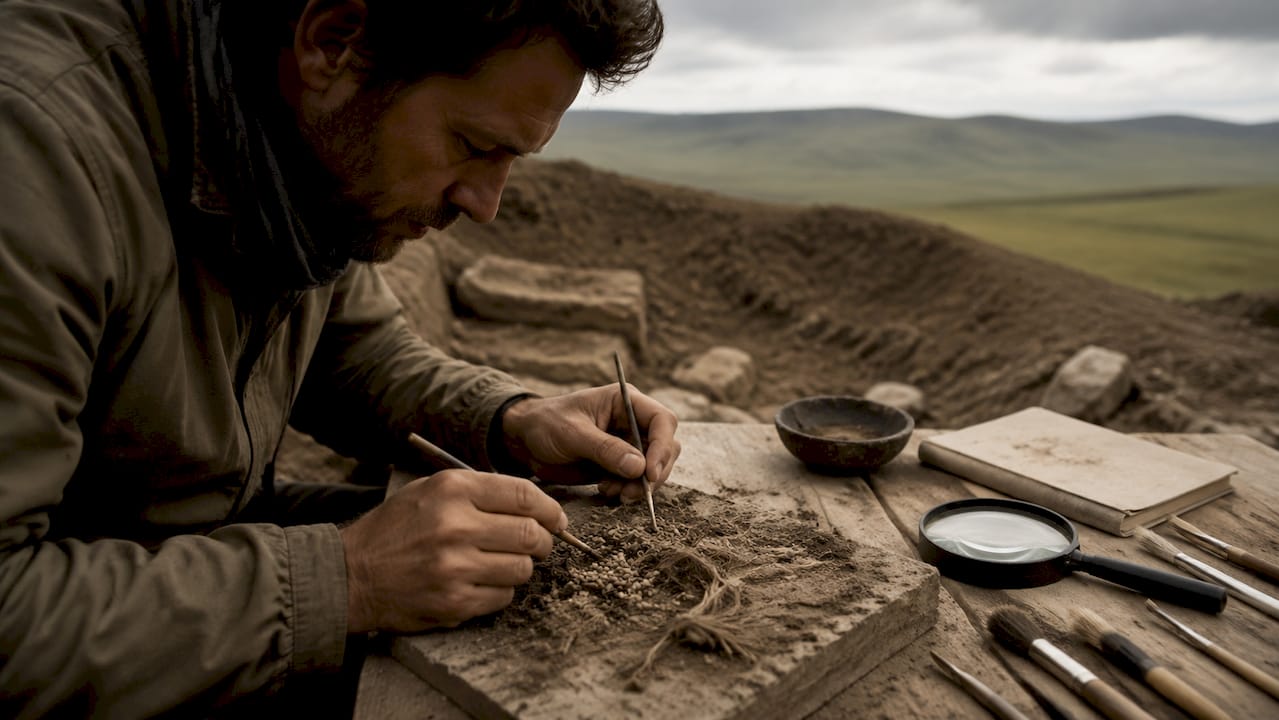
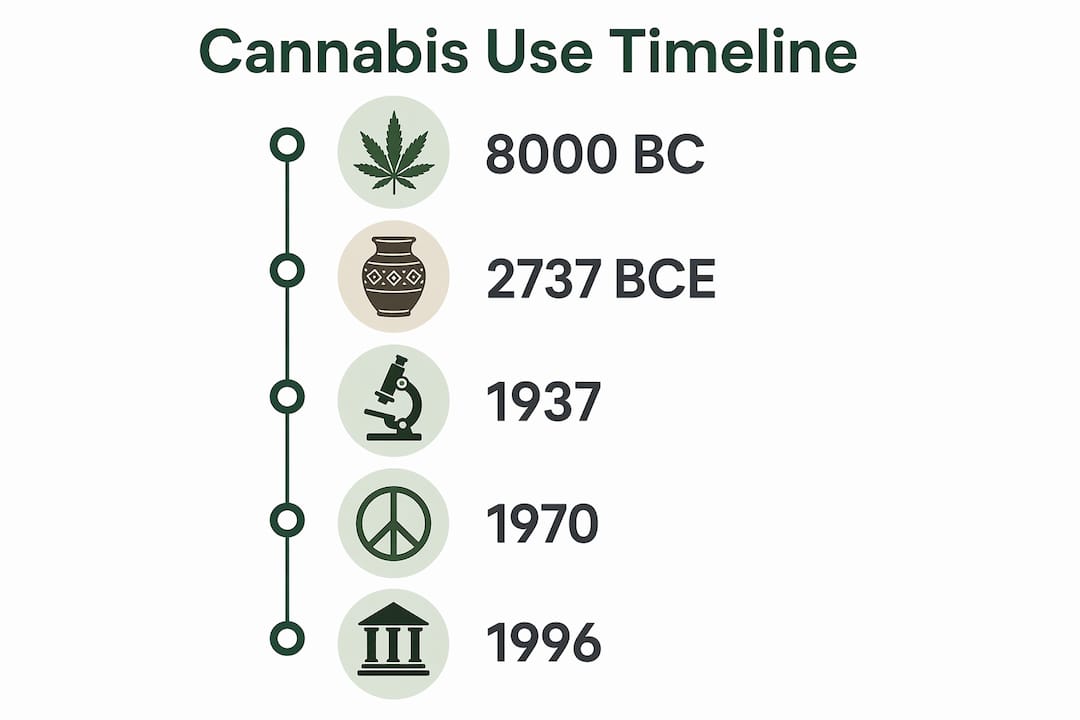
Cannabis cultivation began over 10,000 years ago, with physical evidence found in China, Mongolia, Kazakhstan, and Japan. This is not a claim based on folklore. It is supported by recovered hemp fibres, achenes (seeds), and chemical residues from excavated sites. Cannabis achenes found in Japan date to approximately 8000 BC. Hemp fibres recovered from Neolithic China are estimated at around 7,000 years old. These findings place cannabis among the earliest plants deliberately cultivated by human societies.
The distinction between fibre use and psychoactive use is critical. Early cultivation almost certainly prioritised hemp for rope, textiles, and food. The shift toward psychoactive use came later and is confirmed by a 2019 study led by Meng Ren, which used gas chromatography to identify THC residues in wooden braziers from 2,500-year-old tombs in western China. Those braziers were used in burial rituals, suggesting deliberate inhalation of cannabis smoke in ceremonial contexts.
The legendary date of 2737 BCE, attributed to Emperor Shen Nung’s medicinal use of cannabis, is not archaeologically verified. The Shen Nung date is legendary, compiled in texts written centuries after the supposed events. Researchers treat it as myth-building rather than documented history. The physical evidence from Neolithic sites is far more reliable and considerably older.
Pro Tip: When researching ancient cannabis use, always check whether a source distinguishes between hemp fibre archaeology and psychoactive use evidence. Many popular accounts conflate the two, which distorts the actual cannabis historical timeline.
| Region | Evidence Type | Approximate Date |
|---|---|---|
| Japan | Cannabis achenes | ~8000 BC |
| Neolithic China | Hemp fibres | ~5000 BC |
| Western China (tombs) | THC residues in braziers | ~500 BC |
| Kazakhstan/Mongolia | Achenes and fibre fragments | ~3000 BC |
Ancient cultures across Asia, the Middle East, and North Africa wove cannabis into medicine, religion, and daily industry. The Shennong Pen Ts’ao Ching, one of China’s earliest pharmacopoeias, records cannabis as a treatment for conditions including rheumatism, malaria, and absent-mindedness. While the text’s legendary attribution to Shen Nung is disputed, the pharmacological knowledge it contains reflects centuries of accumulated practice.
India’s relationship with cannabis is among the most thoroughly documented in the ancient world. The Atharva Veda, composed roughly 1500–1200 BCE, lists cannabis (referred to as bhang) as one of five sacred plants. Hindu traditions associated it with the god Shiva, and ritual consumption of bhang preparations persists in India to this day. This is not a marginal practice. It is a continuous cultural thread spanning over three millennia.
Beyond Asia, ancient cannabis usage reached Egypt, Persia, and Assyria through trade and migration:
The medical uses of cannabis across these civilisations were not incidental. They reflect a sophisticated, cross-cultural recognition of the plant’s therapeutic properties, centuries before modern pharmacology could explain the endocannabinoid system.
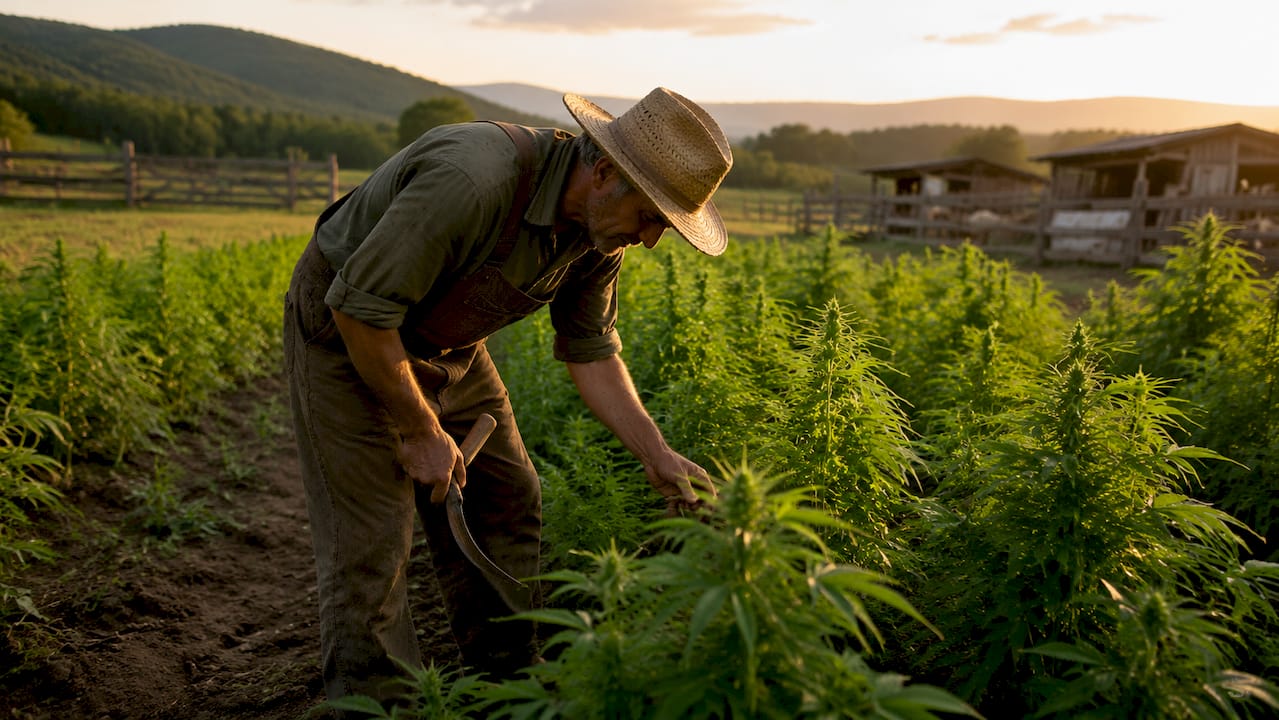
The transition from ancient to early modern cannabis use is defined by the plant’s industrial value, particularly its role in naval power. Hemp fibre produces rope and canvas of exceptional strength, making it indispensable to any seafaring empire.
The terminology shift from “hemp” to “cannabis” to “marijuana” is itself historically significant. The word “marijuana” gained currency in the United States during the early 20th century, partly through deliberate association with Mexican immigrants. This linguistic manoeuvre would later serve a political purpose.
Cannabis prohibition in the United States was not the product of scientific consensus. It was the product of political calculation and racial propaganda. Harry Anslinger, head of the Federal Bureau of Narcotics from 1930, weaponised cannabis fears by linking the plant to Black jazz musicians and Mexican immigrants in newspaper campaigns. His rhetoric was explicit and documented. The goal was moral panic, not public health.
The result was the Marihuana Tax Act of 1937, which passed in 92 seconds despite formal opposition from the American Medical Association. The AMA’s representative, Dr. William Woodward, argued that the legislation was based on hearsay rather than evidence. Congress ignored him. The speed of that vote, measured in seconds, tells you everything about the scientific rigour applied.
“The history of cannabis prohibition is not a story of evidence-based policy. It is a story of how racial anxiety and bureaucratic ambition can override medical expertise in a matter of minutes.” — Paraphrased from the documented record of the 1937 congressional hearings.
The Controlled Substances Act of 1970 then classified cannabis as a Schedule I substance, placing it alongside heroin and above cocaine in terms of perceived danger. Schedule I classification means no accepted medical use and high abuse potential. That classification remains in place today at the federal level in the United States, despite 40 states operating medical cannabis programmes.
| Milestone | Year | Significance |
|---|---|---|
| Marihuana Tax Act | 1937 | Effectively criminalised cannabis federally |
| Controlled Substances Act | 1970 | Classified cannabis as Schedule I |
| California Proposition 215 | 1996 | First U.S. medical cannabis legalisation |
| Colorado adult-use sales | 2014 | First legal recreational market in the U.S. |
| Canada Cannabis Act | 2018 | First G7 nation to legalise adult-use cannabis nationally |
Modern cannabis reform began not with lobbyists but with patients. California’s Proposition 215, passed in 1996, was driven by people living with AIDS, cancer, and glaucoma who needed legal access to a medicine that worked. The patient-led reform movement that followed was grassroots in the truest sense. Caregivers, advocates, and terminally ill individuals built the political foundation that professional lobbyists later inherited.
As of april 2026, 24 U.S. states plus Washington D.C. have legalised adult-use cannabis, and 40 states have medical programmes. Canada became the first G7 nation to legalise cannabis nationally in 2018. These are structural changes to law, not just cultural shifts.
The social equity dimension of modern reform is where the history of cannabis legalization becomes complicated:
Pro Tip: If you are researching cannabis reform for academic purposes, the state-by-state legalization record shows a clear pattern: voter initiatives tend to be more permissive, while legislative actions tend to be more cautious and heavily regulated.
The historical significance of marijuana reform is inseparable from the history of its prohibition. You cannot understand why equity programmes exist without understanding Anslinger’s campaigns. The two stories are the same story, told from opposite ends of the timeline.
The history of cannabis use is a 10,000-year record of cultivation, medicine, industrial production, racialised prohibition, and patient-driven reform that no single myth or legend can adequately capture.
| Point | Details |
|---|---|
| Archaeological evidence is definitive | Hemp fibres and THC residues confirm cannabis use from 8000 BC onward, predating written records. |
| Ancient medicinal use was cross-cultural | China, India, Egypt, Assyria, and Greece all documented cannabis as medicine centuries before modern pharmacology. |
| Prohibition was politically constructed | The 1937 Marihuana Tax Act passed in 92 seconds, driven by racial propaganda rather than scientific evidence. |
| Modern reform began with patients | Proposition 215 in 1996 was built by caregivers and terminally ill individuals, not professional lobbyists. |
| Equity programmes face systemic barriers | Licensing costs and capital access continue to exclude the communities most harmed by prohibition from legal markets. |
The most persistent problem in cannabis historiography is the gap between what people want to believe and what the evidence actually shows. The Shen Nung story is a perfect example. It circulates endlessly in popular media as established fact. Researchers know it is legend. That gap is not trivial. When we build policy arguments on mythologised history, we build on unstable ground.
The same applies to the founding fathers narrative. The claim that Washington and Jefferson smoked cannabis is almost certainly false. They grew hemp for rope and canvas. Conflating industrial cultivation with psychoactive use is the kind of error that makes serious historians dismiss cannabis scholarship entirely, which is a loss for everyone trying to understand the plant’s genuine record.
What I find most striking, after spending considerable time with the primary sources, is how thoroughly the prohibition story has been sanitised in mainstream accounts. Anslinger’s actual words, his documented campaigns, the explicit racial targeting, these are not contested by historians. They are in the congressional record. Yet popular accounts of cannabis prohibition still describe it as a misguided but well-intentioned policy. It was not. Understanding that distinction is not just historically accurate. It is the only honest foundation for evaluating whether today’s equity programmes are adequate responses to what actually happened.
— Juiced
Greensociety has spent years building resources that connect cannabis history to the products and knowledge Canadians actually use today. Whether you are tracing the plant’s ancient medicinal roots or looking to understand what modern cultivars have to offer, the Greensociety blog covers both with the same commitment to accuracy.

Start with the ancient medicine to modern market overview for historical context, then explore the best flower varieties for 2025 to see how centuries of cultivation have shaped today’s genetics. If edibles are your interest, the cannabis kitchen guide offers practical recipes grounded in the same culinary traditions that ancient cultures pioneered. Greensociety delivers discreetly across Canada, with quality and variety that honours the plant’s long history.
Cannabis use dates back over 10,000 years, with cannabis achenes found in Japan around 8000 BC and hemp fibres recovered from Neolithic China estimated at approximately 7,000 years old.
Hemp refers to cannabis cultivated for fibre, seed, and food, while cannabis in a psychoactive context refers to varieties bred for THC content. Early civilisations primarily cultivated hemp for industrial purposes before psychoactive use became documented.
The Marihuana Tax Act of 1937 criminalised cannabis through a process driven by Harry Anslinger’s racialised propaganda campaigns rather than medical evidence. The American Medical Association formally opposed the legislation at the time.
California’s Proposition 215, passed in 1996, was the first modern legalisation of medical cannabis in the United States. It was driven primarily by patients and caregivers affected by AIDS, cancer, and other serious illnesses.
Canada became the first G7 nation to legalise adult-use cannabis nationally in 2018 under the Cannabis Act, marking a significant departure from the prohibition framework established in the early 20th century.