Free Shipping
on orders over $150.00
$0.00
$150.00
Add $150.00 more for free shipping!


TL;DR:
- Hybrid cannabis strains are bred by crossing indica and sativa plants to combine their traits and effects. Most commercial cannabis today is a hybrid, with effects varying based on cannabinoid and terpene profiles rather than labels alone. Selecting strains based on chemical composition and personal goals yields more consistent results than relying solely on the hybrid subtype.
Hybrid strains are cannabis plants bred by crossing indica and sativa parents to combine their genetic traits, effects, and growth characteristics. The term “hybrid” is the standard industry label for this category, and it covers the vast majority of cannabis sold in Canada today. Most commercial cannabis is hybrid to some degree, whether indica-dominant, sativa-dominant, or balanced. Understanding hybrid cannabis meaning goes well beyond the label on the package. It means knowing how a strain was bred, what its chemical profile looks like, and how those factors shape your experience.
A hybrid strain results from cross-pollinating two genetically distinct cannabis parents, typically a sativa and an indica. The offspring inherits traits from both parents, which breeders then select and refine over multiple generations. The goal is to produce plants with specific combinations of potency, flavour, growth speed, and effect profile.
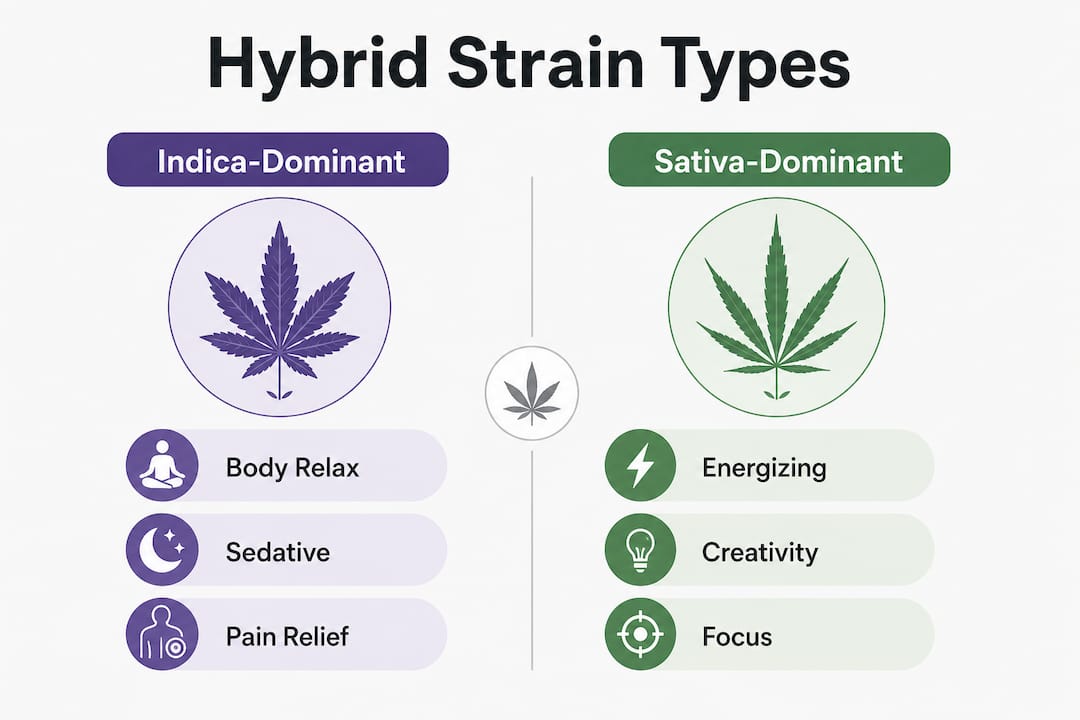
The three main subtypes are indica-dominant, sativa-dominant, and balanced hybrids. Indica-dominant hybrids carry more of the relaxing, body-centred qualities associated with indica plants. Sativa-dominant hybrids lean toward the uplifting, mentally active qualities of sativa. Balanced hybrids sit roughly in the middle, offering a mix of both. These categories help consumers and dispensaries organise a huge variety of products into something navigable.
Hybrid labelling helps consumers navigate a wide variety of cannabis products by grouping strains with broadly similar effects. That said, the label is a starting point, not a complete picture. The actual experience depends heavily on the strain’s cannabinoid and terpene content, which varies even within the same subtype.
Breeders create hybrids by collecting pollen from a male plant of one variety and applying it to the female flowers of another. The resulting seeds carry genetic material from both parents. F1 hybrids can exhibit hybrid vigour, meaning the first generation often shows stronger growth and yield than either parent. Later generations segregate according to Mendelian genetics, meaning traits split and recombine in predictable patterns that breeders use to stabilise desired characteristics.
Hybrid cannabis breeding targets specific traits: potency, flavour, ease of cultivation, and balanced effects. A breeder might cross a high-THC sativa with a fast-flowering indica to produce a plant that delivers cerebral effects but finishes quickly indoors. Another cross might combine a CBD-rich indica with an aromatic sativa to create a flavourful, moderate-potency strain suited to medical consumers.
| Hybrid type | Dominant traits | Typical effects | Common use |
|---|---|---|---|
| Indica-dominant | Body relaxation, sedation | Calming, sleep-supportive | Evening, pain relief |
| Sativa-dominant | Mental stimulation, energy | Uplifting, creative | Daytime, focus |
| Balanced | Mixed indica and sativa | Flexible, moderate | Anytime, general use |
Pro Tip: When reading a product label, look past the hybrid subtype and check the THC and CBD percentages. Two indica-dominant hybrids can feel very different if one has 25% THC and the other has 14% THC with added CBD.
The effects of a hybrid depend primarily on its cannabinoid and terpene profiles, not just its lineage. Indica-dominant hybrids tend to be relaxing; sativa-dominant hybrids tend to be energising; balanced hybrids offer a mix of both. This is a useful rule of thumb, but it breaks down quickly when you look at the actual chemistry of individual strains.
Indica strains are generally better for nighttime use, while sativa strains are preferred for daytime. Hybrids can be tailored to either context by leaning toward one parent. A sativa-dominant hybrid with a high myrcene content, for example, may feel more sedating than its lineage suggests. Terpenes like limonene, pinene, and caryophyllene each contribute distinct qualities that shape the overall experience in ways that the indica/sativa label alone cannot capture.
Several factors influence what a hybrid actually does for you:
Pro Tip: If you are new to hybrids, start with a balanced or indica-dominant strain at a lower THC level. Give yourself time to assess the effect before increasing the dose.
The word “hybrid” carries a specific botanical meaning, but in commercial cannabis, it has become largely a marketing category. Researchers Sawler et al. (2015) and Schwabe et al. (2021) found extensive admixture among strain genomes, meaning that the genetic boundaries between indica and sativa have blurred to the point of near-collapse in most commercial varieties.
After decades of crossbreeding, nearly all modern drug-type cannabis is a form of hybrid, even when labelled simply as indica or sativa. Pure landrace strains, the original geographically isolated varieties from places like Afghanistan or Thailand, are rare in the Canadian retail market. What gets sold as “pure indica” is almost always a stabilised hybrid with dominant indica traits.
The practical implication is clear: a strain’s label tells you about its dominant characteristics, not its genetic purity. Relying on “indica,” “sativa,” or “hybrid” alone to predict effects is less reliable than reading the actual cannabinoid and terpene breakdown on the product.
This does not mean the categories are useless. They give consumers a rough map of what to expect. The problem arises when the label becomes a substitute for understanding the actual chemistry. Genetic profiling technologies are making it possible for growers and consumers to better understand and select hybrids for specific cannabinoid and terpene combinations. As these tools become more accessible, the industry is slowly shifting toward chemical profiling as the primary way to describe and sell cannabis. For now, treat the hybrid label as a starting point and the lab results as the real information.
You can read more about indica and sativa differences to better understand what each parent plant contributes to a hybrid’s profile.
Choosing the right hybrid is a process of matching the strain’s profile to your goals. The following steps give you a practical framework.
Consumers should assess hybrids based on effects and chemical profiles rather than solely on marketing labels. This approach takes a little more effort upfront but produces far more consistent results. For medical consumers especially, matching the chemical profile to a specific symptom or condition is worth the extra attention. For recreational consumers, it means fewer disappointing purchases and more enjoyable sessions.
If you are also curious about how CBD products interact with hybrid cannabis, understanding their safety profiles and usage differences can help you make more informed choices across both categories.
Hybrid strains are defined by their cannabinoid and terpene profiles, not their lineage label, and selecting by chemical profile produces more consistent results than selecting by subtype alone.
| Point | Details |
|---|---|
| Definition of hybrid strains | A hybrid is a cannabis plant bred from indica and sativa parents to combine their traits. |
| Three main subtypes | Indica-dominant, sativa-dominant, and balanced hybrids each offer different effect profiles. |
| Chemical profile over label | THC, CBD, and terpene content predict effects more reliably than the indica/sativa/hybrid label. |
| Genetic reality | Nearly all modern commercial cannabis is genetically admixed, even when labelled indica or sativa. |
| Selection approach | Match the strain’s cannabinoid and terpene profile to your specific goal, then start with a low dose. |
I have spent years watching Canadian cannabis consumers get frustrated by strains that did not deliver what the label promised. An “energising sativa-dominant hybrid” that put them to sleep. A “relaxing indica” that sparked anxiety. The disconnect is real, and it comes from treating the hybrid category as a guarantee rather than a guideline.
The most useful shift I have seen is when consumers stop asking “is this indica or sativa?” and start asking “what is the THC level, what are the terpenes, and what do those terpenes actually do?” That question gets answered on the product label if you know where to look. In the Canadian regulated market, licensed producers are required to disclose cannabinoid content, and many now list dominant terpenes as well.
My honest observation is that balanced hybrids are underrated. Consumers often chase the extremes, either maximum THC or a specific dominant type, and miss the middle ground where a lot of genuinely pleasant, functional experiences live. A well-bred balanced hybrid with a thoughtful terpene profile can be more useful across more situations than a high-THC indica-dominant strain that works brilliantly for one purpose and poorly for everything else.
Personal experimentation still matters. No article, including this one, can tell you exactly how a strain will affect you. What it can do is give you better questions to ask before you buy.
— Juiced
Knowing what hybrid strains mean is the first step. Knowing which specific products to buy is the next one. Greensociety has put together practical resources to help you move from understanding to confident purchasing.

The 2026 cannabis flower buying guide walks you through the full process of selecting and ordering cannabis flower online in Canada, covering hybrid options, quality indicators, and what to look for in a product listing. If you want to narrow your search further, the guide on selecting flower online with confidence covers how to read lab results, assess product quality, and match strains to your needs. Greensociety carries a wide selection of hybrid strains with clear product information so you can apply everything covered here to a real purchase.
A hybrid cannabis strain is a plant bred by crossing indica and sativa parents to combine traits from both. The offspring can lean indica-dominant, sativa-dominant, or sit balanced between the two.
Nearly all modern commercial cannabis is genetically admixed. Researchers have found that pure indica and sativa boundaries no longer exist in most cultivated strains, making the hybrid label broadly applicable to the majority of products on the market.
Hybrid strains are intentionally bred to combine specific traits from both indica and sativa plants, such as pairing the relaxing body effects of indica with the mental clarity of sativa. Pure landrace strains carry a single regional lineage, though these are rare in the Canadian retail market.
Check the THC and CBD percentages and, where available, the terpene profile. Match those to your goal, whether that is relaxation, focus, pain relief, or general enjoyment, and start with a low dose to assess your personal response.
The label gives a useful general direction but is not a reliable predictor on its own. Terpene profiles and cannabinoid ratios are more accurate indicators of the actual experience you will have with a specific hybrid strain.