Free Shipping
on orders over $150.00
$0.00
$150.00
Add $150.00 more for free shipping!


TL;DR:
- Choosing cannabis strains effectively depends on matching cannabinoid and terpene profiles to your specific goals, not on strain names or THC percentages. Defining your desired effect and reading a detailed COA guides you to products tailored to anxiety relief, sleep support, pain management, or mood elevation. Experimentation with documentation helps identify the most compatible cannabinoid and terpene combinations, leading to a personalized, satisfactory cannabis experience.
Choosing cannabis strains is defined by one principle: match the product’s cannabinoid and terpene profile to your specific goal, not to a strain name or THC percentage. The traditional indica/sativa framework is a marketing construct. Experts urge prioritising cannabinoid and terpene profiles over those labels entirely. Whether you are seeking anxiety relief, pain management, better sleep, or creative energy, the right selection method starts with your intended effect and works backward to the chemistry. This guide walks you through every step of that process, from clarifying your goals to reading a Certificate of Analysis (COA) and matching a format to your lifestyle.
Defining your clear goal before selecting cannabis reduces trial and error and measurably improves satisfaction. This single step separates confident buyers from people who cycle through products without ever finding what works. Your goal is the filter that makes every other decision easier.
Cannabis goals generally fall into a handful of categories. Knowing which one applies to you narrows hundreds of products down to a manageable shortlist:
Each of these goals points toward a different cannabinoid ratio and terpene combination. Someone seeking sleep support should look for products high in myrcene and CBN, not a product labelled “indica” with 28% THC. Someone managing anxiety should prioritise CBD-dominant or balanced THC:CBD ratios, not chase the highest potency on the shelf.
Pro Tip: Write your goal in one sentence before you shop. “I want to feel calm and sleep through the night” is specific enough to guide every choice that follows. “I want to get high” is not.

Cannabinoids are the primary active compounds in cannabis, and their ratios determine the core character of your experience. THC (tetrahydrocannabinol) is the main psychoactive compound. CBD (cannabidiol) and CBG (cannabigerol) are non-psychoactive and modulate both the intensity of THC and the therapeutic profile of the product.
| Cannabinoid | Psychoactive? | Primary effects | Best suited for |
|---|---|---|---|
| THC | Yes | Euphoria, pain relief, appetite stimulation | Recreation, pain, nausea |
| CBD | No | Anxiety reduction, anti-inflammatory, calming | Anxiety, inflammation, sleep |
| CBG | No | Focus, antibacterial, mood support | Daytime use, mild mood lift |
| Delta-8 THC | Mildly | Lighter euphoria, less anxiety than Delta-9 | Beginners, anxiety-prone users |
| THCa | No (until heated) | Anti-inflammatory in raw form | Wellness, non-intoxicating use |
Products with over 20% THC require caution for anxiety-prone or new users due to increased risk of psychoactive intensity and paranoia. This matters because most dispensary shelves are dominated by high-THC flower, and potency is often marketed as a quality signal. It is not. A 15% THC product with a well-matched terpene profile will outperform a 30% product that is wrong for your goals.
The COA (Certificate of Analysis) is the most reliable tool for comparing products. It lists exact cannabinoid and terpene percentages from third-party lab testing. Reading a COA takes two minutes and tells you more than any strain name ever could. Understanding THC percentages in context, rather than as a standalone number, is the skill that separates informed buyers from impulsive ones.
Pro Tip: If a product has no COA available, do not buy it. Unverified cannabinoid content is the most common source of disappointing or adverse cannabis experiences.
Terpenes are the aromatic compounds that give cannabis its scent and, critically, shape the nuance of its effects. Terpene profiles provide a scientifically grounded way to predict cannabis effects, outperforming indica/sativa classifications by a significant margin. Two products with identical THC percentages but different terpene profiles will produce noticeably different experiences.
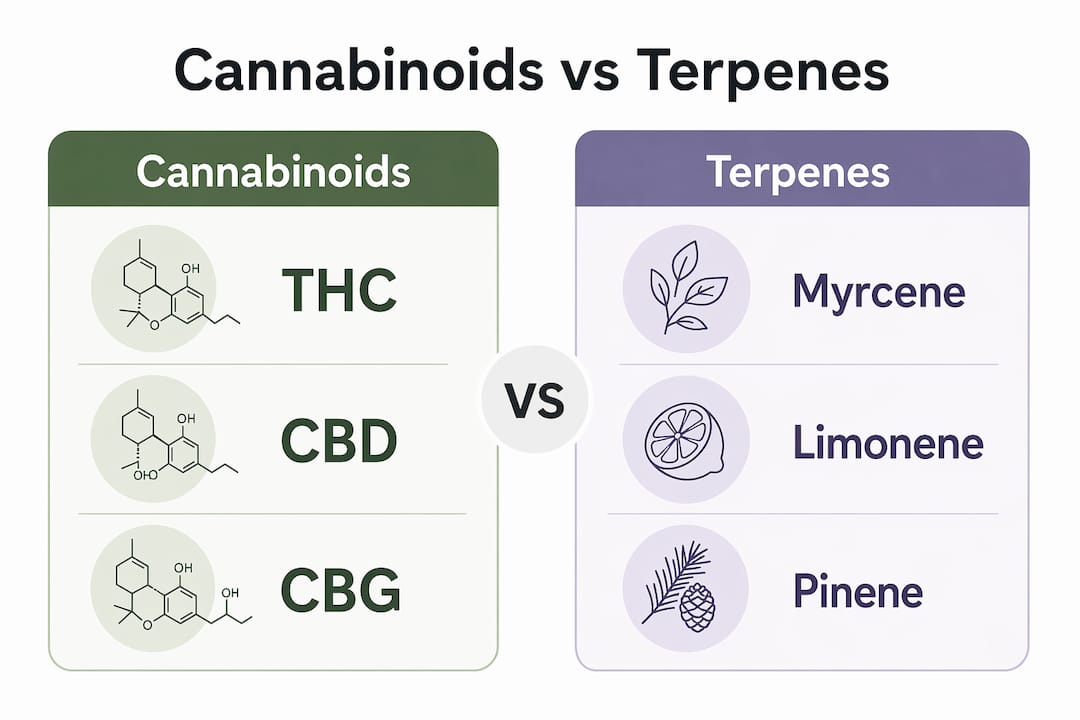
Terpenes like myrcene and limonene drive the entourage effect and can direct sedation or mood elevation. Understanding the six most common terpenes gives you a practical shorthand for selecting strains:
| Terpene | Aroma | Primary effect | Common in |
|---|---|---|---|
| Myrcene | Earthy, musky | Sedation, muscle relaxation | Sleep and pain products |
| Limonene | Citrus | Mood elevation, stress relief | Daytime and social use |
| Linalool | Floral, lavender | Anxiety reduction, calm | Anxiety and sleep products |
| Beta-caryophyllene | Spicy, peppery | Anti-inflammatory, pain relief | Pain management products |
| Pinene | Pine, fresh | Alertness, memory retention | Focus and energy products |
| Terpinolene | Floral, herbal | Uplifting, mildly sedating | Balanced recreational use |
Your preferred cannabis scent can guide effect expectations. This is not coincidence. Biological olfactory preferences reflect physiological needs, meaning the aromas you find appealing often align with the terpene profiles your body responds well to. If you are drawn to citrus-forward cannabis, limonene-dominant products are likely a good match. If earthy, musky scents appeal to you, myrcene-heavy products may suit your physiology.
Specific terpene profiles can counteract adverse effects like anxiety that are often attributed mistakenly to cannabinoids alone. Linalool and beta-caryophyllene, for example, have demonstrated anxiolytic properties that can offset the anxiety some users experience from THC. This is why two products with the same THC content produce such different outcomes. The entourage effect describes this interaction between cannabinoids and terpenes working together, and it is the real mechanism behind why one product feels right and another does not.
Pro Tip: When shopping in person, smell the product before reading the label. Your nose is a faster and often more accurate guide to terpene content than the product name.
Different cannabis product formats differ in onset time and duration, which directly influences which format suits your goal and lifestyle. Choosing the right strain chemistry is only half the equation. Getting the format and dose wrong can turn a well-matched product into a frustrating experience.
Here is how the main formats compare:
The inverted U dose-response curve means too much cannabis can cause unwanted effects like anxiety or sedation even when the strain is appropriate for your goals. Most negative cannabis experiences are dose failures, not strain failures. This distinction matters because many users blame the product when the real problem was taking too much.
“Start low and go slow” is not a cliché. It is the single most effective strategy for avoiding adverse effects and finding your personal therapeutic window.
Starting with 1 to 2.5 mg THC doses is the standard recommendation for new users or anyone trying a new format. For edibles specifically, wait the full 90 minutes before considering a second dose. The most common edible mistake is re-dosing at 45 minutes because “nothing is happening,” then experiencing a double dose hitting simultaneously.
Pro Tip: Match your format to your goal’s time requirements. If you need sleep support, an edible taken 90 minutes before bed may outlast flower. If you need fast anxiety relief, a tincture or vape gives you control that an edible cannot.
Strain names are marketing labels. Chemical profiles vary widely even within the same strain name from different producers. A product called “Blue Dream” from one licensed producer will have a meaningfully different cannabinoid and terpene profile than “Blue Dream” from another. Buying by name alone is the most reliable way to get inconsistent results.
Effective experimentation follows a few clear principles:
The goal of experimentation is not to find one perfect strain. It is to understand which cannabinoid ratios and terpene combinations your body responds to well, so you can apply that knowledge to any product, from any producer, at any time.
Choosing cannabis strains effectively requires matching cannabinoid ratios and terpene profiles to your specific goal, then selecting a format and dose that suits your timeline and tolerance.
| Point | Details |
|---|---|
| Start with your goal | Define your intended effect before selecting any product to avoid purchasing mismatches. |
| Read the COA | Cannabinoid and terpene percentages from lab testing predict effects more reliably than strain names. |
| Prioritise terpenes | Terpene profiles like myrcene for sleep or limonene for mood elevation outperform indica/sativa labels. |
| Match format to timeline | Flower and vapes offer fast onset; edibles provide longer duration but require careful dosing. |
| Track and iterate | Document each session to build a personal profile of what cannabinoid and terpene combinations work for you. |
The most consistent mistake I see is people chasing THC percentage as a proxy for quality. A 30% THC product with no terpene data on the label is a gamble. A 16% THC product with a detailed COA showing high myrcene, linalool, and beta-caryophyllene is a calculated choice. The second buyer almost always has a better experience, and they paid less for it.
The other pattern I find worth flagging: people give up on cannabis too quickly after one or two bad experiences, usually caused by too high a dose or the wrong format. An edible taken on an empty stomach at a social event is not a fair trial of cannabis. It is a recipe for a rough two hours. The product was not wrong. The context and dose were.
What actually works is patience combined with documentation. The people who get the most out of cannabis are the ones who treat the first month as a learning period rather than expecting immediate results. They track what they try, they adjust one variable at a time, and they pay attention to terpene content rather than brand names. That approach works every time, regardless of whether your goal is medical or recreational.
The uncomfortable truth about strain selection is that there is no universal answer. There is only your answer, found through methodical, low-dose experimentation guided by chemistry rather than marketing.
— Juiced
Greensociety carries a curated selection of lab-tested flower, edibles, vapes, tinctures, and concentrates, each with detailed product information to support informed choices. Whether you are applying the terpene-first approach for the first time or refining a selection you have been building for months, the cannabis flower selection guide at Greensociety walks you through exactly what to look for before you buy. Products are sourced from verified producers, shipped discreetly, and backed by a platform built for both new and experienced cannabis consumers across Canada.
Start with a CBD-dominant or balanced THC:CBD product at a low dose of 1 to 2.5 mg THC. Prioritise terpene profiles over strain names and choose a format like a tincture or low-dose vape for easier dose control.
No. Experts consistently recommend prioritising cannabinoid and terpene profiles over indica/sativa classifications, which are marketing terms that do not reliably predict effects across different producers.
Terpenes shape the nuance of your experience by contributing to sedation, mood elevation, anxiety reduction, and pain relief. Myrcene promotes relaxation, limonene lifts mood, and linalool reduces anxiety, regardless of THC content.
Edibles are processed through the liver, converting THC into a more potent compound with a longer duration of 4 to 8 hours. Onset takes 30 to 90 minutes, which leads many users to re-dose too early and experience an overwhelming effect.
Try at least three products with distinct cannabinoid and terpene profiles before drawing conclusions. Most negative experiences are caused by incorrect dosing or a mismatched format rather than cannabis being unsuitable for you.