Free Shipping
on orders over $150.00
$0.00
$150.00
Add $150.00 more for free shipping!


TL;DR:
- Choosing cannabis based on personal goals and chemical profiles ensures a better experience than relying on strain names.
- Understanding cannabinoids and terpenes helps tailor strains for relaxation, energy, or pain relief effectively.
- Reading lab COAs is essential for safety, confirming product content, and avoiding contaminants.
You walk into an online dispensary, ready to find something that helps you unwind after a long week, and suddenly you’re staring at hundreds of strain names, percentages, and labels that mean almost nothing to you yet. It’s a common experience. Whether you’re a first-time buyer or someone who’s been at it for years without a clear system, picking the right cannabis strain doesn’t have to be a guessing game. This guide walks you through every key decision, from defining your goals to reading lab results, so you can shop with real confidence.
| Point | Details |
|---|---|
| Know your intent | Identify your goal—whether relaxation, pain relief, or alertness—to guide your strain selection. |
| Balance THC and CBD | Choosing the right mix for your body and experience level reduces risks and boosts benefits. |
| Look beyond strain names | Consider terpene profiles and lab results to predict effects more reliably than labels alone. |
| Prioritise lab-tested cannabis | Always review certificates of analysis for safety, potency, and purity checks. |
| Track and adjust your experience | Start low, document the effects, and tweak your approach for best personal results. |
Before you even glance at a strain name, you need to ask yourself one honest question: what do you actually want from this experience? That sounds simple, but it’s the step most people skip. They jump straight to browsing, get pulled in by a catchy name or a high THC number, and end up with something that doesn’t quite fit.
The most common cannabis goals break down into a few clear categories:
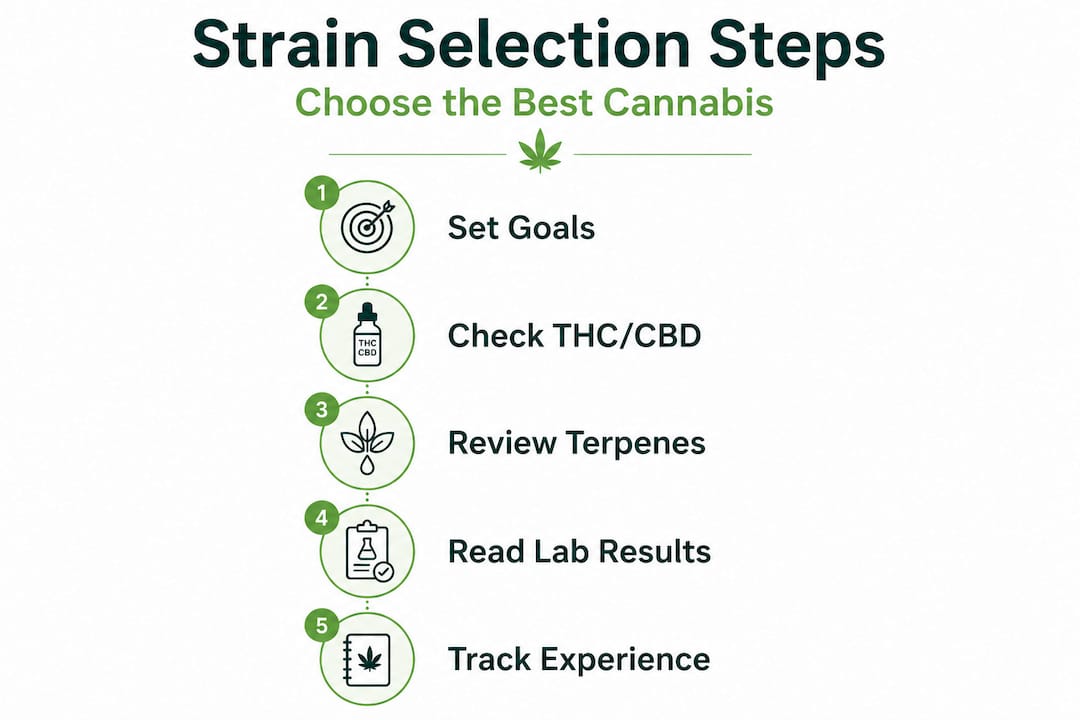
Once you know which category fits your situation, you have a real direction. According to a step-by-step selection framework, the first move is always to define your goal, whether that’s relaxation, energy, or pain relief, before matching it to a THC/CBD ratio and your personal tolerance. Everything else flows from there.
One important thing to understand early: the old indica versus sativa split is a massive oversimplification. Indica was supposed to mean “body high, relaxing,” and sativa was supposed to mean “head high, energising.” In reality, those labels describe plant structure, not chemical effect. Modern cannabis science focuses instead on the concept of a chemovar, which is the actual chemical profile of a strain, including its cannabinoids and terpenes. Two strains with the same “indica” label can produce completely different experiences if their chemical makeup differs.
“The indica/sativa distinction is more useful for growers than for consumers. What matters for your experience is the chemovar, not the leaf shape.”
When you start choosing effects for Canadian needs, thinking in terms of chemovars rather than labels will serve you far better. If you want to go deeper on how differences in cannabis strains actually manifest, it’s worth exploring before your next purchase.
Pro Tip: Write down your top two goals before you start browsing. Having them in front of you keeps you from getting distracted by marketing language or flashy packaging.
With your goals locked in, the next layer is understanding the two primary cannabinoids: THC and CBD. These two compounds do very different things, and their ratio in a given strain shapes your experience more than almost any other factor.
THC (tetrahydrocannabinol) is the compound responsible for the psychoactive effects of cannabis. It’s what produces the “high,” the altered perception, the euphoria, and in higher doses, the potential for anxiety or paranoia. Not everyone responds to THC the same way. Some people can enjoy 25% THC flower with no issues; others find that anything above 15% sends their thoughts racing uncomfortably.
CBD (cannabidiol) is non-intoxicating and actually works to moderate some of THC’s more intense effects. Higher CBD content in a strain tends to produce a smoother, calmer experience. For anyone new to cannabis or returning after a long break, strains for pain relief with balanced THC:CBD ratios are often a smarter starting point than high-THC options.
Here’s a quick comparison to guide your thinking:
| THC/CBD profile | Best suited for | Typical experience |
|---|---|---|
| High THC, low CBD (25%+ / <1%) | Experienced users, recreational | Strong euphoria, potential anxiety |
| Moderate THC, balanced CBD (15% / 8%) | Intermediate users, medical | Mild high, reduced anxiety |
| Low THC, high CBD (<10% / 15%+) | Beginners, medical, daytime | Minimal psychoactivity, calm focus |
| Equal ratio (1:1 THC:CBD) | Versatile, medical | Gentle high, strong body effect |
For beginners or those with low tolerance, moderate THC (10-20%) with balanced or high CBD strains such as Harlequin or Cannatonic are consistently recommended. These profiles give you a real effect without overwhelming your system.

The science backs this up in a meaningful way. A Frontiers in Psychology study involving 116 participants found that THC-dominant cannabis impairs memory significantly more than strains with a 1:1 THC:CBD ratio. That’s not a minor difference. If you’re using cannabis during the day or need to stay functional, a balanced ratio isn’t just a preference, it’s a practical advantage.
Understanding the entourage effect also matters here. THC and CBD don’t operate in isolation. They interact with each other and with terpenes to produce effects that neither compound would create on its own. This synergy is why a 20% THC strain with rich CBD and terpene content can feel smoother than a 20% THC strain with almost nothing else in it.
Here’s where cannabis selection gets genuinely interesting. Terpenes are the aromatic compounds found in cannabis (and in many other plants) that give each strain its distinctive smell and flavour. But they do far more than make your cannabis smell like citrus or pine. They actively contribute to the effects you feel.
The most well-studied cannabis terpenes and their associated effects include:
Terpene profiles can be more predictive of your actual experience than the indica or sativa label on the package. If you consistently enjoy a certain type of effect, look at the terpene profile of the strains that worked for you. You’ll likely find a pattern.
SC Labs developed a practical terpene classification system that groups strains into categories like “Sweets & Dreams” for relaxation-focused profiles. SC Labs terpene classes give you a data-backed shortcut when you’re trying to match a strain to a specific goal without having to read every detail from scratch.
Pro Tip: When you find a strain you love, note its top three terpenes. Next time you’re shopping, use those terpenes as your search filter rather than relying on strain names, which can vary widely between growers.
If you’re specifically looking for top strains for relaxation, prioritise strains with high myrcene and linalool content. These two terpenes together create a noticeably calming effect that complements a moderate THC level well.
You’ve identified your goals, understood your cannabinoid preferences, and learned to read terpene profiles. Now comes a step that many buyers skip entirely, and it’s arguably the most important one for your safety: reviewing the lab certificate of analysis, or COA.
A COA is a document produced by an independent laboratory that verifies exactly what’s in your cannabis product. It tells you the actual cannabinoid and terpene content (which may differ from what’s on the label), and it screens for contaminants like pesticides, heavy metals, moulds, and residual solvents.
“A COA isn’t just paperwork. It’s the only objective confirmation that what you’re buying is what the seller claims it is.”
Here’s what to check when you’re reading cannabis lab results:
The full step-by-step selection process includes reviewing the lab COA as a non-negotiable step before purchase. Any reputable seller will make this document available. If a product doesn’t have one, that alone is reason enough to look elsewhere.
Understanding lab testing for cannabis safety isn’t just for medical patients. Recreational users benefit equally from knowing their product is clean, accurately labelled, and free of anything that shouldn’t be there.
You’ve done your research, selected a strain with a solid chemical profile and a clean COA. Now it’s time to actually use it, and this stage has its own best practices worth following.
The golden rule: start low and go slow. This applies whether you’re completely new to cannabis or simply trying a new strain for the first time. Even experienced users can be surprised by how differently two strains with similar THC percentages can feel in practice.
Here’s a practical approach to your first trial with any new strain:
According to the same selection framework, trialling a low dose and journalling effects is the final step in a responsible strain selection process. It’s the step that transforms a one-time purchase into a genuinely personalised routine.
Understanding strain genetics for effects can also help you predict how a new strain might behave before you try it, especially if you already know which parent strains you respond well to.
Pro Tip: Keep a simple rating system in your journal. Score each session from 1 to 5 on relaxation, energy, mood, and any side effects. After five or six sessions, patterns emerge that are far more useful than any product description.
If you’re using cannabis for a medical condition, always loop in a healthcare professional. Your journal data becomes genuinely valuable in those conversations.
Here’s an honest take that most strain guides won’t give you: the name on the package means almost nothing. “Blue Dream,” “OG Kush,” and “Girl Scout Cookies” are marketing terms as much as they are botanical identifiers. Two batches of the same named strain from different growers can have entirely different terpene profiles, different cannabinoid ratios, and produce noticeably different effects.
The traditional indica versus sativa framework still dominates how cannabis is marketed and discussed. Some research does show indica-leaning strains producing lower-arousal effects on average, but the same studies consistently emphasise enormous individual variability. In other words, what relaxes one person might energise another, and the strain name is a poor predictor of which outcome you’ll get.
What actually predicts your experience? Your own history with specific cannabinoid and terpene combinations. That’s it. No marketing claim, no budtender recommendation, and no online review can substitute for your personal data. The step-by-step process outlined in this guide isn’t just a shopping checklist. It’s a method for building a personal database of what works for your body and your goals.
We’ve seen this play out repeatedly. Customers who track their sessions and pay attention to COAs consistently report better outcomes than those who shop by strain name alone. The cannabis industry is moving toward chemovar-based labelling for exactly this reason. Until that becomes the standard everywhere, your own notes are your best tool.
Ready to put this knowledge to work? At Green Society, we’ve built our product catalogue and educational resources around exactly this kind of informed, intentional approach to cannabis.
Whether you’re narrowing down your first purchase or refining a routine you’ve had for years, our guides are designed to help you move from guesswork to confidence. Explore our breakdown of the best cannabis flower varieties to see which options align with the chemical profiles you’ve identified, or work through our cannabis flower checklist before your next order to make sure you’re evaluating every product with the right criteria. Every product we carry comes with lab-verified quality, so you can shop knowing the COA is already done for you.
Beginner users should look for strains with moderate THC (10-20%) and higher CBD content, such as Harlequin or Cannatonic, which reduce the risk of anxiety or overwhelming effects while still delivering a noticeable experience.
Modern research shows that effects depend far more on the chemical profile of a strain, including its terpenes and cannabinoid ratios, than on whether it’s classified as indica or sativa.
A certificate of analysis confirms actual cannabinoid and terpene percentages and verifies that the product is free of pesticides, heavy metals, and other harmful contaminants, as outlined in the strain selection process.
Terpenes are aromatic compounds that actively shape the effects of cannabis, with profiles like SC Labs’ terpene classes offering data-backed guidance for matching terpene combinations to specific goals like relaxation or alertness.
Look for strains with balanced THC:CBD ratios and consult a healthcare professional if you’re managing chronic pain, as matching the right cannabinoid and terpene profile to your specific condition makes a significant difference in outcomes.