Free Shipping
on orders over $150.00
$0.00
$150.00
Add $150.00 more for free shipping!


TL;DR:
- Cannabis impacts people differently based on age because the endocannabinoid system and brain development change over a lifetime.
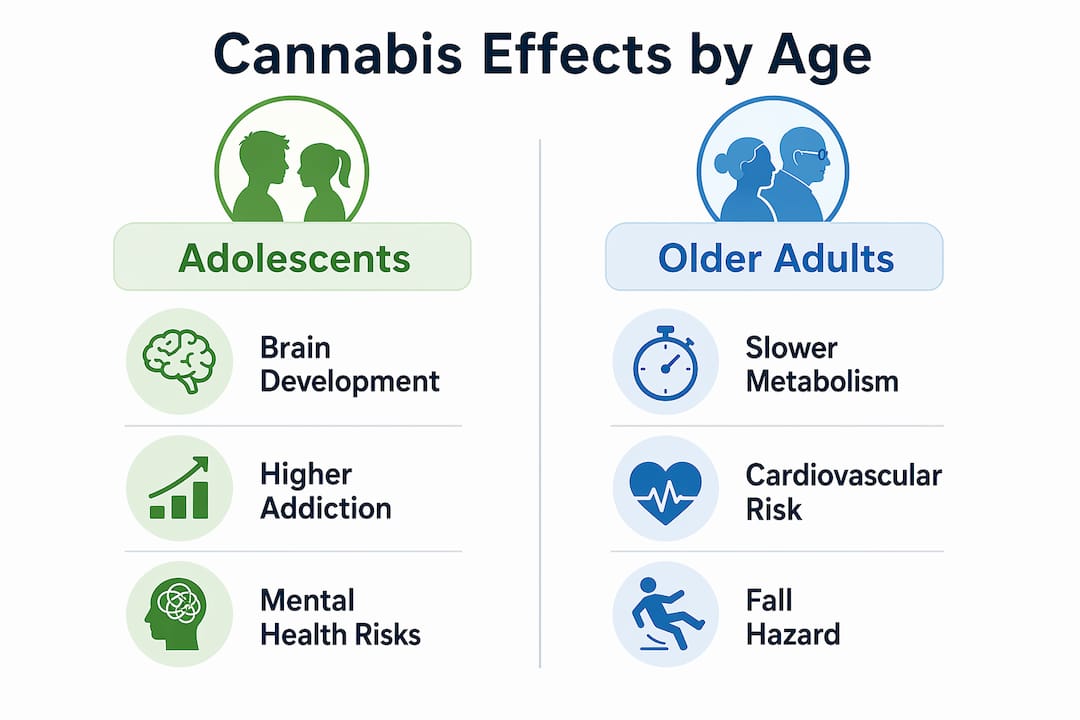
- Adolescents face higher risks of addiction and lasting mental health effects, especially if they start early.
- Older adults metabolize cannabis more slowly, increasing the risk of cardiovascular issues, falls, and drug interactions.
Cannabis affects people differently depending on their age, and the gap between a teenager’s experience and an older adult’s is wider than most people expect. The endocannabinoid system (ECS), which governs how the body processes cannabinoids like THC and CBD, changes significantly across a lifetime. A 16-year-old’s developing brain responds to cannabis in ways that are fundamentally different from a 60-year-old’s slower metabolising system. Understanding cannabis effects by age is not just useful context. It is the difference between informed use and avoidable harm.
The adolescent brain is still developing until approximately age 25. That single fact defines the entire risk profile for young people who use cannabis. The prefrontal cortex, which governs decision-making, impulse control, and emotional regulation, is the last region to fully mature. Cannabis disrupts this process in ways that can leave lasting marks.
A large cohort study of 463,396 adolescents found that past-year cannabis use by those aged 13–17 significantly raised the risk of psychotic, bipolar, depressive, and anxiety disorders by age 26. That is not a marginal statistical signal. It represents a measurable shift in psychiatric outcomes tied directly to early use.
The addiction numbers are equally stark. Teen-onset users develop addiction at a rate of 1 in 6, compared to 1 in 10 for those who begin as adults. Starting earlier means the brain is wired around cannabis during its most formative years, making dependence harder to avoid and harder to reverse.
Structural brain changes have also been observed in adolescents who use cannabis regularly. Memory consolidation, learning speed, and attention span are the functions most consistently affected. These are not temporary impairments that clear up after a few weeks of abstinence. Research points to lasting consequences that follow users into adulthood.
Key risks for adolescents and young adults include:
Pro Tip: If you are under 25 or have a family history of psychosis or bipolar disorder, the evidence strongly supports delaying cannabis use until the brain has fully matured.
For adults with fully developed brains, the risk profile shifts considerably. The ECS in a mature adult is stable, and the acute cognitive disruptions seen in adolescents are less pronounced. That does not mean cannabis is without effect. It means the effects are different in character and generally more manageable.

Dose and frequency remain the primary variables. Occasional, low-dose use in healthy adults aged 25–54 carries a different risk profile than daily high-potency consumption. The ECS declines with age, which means even within this age group, a 50-year-old processes cannabis differently than a 28-year-old. The biological response shifts gradually rather than all at once.
One genuinely surprising finding comes from research on middle-aged adults. Some studies on adults aged 40–77 show moderate cannabis use correlates with larger brain volumes and better cognitive function. The clinical significance of this finding remains unclear and contested. Still, it challenges the assumption that cannabis is uniformly harmful across all adult age groups.
Common effects and considerations for adults aged 25–54 include:
Pro Tip: Adults using cannabis for medicinal purposes should track dose, frequency, and product potency. Keeping a simple log helps identify what works and flags patterns of increasing use before they become problematic.
Older adults face a distinct set of risks, and the most important one is metabolic. Cannabinoids metabolise more slowly in older adults, causing prolonged effects and a higher risk of unintended accumulation in the body. This is especially significant for people managing multiple prescriptions, since cannabis interacts with a wide range of medications including blood thinners, sedatives, and heart medications.
The cardiovascular risks are serious and specific. Regular cannabis use in older adults is linked to a 29% increased risk of heart attacks and a 20% increased risk of strokes, driven by THC-triggered inflammation in blood vessels. These are not theoretical risks. They represent real outcomes documented in older populations.
Falls are another underappreciated danger. Cannabis can cause orthostatic hypotension, a sudden drop in blood pressure when standing, which leads to dizziness, blurred vision, and loss of balance. For adults over 55, a fall is not a minor inconvenience. It can mean a fractured hip, hospitalisation, and a significant decline in independence.
One factor that catches many older adults off guard is potency. Modern cannabis products are far more potent than what was available decades ago. Someone who used cannabis in the 1980s and assumes their prior tolerance still applies is taking a genuine risk. Today’s concentrates and high-THC flowers operate in a completely different potency range.
| Risk factor | Detail |
|---|---|
| Slower metabolism | Cannabinoids stay in the system longer, increasing accumulation risk |
| Cardiovascular effects | 29% higher heart attack risk, 20% higher stroke risk with regular THC use |
| Falls and hypotension | Orthostatic hypotension causes dizziness and increases injury risk |
| Drug interactions | Cannabis interacts with blood thinners, sedatives, and cardiac medications |
| Potency gap | Modern THC levels far exceed legacy products, raising adverse event risk |
Pro Tip: Older adults new to cannabis, or returning after a long break, should start with the lowest available dose and wait at least two hours before considering more. The phrase “start low, go slow” is not a cliché here. It is a clinical recommendation.
For a broader look at how cannabis can fit into later life, the Greensociety guide on cannabis and aging covers both the potential benefits and the precautions worth taking.
Addiction risk is not evenly distributed across age groups. The earlier someone starts, the higher their risk. Teen-onset users face a 1 in 6 chance of developing cannabis use disorder, while adult-onset users face a 1 in 10 chance. That gap reflects how the developing brain forms habitual pathways more readily than a mature one.
Daily use dramatically increases risk at any age. Between one-quarter and one-half of daily cannabis users develop addiction over time. Daily use is the single strongest behavioural predictor of dependence, more so than the method of consumption or the specific product used.
Cannabis use disorder presents with recognisable warning signs:
Harm reduction by age group looks different in practice. For young adults, the priority is delaying initiation and avoiding daily use. For adults in the 25–54 range, the focus shifts to frequency management and potency awareness. For older adults, the key concern is recognising that slower metabolism means effects accumulate faster than expected, making overconsumption easier and harder to predict. The Greensociety article on cannabis overconsumption risks covers the warning signs in detail.
Safe cannabis use is not a single set of rules. It is a set of age-calibrated decisions. The guidance that protects a 20-year-old is not the same guidance that protects a 65-year-old.
Pro Tip: Edibles are particularly risky for first-time or returning users of any age because the onset is delayed by 30–90 minutes. People often consume more while waiting for effects, leading to unintended overconsumption.
Cannabis effects vary by age because the body’s endocannabinoid system, metabolism, and brain development all change across a lifetime, making age the single most important variable in predicting risk and response.
| Point | Details |
|---|---|
| Teen use carries the highest risk | Adolescents face a 1 in 6 addiction risk and elevated psychiatric disorder rates. |
| Brain development ends around 25 | Starting before age 25 disrupts critical neurological development with lasting effects. |
| Older adults metabolise cannabis slowly | Slower metabolism prolongs effects and raises cardiovascular and fall risks significantly. |
| Daily use predicts addiction | Between 25% and 50% of daily users develop cannabis use disorder regardless of age. |
| Potency has increased sharply | Modern cannabis products are far stronger than legacy products, requiring dose recalibration. |
The public conversation about cannabis tends to flatten the age question into two camps: teens should not use it, and adults can make their own choices. That framing is too simple, and it leaves older adults particularly exposed.
What I find consistently underappreciated is how much the 55-and-older population underestimates their own vulnerability. Many people in that group have prior cannabis experience from decades ago and assume familiarity equals safety. It does not. The product they used in 1985 and the concentrate available today are not the same substance in any meaningful pharmacological sense. Combine that with slower metabolism, polypharmacy, and a cardiovascular system that is less resilient, and the risk profile is genuinely serious.
The youth risk is better communicated, even if not always heeded. The older adult risk is barely discussed in mainstream cannabis education, and that gap needs to close. Informed use across the lifespan means acknowledging that biology changes, and that cannabis use needs to change with it.
— Juiced
Understanding how age shapes your response to cannabis is the first step. The second is choosing products that fit that understanding.

Greensociety offers a range of resources to help you make confident, informed choices. Whether you are selecting your first flower strain or looking for lower-potency options suited to a more cautious approach, the guide on how to select cannabis flower walks through exactly what to look for. For those interested in edibles as a controlled consumption method, the Greensociety edible recipes and tips resource covers dosing, timing, and product selection. Responsible use starts with good information and the right product for your stage of life.
Yes. Older adults metabolise cannabinoids more slowly, meaning cannabis remains active in the body longer and effects are more prolonged compared to younger adults.
Cannabis use carries the lowest developmental risk after age 25, when brain development is complete. Even then, frequency and potency remain important variables.
No. Canadian law sets the minimum legal age at 18 or 19 depending on the province. Greensociety provides a full breakdown of provincial age requirements for reference.
Cannabis can cause orthostatic hypotension, a sudden drop in blood pressure when standing, which leads to dizziness and impaired coordination. This risk is significantly elevated in adults over 55.
Yes. A study of 463,396 adolescents found that teen cannabis use significantly raises the risk of psychotic, bipolar, depressive, and anxiety disorders by age 26. Adult-onset use carries a lower but still real psychiatric risk.