Free Shipping
on orders over $150.00
$80.00
$150.00
Add $70.00 more for free shipping!
-
×
 Green Society Herb Grinder
$40.00
Green Society Herb Grinder
$40.00


TL;DR:
- Legal ages for cannabis vary across regions, with some provinces in Canada setting the limit at 18 and others at 21, while most US states require users to be at least 21. European countries typically use 18 as the minimum age, but specific laws differ by country, possession limits, and cultivation rules. Age verification and responsible use are essential for legal access, but personal knowledge, safety habits, and informed choices ultimately determine responsible consumption.
Many Canadians and international visitors assume that cannabis has a single, universal legal age. That assumption is wrong, and it can get you into real trouble. Provincial age requirements vary across Canada, ranging from 18 in Alberta to 21 in Quebec, while every legal US state sets the bar at 21 for recreational use. Europe adds another layer of variation entirely. Knowing exactly where the line sits in your region is not just responsible; it is a legal obligation with consequences that can follow you long after the moment passes.
| Point | Details |
|---|---|
| Ages vary by region | There is no single legal age for cannabis—rules differ across provinces, states, and countries. |
| Health rationale | Age limits aim to protect young brains, but research and debate challenge what age is truly ‘best’. |
| Penalties are strict | Supplying or selling cannabis to underage people carries serious legal consequences. |
| Retailers enforce ID checks | Licensed retailers use strong age verification and nearly perfect compliance to keep minors out. |
| Stay up to date | Laws, ages, and exceptions change—always re-check local rules before you buy or use. |
Let’s start by looking at who decides the legal age and why it varies so much.
No international body hands down a universal cannabis age. Instead, governments at different levels weigh public health data, cultural norms, political pressures, and existing alcohol and tobacco age frameworks before landing on a number. The result is a patchwork of rules that genuinely reflects the values and priorities of each jurisdiction.
The most common thresholds you will encounter are 18, 19, and 21. Each carries its own logic. Age 18 aligns cannabis with the general age of majority in many countries. Age 19 is Canada’s compromise number, reflecting that most provinces treat 19 as adulthood for controlled substances. Age 21 follows the United States alcohol precedent and is tied directly to neuroscience arguments about brain development continuing into the early twenties.
Canada uses a federalist model, meaning the federal government set broad legalisation parameters under the Cannabis Act (2018), but left age limits to the provinces and territories. This is why cannabis laws in Canada look different depending on which side of a provincial border you are on. Alberta chose 18, treating cannabis like other adult products regulated at the age of majority. Quebec originally set 18, then raised it to 21, making it the strictest province in the country. Every other province and territory sits at 19.
The United States presents a different structural conflict. Recreational use is legal in 24 states plus the District of Columbia as of 2026, and every one of those jurisdictions requires purchasers to be at least 21. Federal law still classifies cannabis as a controlled substance, creating a tension between state-level permission and federal prohibition that affects everything from banking to employment policy.
Europe is its own story. Cannabis laws in Europe are fragmented, with full recreational legalisation limited to a handful of countries and decriminalisation models operating in many others. Most European frameworks use 18 as their threshold where recreational purchase is permitted. The approach to navigating cannabis rules abroad requires research specific to each country you visit.
“Age limits for cannabis are never arbitrary. They represent a policy choice that attempts to balance individual freedom against documented risks to developing brains, while also reflecting the political realities of the moment.”
The uncomfortable truth is that no single age satisfies every health, social, and legal goal simultaneously. That tension is precisely why the numbers keep shifting.
Now that you know who sets the rules, let’s see how the rules compare across key regions.
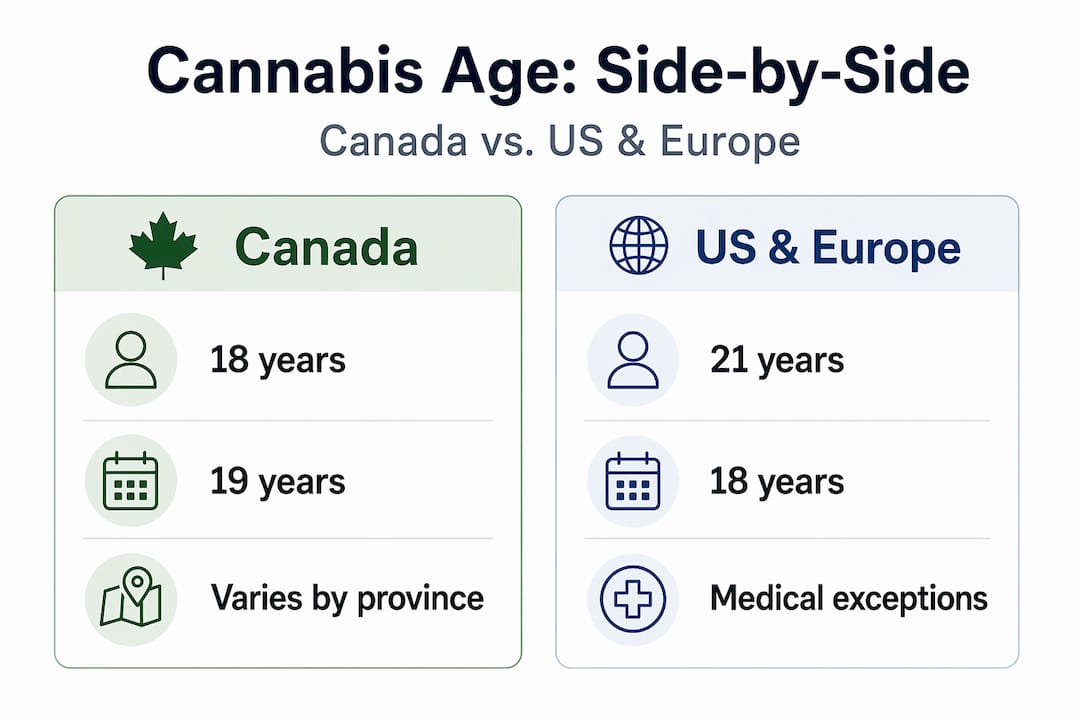
The table below gives you a quick reference for recreational and medical minimum ages in major regions. Use it as a starting point, not a substitute for checking current local law before you purchase or travel.
| Region | Recreational age | Medical age | Notes |
|---|---|---|---|
| Alberta, Canada | 18 | 18 | Youngest in Canada |
| Quebec, Canada | 21 | 18 | Raised from 18 in 2020 |
| All other Canadian provinces | 19 | 18 | Includes BC, Ontario, Manitoba |
| US legal states | 21 | 18 (most states) | Federal conflict still active |
| Germany | 18 | 18 | Up to 25g public, 50g home |
| Malta | 18 | 18 | Up to 7g public, 4 plants per household |
| Luxembourg | 18 | 18 | Home cultivation permitted |
| Netherlands | 18 | 18 | Tolerated system, not fully legal |
Medical cannabis access in most US states is available to patients aged 18 and over with a qualifying condition and a physician’s recommendation. Patients under 18 require parental consent and physician approval in most state programmes, making it technically accessible to minors in defined medical circumstances.
Europe’s emerging legal markets are worth understanding in more detail. Germany, Malta, and Luxembourg all use 18 as their recreational minimum, but the specific possession limits, cultivation rules, and public consumption restrictions differ meaningfully between them. Germany, for instance, permits up to 25 grams in public and up to 50 grams at home, with a maximum of three plants per person.
Pro Tip: Before ordering or purchasing cannabis in any province or visiting a dispensary while travelling, check the provincial legalization laws that apply specifically to your location. Age is just one element; possession limits and consumption zones also vary significantly.
One emerging trend worth watching is digital age verification for online purchases. As the online cannabis shopping market grows, regulators are requiring platforms to implement more robust age-gating measures, including government ID uploads, credit card verification tied to adult accounts, and age confirmation at the point of delivery. Prince Edward Island has even explored raising its online minimum age, reflecting how seriously regulators take digital access. Illinois cannabis sales hitting $2 billion in 2024 demonstrates how commercially significant these regulated markets have become, and with that scale comes intensified scrutiny of every point of sale.
Understanding the numbers is important, but so is knowing why those numbers exist.

The most frequently cited argument for higher cannabis age limits is brain development. The human brain continues developing well into a person’s mid-twenties, with the prefrontal cortex, which governs decision-making and impulse control, being particularly vulnerable to disruption from psychoactive substances during adolescence and early adulthood.
Research indicates that different ages optimise for different outcomes: age 21 aligns with the strongest protections for educational attainment, age 19 with mental health outcomes, and age 18 with certain physical health metrics. No single age works as a perfect cutoff for all health considerations simultaneously. This is part of why there is active debate about whether current limits are set too low.
The main arguments in the current debate are:
The compliance question is also relevant here. Compliance checks in US legal states show licensed retailers are nearly 100% effective at refusing sales to minors, suggesting that age limits at licensed stores do work in practice. This gives weight to the argument that legalisation paired with strong age verification is more effective than prohibition at keeping cannabis out of underage hands.
When you make a purchase, knowing your obligations around safe cannabis purchasing is as important as knowing the age threshold. Legal purchase means legal product, and that is a meaningful safety distinction.
So, what really happens if someone ignores these age limits? Let’s break down the real-world risks.
The penalties for selling cannabis to a minor are severe, and they apply to retailers, individuals, and anyone who facilitates access. Ohio, for example, recently increased penalties to include felony-level charges and automatic licence revocation for selling to individuals under 21. This is not a fine you can absorb and move on from; it can end a business and result in a criminal record.
| Region | Penalty type | Severity | Licence consequence |
|---|---|---|---|
| Canada (federal) | Summary offence | Up to 14 years if providing to minor | Possible revocation |
| Ontario | Provincial offence | Significant fine plus criminal referral | Licence suspension |
| Ohio, US | Felony | Criminal conviction | Automatic revocation |
| Most US states | Misdemeanor to felony | Fines plus possible jail time | Suspension or revocation |
| Germany | Administrative | Fines, possible criminal charge | Business closure risk |
For consumers, the practical steps to stay compliant are straightforward:
Pro Tip: If you ever feel uncertain about whether a retailer is operating legally, check your legal cannabis checklist before completing a purchase. Legal retailers will never pressure you or skip the ID process.
Licensed retailers in legal US states demonstrate near-complete compliance with age verification requirements. This is the direct result of the consequences being significant enough that no responsible business will risk a sale to a minor. The cannabis conviction penalties for those caught on the wrong side of these laws are serious and long-lasting.
Now that you’ve learned the technical side, here’s a deeper perspective on cannabis, responsibility, and real-world safety.
Age limits are a legal floor, not a guide to good decisions. Turning 19 or 21 does not automatically mean you are ready to use cannabis wisely, any more than turning 16 means you are automatically a safe driver. The legal threshold gets you through the door. What you do once you are inside is still entirely up to you.
What we see consistently in markets where cannabis has been legal for several years is that the people who have the best experiences are those who treated the legal framework as a starting point and built genuine knowledge on top of it. They understand the difference between product types, dosage, consumption methods, and their own personal health context. They talk honestly with their doctors. They do not mix cannabis with alcohol or other substances without understanding the interaction. These are not the habits instilled by age verification alone.
The more uncomfortable truth is that age limits, while genuinely important, can create a false sense that safety is someone else’s responsibility. Once you are of legal age, the retailer has done their job. Your safety, your choices, and your wellbeing become your own responsibility.
We think the cultural conversation around cannabis should move further in this direction. Stigma reduction is valuable because it opens up honest conversations between people and their healthcare providers, between parents and teenagers, and within communities. When cannabis was illegal, those conversations were rare because they felt incriminating. Legalisation creates space for education, but only if we actively use it.
If you want to make genuinely informed choices about cannabis, understanding cannabis laws is step one. Understanding yourself, your health, and your reasons for using cannabis is step two. Neither step is optional for responsible use.
For those who want to shop or learn confidently, here are helpful resources and guides.
Now that you have a clear picture of how legal ages work across Canada, the US, and Europe, the next step is putting that knowledge to practical use. Whether you are exploring cannabis for the first time or looking to make smarter, more informed choices about the products you already enjoy, GreenSociety.cc has the resources to support you.
From our detailed cannabis edibles guide covering everything from dosing to preparation, to our cannabis accessories guide that helps you understand the full range of products available, we provide the education and product quality you need to make every purchase a confident one. All purchases on GreenSociety.cc are handled with full age verification, discreet delivery, and a commitment to quality that respects both you and the law.
Even if cannabis is legal in your home province or state, crossing borders with it is illegal under federal and international law, including between two legal US states or into and out of Canada.
Most regions align CBD age limits with general cannabis regulations, so the same provincial or state rules typically apply, though exceptions exist for very low-THC or hemp-derived CBD products sold outside dispensaries.
Penalties vary by jurisdiction but can include heavy fines, criminal charges, or permanent loss of licence, even for a first offence in many US states and Canadian provinces.
Online retailers use digital age-gating and may require a government ID upload, credit card verification, or confirmed identification at the point of delivery to prevent underage access.
Yes; jurisdictions like Prince Edward Island have actively explored raising the minimum age to 21, so staying current with local legislation in your province or state is essential.