Free Shipping
on orders over $150.00
$0.00
$150.00
Add $150.00 more for free shipping!


TL;DR:
- Genetics, receptor biology, and daily physiological changes influence individual cannabis responses significantly.
- Understanding these factors can help users dose more safely and predict their experiences better.
Cannabis affects people differently because of a complex mix of genetics, brain chemistry, and daily physiological state. Two people can share the same product, the same dose, and the same setting, yet have completely opposite experiences. One feels relaxed and euphoric. The other feels anxious and overwhelmed. Understanding why cannabis individual reactions vary so widely is not just interesting science. It is practical knowledge that helps you use cannabis more safely and confidently. The core explanation sits in three places: how your body breaks down THC, how your brain’s receptors respond to it, and what your internal state is doing at the moment you consume.
The most underappreciated factor in cannabis effects variations is genetics, specifically the CYP2C9 enzyme. CYP2C9 is the liver enzyme responsible for breaking down THC after it enters your bloodstream. People with different variants of this gene metabolise THC at dramatically different speeds.
The CYP2C9*3 allele is the key variant to know. Individuals who carry two copies of this allele (the *3/*3 genotype) experience roughly three times higher THC plasma concentrations compared to people with the standard gene variant. That means a standard 10 mg edible can hit a poor metaboliser the same way a 30 mg dose would hit someone with normal metabolism. Body weight, tolerance history, and product quality all matter far less than this single genetic variable when it comes to edibles.
The population numbers make this relevant to a lot of people. Genetic variants in CYP2C9 affect 1–2% of people of European descent severely (the *3/*3 group), while 15–20% carry one copy of the variant and experience moderately elevated effects. That is a significant portion of cannabis users who are unknowingly predisposed to stronger reactions at standard doses.
| Genotype | Effect on THC metabolism | Practical implication |
|---|---|---|
| CYP2C9 *1/*1 (standard) | Normal THC breakdown speed | Standard dosing guidelines apply |
| CYP2C9 *1/*3 (one variant) | Moderately slower metabolism | Elevated effects at standard doses |
| CYP2C9 *3/*3 (poor metaboliser) | ~300% higher THC plasma levels | Very low starting doses required |
Edibles carry the highest risk for poor metabolisers because oral THC passes through the liver before reaching the bloodstream, amplifying the CYP2C9 effect. Inhaled cannabis bypasses the first-pass liver metabolism, so the genetic impact is less dramatic but still present. If you have ever felt floored by an edible that barely touched a friend, your CYP2C9 genotype is the most likely explanation.
Pro Tip: If edibles consistently hit you harder than expected, start with 2.5 mg THC and wait a full two hours before considering more. Genetic slow metabolisers often feel the peak effect 90 minutes to three hours after consumption.
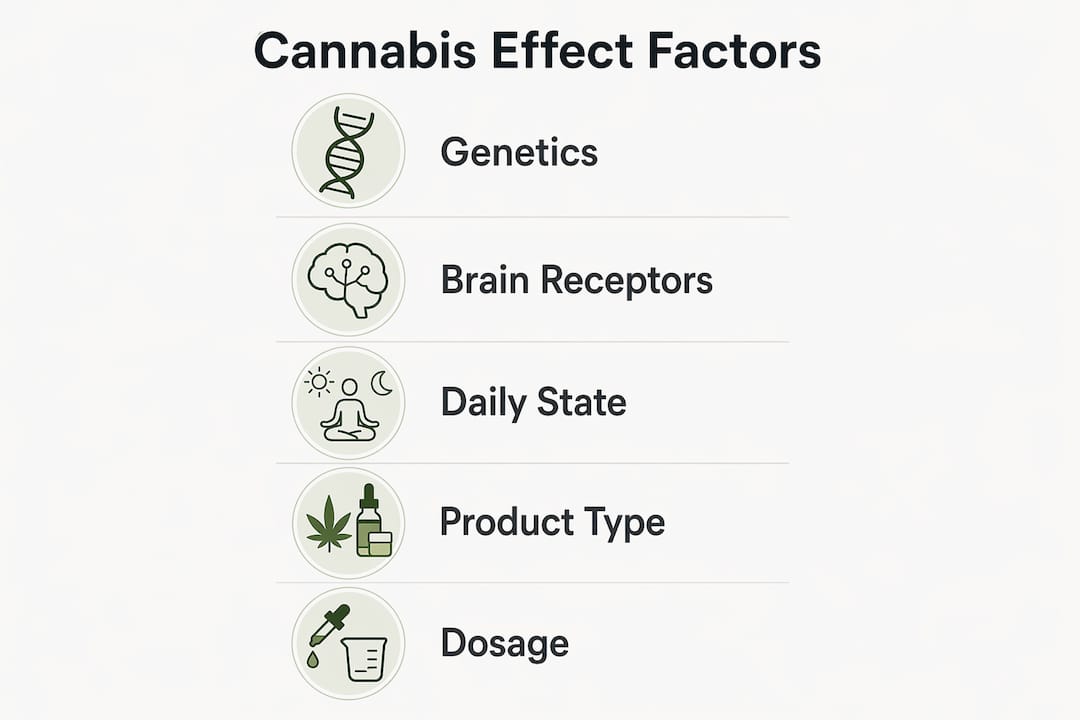
Genetics do not stop at metabolism. The brain itself varies significantly between people in ways that directly control how cannabis feels. The CB1 receptor is the primary target for THC in the brain, and both its density and sensitivity differ from person to person.

CB1 receptors are distributed throughout the brain, with the highest concentrations in areas governing memory, coordination, reward, and emotional processing. People with naturally higher CB1 receptor density in reward circuits tend to experience stronger euphoric effects from the same dose. People with lower density, or with receptors that are less sensitive, may feel little effect at all from doses that leave others couch-locked.
The CNR1 gene controls CB1 receptor expression. A specific variant of this gene, the rs1049353 T allele, increases the odds of psychotic adverse effects from cannabis by approximately sixfold (OR=6.1, 95% CI 1.7–27.9). This is not a fringe risk. It is a measurable genetic signal that explains why some people experience paranoia or dissociation from cannabis while others never do.
Tolerance adds another layer of complexity. Regular cannabis use causes uneven CB1 receptor downregulation, meaning the brain reduces receptor sensitivity in some areas faster than others. Receptors in reward-processing regions downregulate quickly, which is why euphoric effects fade with regular use. Receptors in anxiety-processing regions downregulate more slowly. The result is a tolerance pattern where the pleasant effects diminish but the potential for anxiety or paranoia remains. Long-term users who increase their dose to chase the original high are often walking into this trap.
THC also has a biphasic dose-response, meaning its effects reverse at higher doses. Low doses of 2.5–5 mg typically reduce anxiety and improve mood. Doses above 10–15 mg frequently trigger paranoia, panic, and cognitive impairment. This reversal is not a sign of a bad product. It is a predictable neurological response that varies in threshold from person to person based on receptor genetics and current tolerance.
“For non-tolerant individuals, a 5 mg difference in THC dose can shift the experience from calming to a panic attack. Doses above 10–15 mg significantly raise the risk of adverse psychiatric symptoms.”
Cannabis Effects and Experience: The Science Behind Your High
Understanding your receptor profile is not yet something most people can test directly. But recognising that these differences exist helps you interpret your own reactions without assuming something is wrong with you or the product.
Even if your genetics stay constant, your cannabis experience changes day to day. The endocannabinoid system (ECS) is not a static structure. It responds dynamically to sleep quality, stress levels, hormonal cycles, and what you have eaten.
The ECS produces its own cannabinoid-like molecules, primarily anandamide and 2-AG. These endogenous cannabinoids regulate mood, appetite, and pain, and they compete with THC for the same receptors. When your ECS is already active due to exercise or relaxation, THC has a different effect than when your system is depleted from chronic stress. Sleep, stress, and hormonal fluctuations modulate ECS receptor density daily, which is why the same dose of the same product can feel completely different on a Monday after a poor night’s sleep versus a Saturday after a restful weekend.
The factors that shift your daily cannabis sensitivity include:
Pro Tip: Track your state before each session. Note your sleep hours, stress level, and last meal. After a few weeks, patterns will emerge that show you exactly when cannabis works best for your body.
Exercise is another variable most people overlook. Physical activity raises anandamide levels naturally, which can make post-workout cannabis feel milder. Conversely, cannabis consumed before intense exercise may amplify heart rate and anxiety due to THC’s cardiovascular effects. The mindfulness and mental state you bring to a session shapes the outcome as much as the product itself.
Knowing why cannabis affects you the way it does is only useful if you act on it. The following practices help you navigate your individual response more effectively.
Pro Tip: If you experience anxiety from cannabis, CBD can counteract some of THC’s anxious effects by modulating CB1 receptor activity. A product with a balanced THC:CBD ratio is often a better starting point than high-THC flower for people prone to anxiety. Learn more about how sleep and CBD interact with the ECS.
Cannabis effects vary because genetics, receptor biology, and daily physiological state each alter how THC is processed and experienced in ways that are measurable, predictable, and manageable.
| Point | Details |
|---|---|
| Genetics drive metabolism | CYP2C9 variants can triple THC plasma levels, making standard doses dangerous for poor metabolisers. |
| Receptor genetics shape risk | The CNR1 rs1049353 T allele raises psychotic adverse event odds by approximately sixfold. |
| Daily state shifts sensitivity | Sleep, stress, hormones, and food alter ECS receptor density and THC bioavailability every day. |
| Tolerance is uneven | Euphoric effects fade faster than anxiety-related effects, so increasing dose often backfires. |
| Low and slow is the method | Starting at 2.5 mg THC and tracking your state gives you the data to personalise your experience. |
After years of paying close attention to how people describe their cannabis experiences, the thing that strikes me most is how confidently people assume their experience is universal. Someone has a great time at 10 mg and tells their friend it is a mild dose. That friend takes 10 mg, has a terrible night, and concludes cannabis is not for them. Neither person is wrong. They are just operating without the information that would have made the outcome predictable.
The science of pharmacogenomics is starting to change this. Genetic testing for CYP2C9 variants is already available through several health platforms, and it is only a matter of time before cannabis-specific metabolic profiling becomes a standard recommendation. Until then, the most useful thing you can do is treat yourself as a sample size of one and gather your own data.
What I find genuinely underappreciated is the role of mindset. Not in a vague, feel-good way. In a measurable, neurological way. Apprehension before a session activates the same threat-detection circuits that THC can amplify. Going in relaxed, in a familiar environment, with a dose you trust, is not just comfort. It is harm reduction. The people who consistently have good experiences with cannabis are almost always the ones who have learned to control the variables they can control, starting with their own mental state before they consume.
Individual differences in cannabis response are not a flaw in the system. They are the system working exactly as designed. Your ECS is personal. Treat it that way.
— Juiced
Understanding your biology is the first step. Choosing the right product for your response profile is the next one.

Greensociety’s blog covers the practical side of this in depth. Whether you are figuring out the right flower variety for your tolerance or trying to understand why edibles hit you harder than expected, the guides on the Greensociety blog are built around exactly these questions. The edibles guide for Canadians is particularly useful for anyone who has had an unexpectedly strong experience and wants to understand why. Greensociety also carries a wide range of products across potency levels and cannabinoid ratios, so you can match your purchase to your actual biology rather than guessing.
Genetic differences in the CYP2C9 enzyme cause THC to be metabolised at very different speeds. Poor metabolisers can experience up to three times higher THC plasma levels from the same dose, producing dramatically stronger effects.
Yes. Pre-existing anxiety and negative expectations reliably increase the risk of adverse THC reactions. A relaxed mindset and familiar environment lower that risk in a measurable, neurological way.
Edibles are processed through the liver before entering the bloodstream, amplifying the CYP2C9 genetic effect. Eating a high-fat meal before an edible can also increase THC bioavailability by approximately 2.5 times, making the dose far more potent than expected.
The CNR1 gene variant rs1049353 T allele increases the odds of psychotic and anxious adverse effects by approximately sixfold. Tolerance patterns also play a role, as CB1 receptors in anxiety-processing brain regions downregulate more slowly than those in reward circuits.
Not necessarily. Regular use causes uneven receptor downregulation, where euphoric effects fade faster than anxiety-related effects. Increasing the dose to compensate often raises anxiety and paranoia rather than restoring the original experience.