Free Shipping
on orders over $150.00
$40.00
$150.00
Add $110.00 more for free shipping!
-
×
 Green Society Herb Grinder
$40.00
Green Society Herb Grinder
$40.00

TL;DR:
- Cannabis is restricted to adults to protect brain development until age 25 and reduce addiction risks.
- Enforcement includes strict ID checks, heavy fines, and criminal charges for supplying minors, ensuring public safety.
Cannabis is age-restricted because the human brain continues to develop until around age 25, and exposure to THC before that point causes measurable harm to memory, decision-making, and mental health. This is not a moral judgement. It is a public health policy grounded in neuroscience, and it shapes every cannabis law in Canada and most of the United States. Understanding why cannabis is age-restricted matters whether you are a new adult consumer, a curious reader, or someone who wants to make informed choices. The science is clear, the legal framework is specific, and the practical implications affect every adult who buys or uses cannabis legally.
The human brain is not fully developed until around age 25, with the prefrontal cortex, the region responsible for judgement, impulse control, and memory, maturing last. Cannabis disrupts this process directly. THC binds to cannabinoid receptors that are densely concentrated in developing brain tissue, interfering with the neural pruning and connectivity that define healthy cognitive growth.
The risk of addiction is not theoretical. Daily or near-daily cannabis use among youth raises the risk of cannabis use disorder from 25% to 50%. That is a significant jump, and it explains why health authorities treat early use as a clinical concern rather than a lifestyle choice.
Potency makes this worse. Cannabis THC content has risen from roughly 4% in the 1990s to 25% or higher today, with some concentrates reaching 95%. Higher potency correlates directly with greater addiction risk and more severe psychiatric outcomes, including psychosis and anxiety disorders, particularly in users under 25.
Pro Tip: If you are curious about how cannabis affects adults at different life stages, Greensociety has a detailed breakdown of cannabis effects by age that goes beyond the basics.
Cannabis age limits vary by province in Canada. Alberta sets the minimum at 18, most provinces and territories require 19, and Quebec raised its minimum to 21. These differences reflect each province’s approach to balancing adult access with youth protection.
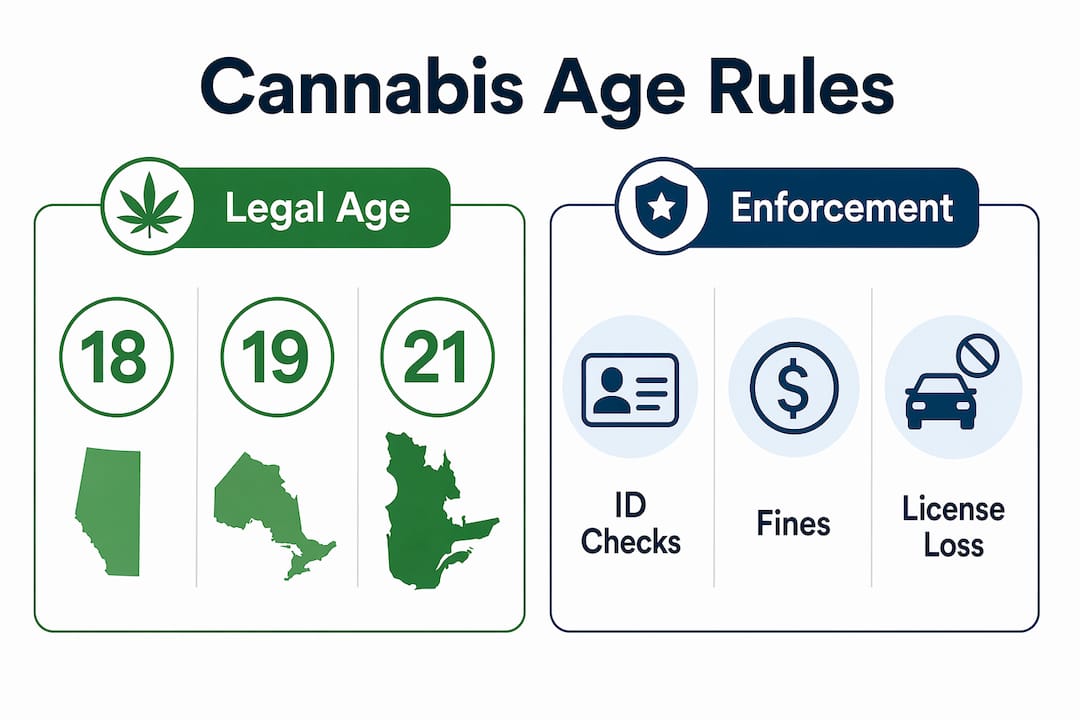
The variation is not arbitrary. Alberta aligned its cannabis age with its drinking age of 18. Most other provinces matched cannabis to their alcohol minimum of 19. Quebec’s decision to raise the age to 21 was a direct response to public health recommendations and concerns about youth consumption rates. Each choice reflects a different reading of the same underlying science.
| Province / Territory | Minimum age for cannabis |
|---|---|
| Alberta | 18 |
| British Columbia | 19 |
| Ontario | 19 |
| Manitoba | 19 |
| Saskatchewan | 19 |
| Nova Scotia | 19 |
| New Brunswick | 19 |
| Prince Edward Island | 19 |
| Newfoundland and Labrador | 19 |
| Yukon | 19 |
| Northwest Territories | 19 |
| Nunavut | 19 |
| Quebec | 21 |
In the United States, every state with a legal adult-use cannabis programme sets the minimum age at 21, aligning with federal alcohol law. Canada’s lower thresholds in most provinces reflect a different regulatory philosophy, one that treats cannabis more like tobacco than alcohol in terms of adult access.
Age verification at cannabis dispensaries goes well beyond a casual ID glance at the till. Dispensaries check valid government-issued ID at entry, not just at point of sale. Vertical-format IDs, which are issued to minors in many jurisdictions, are refused. Expired identification is not accepted under any circumstances.
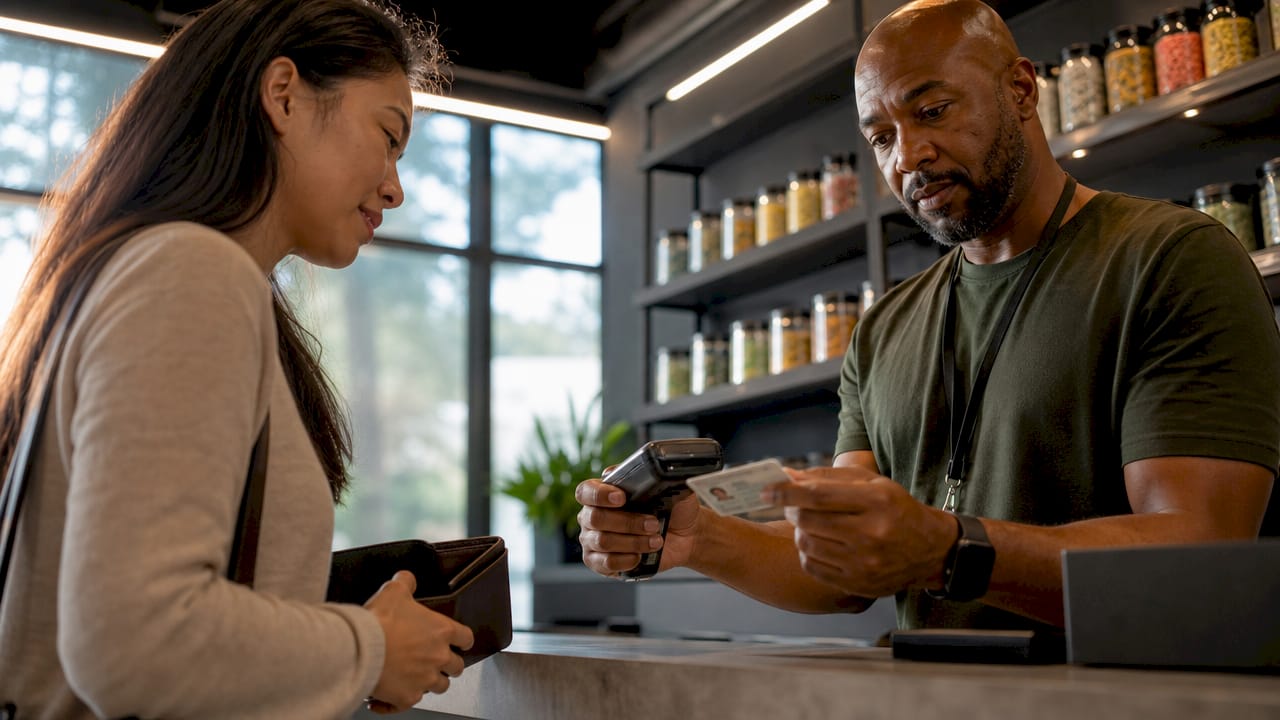
The consequences of non-compliance are serious. Dispensaries that fail to verify age correctly face fines exceeding $250,000 and licence revocation. Individual staff members can face personal liability. These penalties exist because regulators treat age verification as a core condition of the licence, not an optional courtesy.
Supplying cannabis to a minor carries criminal exposure. Providing cannabis to underage individuals is a punishable offence with fines and potential criminal charges. The law treats this similarly to supplying alcohol or tobacco to a minor, with strict liability applied to the provider regardless of claimed ignorance.
Pro Tip: Always carry a valid, non-expired government-issued photo ID when purchasing cannabis, whether in person or online. Vertical IDs issued before your 19th birthday will be refused even if you are now of legal age.
Age restrictions are the foundation of cannabis regulation, but they are not sufficient on their own. Experts consistently argue that transparent education, potency regulation, and child-resistant packaging are all required to meaningfully reduce youth harm. Removing access is step one. Reducing harm for everyone else requires more.
Cannabis regulations model public health policies similarly to alcohol and tobacco. Age limits are the most visible tool, but the full framework is considerably broader.
As a legal adult, cannabis age restrictions shape your purchasing experience in practical ways. Knowing what to expect makes the process straightforward.
Adults who supply cannabis to minors face the same criminal exposure as a licensed retailer who fails to check ID. The law does not distinguish between a store and an individual when it comes to providing cannabis to someone under the legal age.
Cannabis is age-restricted primarily to protect the developing brain, and the legal framework in Canada reflects that science through provincial age limits, strict retail enforcement, and broader public health measures.
| Point | Details |
|---|---|
| Brain development drives the policy | The human brain develops until age 25; THC disrupts this process and raises addiction risk significantly. |
| Provincial ages vary | Alberta sets the minimum at 18, most provinces at 19, and Quebec at 21. |
| Enforcement is strict | Dispensaries face fines over $250,000 and licence loss for failing to verify age at entry. |
| Age limits need support | Potency regulation, honest education, and child-resistant packaging all complement age restrictions. |
| Adults have clear responsibilities | Supplying cannabis to a minor carries criminal charges regardless of whether you are a retailer or an individual. |
The science behind cannabis age restrictions is solid, and I think most adults accept it once they understand it. What gets less attention is the tension between harm reduction and market reality. Potency caps sound sensible until you realise that pushing consumers toward unregulated products may cause more harm than the cap prevents. That is not a reason to abandon regulation. It is a reason to design it carefully.
What I find most telling is Quebec’s decision to raise the age to 21. That was a politically difficult move, and it was made because the data on youth consumption rates was compelling enough to override the access argument. Other provinces may follow. The science on brain development is not going anywhere, and as high-potency products become more common, the pressure to tighten age rules will grow.
For adults who are already of legal age, the practical takeaway is simple. Understand the rules in your province, carry your ID, and recognise that the framework around you exists for reasons that are grounded in evidence, not politics. Responsible consumption starts with knowing why the rules exist in the first place.
— Juiced
Knowing the rules is the first step. Knowing what to buy is the next one.

Greensociety is an online cannabis dispensary built for Canadian adults who want quality products, clear information, and fast delivery. Whether you are new to legal cannabis or a regular buyer looking to refine your choices, the cannabis flower buying guide on the Greensociety blog walks you through the full process, from strain selection to understanding potency labels. For adults who want to shop with confidence and stay on the right side of the rules, Greensociety offers a curated selection of flowers, edibles, concentrates, and more, all from verified sources with transparent product information.
Cannabis is age-restricted in Canada to protect the developing brain, which continues to mature until around age 25. Early cannabis use raises the risk of addiction, cognitive impairment, and mental health issues.
The legal age for cannabis is 18 in Alberta, 21 in Quebec, and 19 in all other provinces and territories.
No. Ontario’s minimum age for recreational cannabis is 19. An 18-year-old cannot legally purchase from a recreational dispensary, even if they hold a valid medical cannabis authorisation.
Dispensaries face fines exceeding $250,000 and can lose their operating licence. Individual staff members may also face personal liability and criminal charges.
Medical cannabis has separate regulatory requirements from recreational cannabis. Age thresholds and access rules differ by province, and medical patients under the recreational age minimum cannot access recreational dispensary menus.