Free Shipping
on orders over $150.00
$0.00
$150.00
Add $150.00 more for free shipping!


The idea that cannabis sparks creative genius is one of the most persistent beliefs in artistic culture. Writers, musicians, and visual artists have long credited cannabis with loosening their imagination and opening new channels of thought. But the science behind this belief is far more nuanced than the mythology suggests. Users often report feeling more creative under cannabis influence, yet objective creativity tests show no consistent improvement. This article explores what research actually tells us about cannabis and creative thinking, when it might genuinely help, and when it could quietly work against you.
| Point | Details |
|---|---|
| Subjective boost vs. actual skill | Cannabis often enhances the feeling of creativity even when it doesn’t improve creative performance. |
| Dose is crucial | Low to moderate THC may help idea generation, but high doses can hurt creative thinking. |
| Risks with chronic use | Frequent or long-term cannabis use can impair key cognitive skills needed for creativity. |
| Individual results vary | Your experience with cannabis and creativity may differ based on biology, tolerance, and creative style. |
| Mindful experimentation | Purposeful, informed use helps you explore potential creative benefits while minimizing downsides. |
To understand cannabis’s effect on creativity, you need to know what it actually does inside your head. THC, the main psychoactive compound in cannabis, binds to CB1 receptors throughout the brain. The prefrontal cortex, the region most responsible for planning, decision-making, and abstract thought, is especially rich in these receptors. THC interacts with the endocannabinoid system in the prefrontal cortex, affecting executive function, cognitive flexibility, and divergent thinking.
Divergent thinking is the ability to generate many different ideas from a single starting point. It is widely considered a core component of creative thought. Convergent thinking, by contrast, involves narrowing down options to find the single best solution. Cannabis tends to loosen associative thinking, which can feel like a creative surge, but this does not always translate into better actual output. Understanding the THC and CBD differences is also important here, since CBD does not produce the same psychoactive effects and interacts with creativity differently.
The effects of cannabis on cannabis’s artistic influence vary widely depending on your brain chemistry, your baseline level of creativity, and the type of task you are working on. Someone who naturally thinks in highly structured ways may experience a loosening effect that feels genuinely useful. Someone already prone to scattered thinking may find cannabis amplifies distraction rather than inspiration. Cannabis and cognitive health research confirms that individual variation is one of the most significant factors in predicting outcomes.
| Thinking type | Cannabis effect at low dose | Cannabis effect at high dose |
|---|---|---|
| Divergent thinking | Mild enhancement possible | Impaired |
| Convergent thinking | Minimal or no benefit | Impaired |
| Subjective creativity | Strongly increased | Strongly increased |
| Objective creative output | Inconsistent | Reduced |
“The gap between how creative cannabis makes you feel and how creative your work actually is may be the most important thing any artist needs to understand about this plant.”
Now that you understand how cannabis influences the creative centres of the brain, it is crucial to consider that effects are not one-size-fits-all. They depend heavily on how much and what kind of cannabis you use.
Low to moderate doses of THC may enhance divergent thinking, a key measure of creativity involving generating multiple ideas, while high doses impair it. This is what researchers call the inverted-U effect: performance improves up to a point, then declines sharply. Think of it like tuning a radio. A little adjustment brings the signal in clearly. Too much and you lose the station entirely.

Most people feel more creative when using cannabis regardless of actual creative output. This subjective boost can be motivating, but it can also mislead you into thinking your work is better than it is. High-potency cannabis has been shown to impair divergent thinking in regular users, which is worth keeping in mind if you favour stronger products.
Here is a practical three-step approach to finding your creative dose:
Microdosing is gaining attention as a way to access the potential benefits of cannabis without the cognitive fog that higher doses can bring. Exploring microdosing cannabis insights and the complete guide to microdosing can help you find a method that suits your creative rhythm. Many artists report that microdosing keeps them present and engaged without the distraction of a full high.
Pro Tip: Keep a simple creative journal. After each cannabis session, rate your subjective feeling of creativity out of ten, then rate the actual quality of what you produced. Over a few weeks, patterns will emerge that are far more useful than any general guideline.
| Dose level | Subjective creativity | Divergent thinking | Convergent thinking |
|---|---|---|---|
| Microdose | Slightly elevated | Mild boost | Largely unaffected |
| Low to moderate | Noticeably elevated | Moderate boost | Slight impairment |
| High | Strongly elevated | Impaired | Significantly impaired |
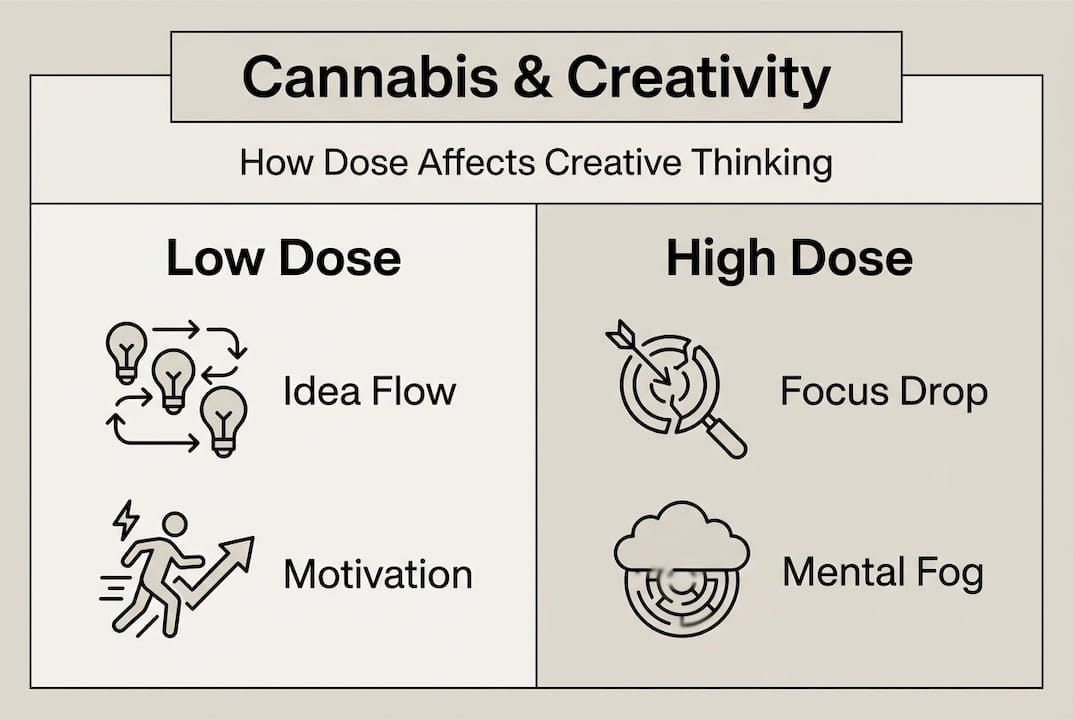
For more on how the creative process and marijuana interact across different creative disciplines, it is worth reading beyond the general research.
Having learned how dose and type can shape the creative experience, it is just as important to balance immediate inspiration with the long-term wellbeing of your creative mind.
Short-term cannabis use can genuinely help with idea generation. The loosening of associative thinking, the sense that unrelated concepts suddenly connect, can be a real asset during brainstorming. But execution is a different matter. Writing a first draft of ideas is not the same as refining them into something polished and coherent. Cannabis may help with the former and actively hinder the latter.
Chronic cannabis use is linked to impairments in attention, executive function, memory, and learning. These are not abstract concerns for a creative person. Memory and attention are the scaffolding on which sustained creative work is built. Losing access to them gradually, without noticing, is a real risk for heavy or frequent users.
The risks are higher for those who begin using cannabis at a young age or who use very frequently over long periods. Here are the key areas to watch:
Pro Tip: Reserve cannabis for the ideation phase of your creative process, not the execution phase. Brainstorm with it, then set it aside when it is time to refine, edit, or produce. Pairing cannabis use with mindfulness and cannabis practices can also help you stay grounded and intentional.
While we have discussed average effects, the real-world impact of cannabis on creativity can shift dramatically from one creative person to another.
Individual factors like tolerance, baseline creativity, and task type determine whether cannabis helps or hinders. It is not a universal enhancer. Research suggests that people with lower baseline creativity may experience more noticeable boosts, while those who are already highly creative may see little benefit or even a slight decline in output quality.
The type of creative work matters enormously. Here is a quick guide to when cannabis may help and when it may not:
People with certain psychiatric conditions, particularly those involving psychosis or a family history of schizophrenia, should approach cannabis with significant caution. The relationship between cannabis and these conditions is complex, and the effects on creative cognition in these cases can be unpredictable and potentially harmful. Consulting a healthcare professional before using cannabis for any purpose is always a sound approach.
Understanding the THC vs CBD guide can also help you make more informed choices about which products are likely to suit your creative goals and personal biology.
If you are ready to explore how cannabis might fit into your creative toolbox, a mindful, science-informed approach is your best bet.
Cannabis enhances perceived creativity more reliably than actual creative output. It is useful for idea generation in low doses but risks impairing execution and long-term cognition. Keeping this in mind, here is a practical framework:
Balancing cannabis with other creativity-support methods, such as mindfulness, regular exercise, and deliberately breaking your routine, gives you a richer toolkit. Exploring cannabis microdosing safety is a smart starting point for anyone who wants to experiment responsibly.
As you reflect on the science and strategies above, you may want to explore legal, high-quality products that align with your curiosity about cannabis and creativity. The research is clear that intentional, low-dose use is where the most promising creative benefits lie.

At GreenSociety.cc, we offer a curated range of products suited to creative exploration, from mild flowers to thoughtfully dosed edibles. Our cannabis and creativity guide is a great place to deepen your understanding, while our resources on microdosing benefits can help you find the approach that works for your creative rhythm. If you are curious about edibles as a gentler, longer-lasting option, our cannabis edibles for creativity section has practical ideas to get you started. Mindful experimentation, backed by quality products, is the foundation of a genuinely creative cannabis practice.
Cannabis typically boosts the feeling of creativity but does not consistently improve actual creative performance. The gap between perceived and real output is one of the most well-documented findings in this area.
Low to moderate doses of THC have the strongest evidence for supporting divergent thinking, while high doses tend to impair it. Microdosing is worth exploring as a starting point.
Yes. Chronic cannabis use is linked to impairments in attention, executive function, memory, and learning, all of which are essential for sustained creative work.
Cannabis may help some people generate new ideas during brainstorming, but it often hinders focused, detail-oriented tasks like editing, planning, or structured problem-solving.