Free Shipping
on orders over $150.00
$0.00
$150.00
Add $150.00 more for free shipping!


TL;DR:
- Cannabis serves as supportive therapy for cancer-related symptoms like nausea, sleep disturbances, and anxiety, but it does not cure cancer. Its effectiveness depends on product type and symptom, with the strongest evidence supporting use for refractory nausea and sleep improvement. Proper medical guidance, product selection, and honest communication with healthcare providers are essential for safe, effective cannabis use during cancer treatment.
Cannabis for cancer patients is a clinically recognised supportive therapy for managing treatment-related symptoms, not a cure for cancer. The two primary cannabinoids, THC (tetrahydrocannabinol) and CBD (cannabidiol), work on the body’s endocannabinoid system to reduce nausea, ease pain, and improve sleep quality during cancer treatment. According to the 2024 ASCO guidelines, evidence quality for cannabis as a primary cancer treatment remains low to very low, meaning no clinical trial has demonstrated tumour shrinkage or cancer cell death in humans. What the research does support is a meaningful role in supportive oncology, and a growing number of Canadian patients are exploring that role with their care teams.
Cannabis shows the clearest clinical benefit in a handful of specific symptom categories, and knowing which ones matters before you start. The BC Cancer 2026 multi-centre trial found that approximately 50% of cancer patients using medical cannabis oil extracts experienced meaningful symptom relief across sleep, anxiety, pain, nausea, breathlessness, and appetite. That is a meaningful proportion, though it also means roughly half of patients in the trial did not experience significant benefit, which is why managing expectations from the outset is so important.
Nausea and vomiting are the best-supported indications. Medical cannabis is recommended as a complementary therapy for chemotherapy-induced nausea and vomiting specifically when standard antiemetics such as ondansetron or metoclopramide have failed. This is not a first-line recommendation. It is a rescue option for refractory cases, and that distinction matters clinically.
Pain is more complicated. Systematic reviews show limited efficacy for cancer pain compared to opioids, with only moderate evidence quality. Cannabis may reduce the dose of opioids needed, which carries its own benefits, but it does not replace strong analgesics for severe cancer pain.
Sleep and anxiety are areas where patient-reported outcomes are consistently positive. Many patients describe cannabis as helping them fall asleep faster and reducing the anxious rumination that often accompanies a cancer diagnosis. These benefits are real, even if large randomised controlled trials are still catching up to the anecdotal evidence.
Appetite is frequently cited as a reason patients try cannabis, but the evidence here is weaker than most people expect. Cannabis has not been shown to reliably improve weight maintenance in cancer patients, despite the popular association between THC and increased appetite.
Pro Tip: Keep a daily symptom diary during any cannabis trial. Rate each symptom on a scale of 0 to 10 before and after each dose. BC Cancer specifically recommends this approach to objectively assess whether a product is working for you.
Not all cannabis products are the same, and the differences between them directly affect what you experience therapeutically. THC is psychoactive and primarily responsible for the “high” associated with cannabis, while CBD is non-psychoactive and may actually counteract some of THC’s more intense effects. Understanding this distinction helps you choose a starting point that fits your symptom profile and your tolerance for psychoactive effects.
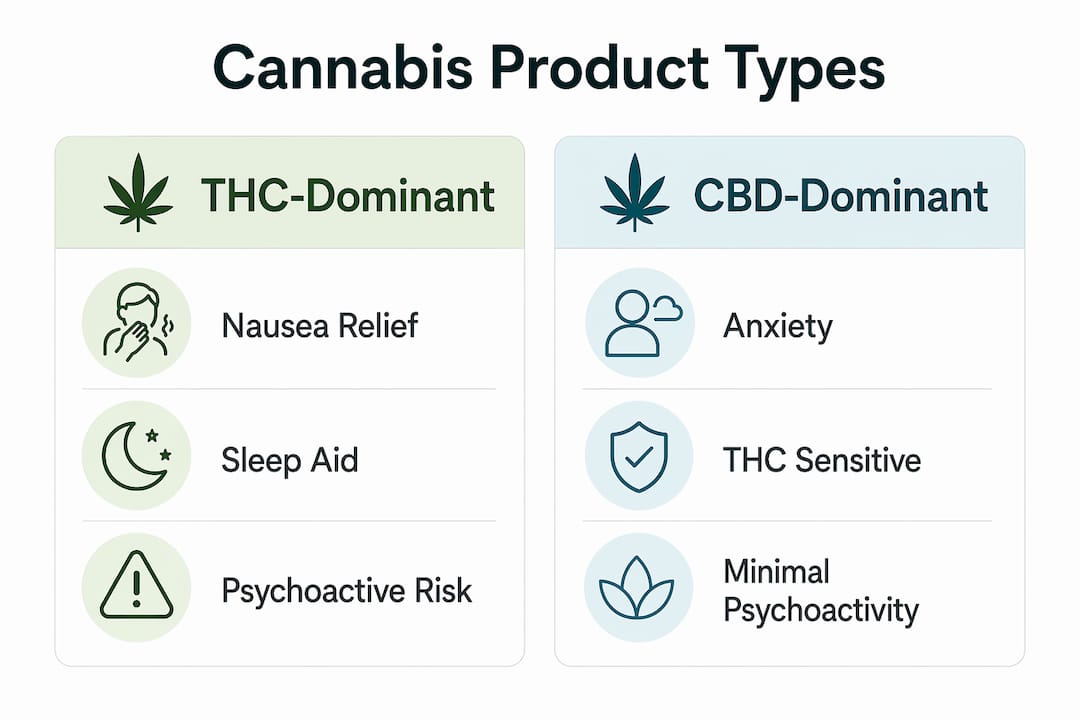
In Canadian clinical practice, three main product types are used for cancer symptom management.
THC-dominant oils are most effective for nausea and sleep but carry the highest risk of psychoactive side effects such as anxiety, disorientation, and sedation. They require careful dose titration, particularly for patients who have never used cannabis before.
CBD-dominant oils are preferred for patients with anxiety, those who are sensitive to THC, or anyone with a personal or family history of psychosis. CBD does not produce intoxication and is generally better tolerated, though it is less effective for nausea than THC.
Balanced 1:1 products combine equal ratios of THC and CBD. Many patients find these offer a middle ground, with meaningful symptom relief and fewer psychoactive effects than THC-dominant products alone.
Beyond oils, two pharmaceutical-grade options are available in Canada. Nabilone (sold as Cesamet) is a synthetic THC capsule approved specifically for chemotherapy-induced nausea. Nabiximols (sold as Sativex) is an oromucosal spray with a 1:1 THC:CBD ratio, approved for pain in certain conditions. Both have standardised dosing, which makes them easier to titrate than unlicensed cannabis oils.
| Product type | Cannabinoid ratio | Best for | Key consideration |
|---|---|---|---|
| THC-dominant oil | High THC, low CBD | Nausea, sleep | Higher psychoactive risk; start very low |
| CBD-dominant oil | High CBD, low THC | Anxiety, mild pain | Well tolerated; less effective for nausea |
| Balanced 1:1 oil | Equal THC and CBD | General symptom relief | Good starting point for most patients |
| Nabilone (Cesamet) | Synthetic THC | Refractory nausea | Standardised dose; prescription required |
| Nabiximols (Sativex) | 1:1 THC:CBD spray | Pain, spasticity | Consistent delivery; prescription required |
Pro Tip: When using an oil, measure your dose with a syringe rather than a dropper. Droppers are imprecise and can lead to accidental overdosing, especially with high-THC products. A 1 mL oral syringe gives you far more control.
Cannabis carries real risks during cancer care, and the fact that it is a plant does not make it inherently safe. Patients must approach cannabis with the same caution as any prescription medication, because the consequences of getting it wrong can be serious.
The most common side effects are manageable. Dry mouth, dizziness, and drowsiness are frequently reported but usually resolve with dose adjustments or by switching product types. These are nuisances rather than dangers for most patients.
The more serious risks include:
Long-term safety profiles for cannabis in oncology remain unclear because regulatory barriers have historically limited large-scale research. This is not a reason to avoid cannabis, but it is a reason to use it under medical supervision rather than independently.
Starting cannabis during cancer treatment requires a structured approach, not guesswork. The following steps reflect current clinical guidance from BC Cancer and Dana-Farber Cancer Institute.
You can find practical guidance on safe cannabis dosing to help you build a structured approach before your first conversation with your care team.
Cannabis is a legitimate supportive therapy for cancer-related symptoms, with the strongest evidence for refractory nausea, sleep disturbance, and anxiety, but it requires medical oversight, careful product selection, and honest communication with your entire care team.
| Point | Details |
|---|---|
| Supportive care only | Cannabis manages symptoms; no evidence supports it as a cancer treatment or cure. |
| Nausea is the strongest indication | Recommended when standard antiemetics fail, not as a first-line treatment. |
| Product type matters | THC, CBD, and 1:1 balanced products each suit different symptoms and risk profiles. |
| Drug interactions are real | Cannabis affects liver metabolism and can alter chemotherapy efficacy or toxicity. |
| Start low, go slow | Begin at 0.5 to 1 mg THC and track effects with a daily symptom diary. |
The patients who benefit most from cannabis during cancer treatment are almost never the ones who approach it as a miracle. They are the ones who treat it like any other medication: methodically, with clear goals, and in close communication with their care team. That discipline is harder than it sounds when you are exhausted, in pain, and looking for relief.
What I find genuinely underappreciated is how much product type matters. I have seen patients dismiss cannabis entirely after a bad experience with a high-THC product, when a CBD-dominant or balanced oil would likely have served them well. The reverse is also true. Patients who try CBD alone for refractory nausea and see no improvement sometimes conclude cannabis does not work for them, when the clinical evidence points clearly toward THC for that specific symptom.
The other thing worth saying plainly: the gap between what patients hope cannabis will do and what the evidence actually supports is still wide. The idea that cannabis can shrink tumours or reverse cancer progression is not supported by any human clinical trial data. Repeating that is not pessimism. It is respect for patients who deserve accurate information so they can make genuinely informed decisions about their care.
Research in this area is moving quickly. The BC Cancer 2026 trial represents the kind of rigorous, multi-centre work that will eventually give us clearer dosing protocols and better patient selection criteria. Until then, the honest answer to “should cancer patients use cannabis?” is: possibly, for specific symptoms, with medical guidance, and with realistic expectations.
— Juiced
If you are considering cannabis as part of your cancer symptom management, Greensociety offers a curated selection of products alongside practical educational resources to help you get started safely. Before purchasing anything, review the cannabis dosage guidelines on the Greensociety blog, which covers starting doses, titration strategies, and what to expect from different product types. For patients interested in edible formats as an alternative to oils, the edible recipes and tips guide explains how to use cannabis-infused foods for more predictable, longer-lasting symptom relief. Always consult your oncologist or nurse practitioner before beginning any cannabis product during active cancer treatment.
No. No clinical evidence supports cannabis as a cancer treatment. Its role is symptom management during cancer care, not tumour reduction or disease modification.
THC-dominant products, including pharmaceutical nabilone (Cesamet), show the strongest evidence for chemotherapy-induced nausea when standard antiemetics have failed. A physician’s guidance is required to access prescription options.
CBD is generally well tolerated, but it affects liver metabolism and can interact with certain chemotherapy drugs. Always disclose CBD use to your oncologist and pharmacist before starting.
BC Cancer recommends keeping a daily symptom diary and rating each symptom before and after each dose. If scores do not improve after a consistent trial period, a different product type or dose may be needed.
Yes, without exception. Cannabis can interact with immunotherapy and chemotherapy agents, and your oncologist needs a complete picture of everything you are taking to keep your treatment plan safe.