Free Shipping
on orders over $150.00
$0.00
$150.00
Add $150.00 more for free shipping!

TL;DR:
- Safe cannabis delivery involves strict age verification, secure packaging, GPS tracking, and restricted zones.
- The delivery process includes order placement, secure packaging, driver checks, ID verification, and undelivered product protocols.
- Human professionalism and buyer preparedness are key to trust and safety in cannabis delivery experiences.
Many adults ordering cannabis online share the same quiet worry: will my order actually arrive safely, legally, and without drama? It’s a fair concern. Legal cannabis delivery is still a relatively new system in Canada and many parts of the world, and not every platform follows the same standards. A well-structured delivery workflow removes the guesswork entirely. It covers everything from your first click to the moment the product lands in your hands. This guide walks you through every stage of that process so you know exactly what to expect, what to look for, and how to protect yourself as a buyer.
| Point | Details |
|---|---|
| Legal and safe workflow | A regulated process and verified drivers protect your safety and keep deliveries above board. |
| Stepwise instructions | Following a clear workflow ensures your cannabis order arrives securely and without legal risk. |
| Robust technology | GPS tracking, real-time order monitoring, and properly trained staff reduce mistakes and improve security. |
| Avoiding pitfalls | Recognizing common problems like address issues or restricted locations helps you prevent delays or missed orders. |
Safety in cannabis delivery isn’t just about locking a bag in a vehicle. It’s a layered system of legal requirements, operational protocols, and customer-facing standards that work together. When one piece is missing, the whole chain becomes unreliable.
At the foundation, a safe workflow requires strict age verification at two points: when the order is placed and again at the door. No exceptions. Beyond that, key safety requirements include GPS-tracked vehicles, secure lockboxes, commercial insurance, and trained drivers who are classified as employees rather than contractors. This distinction matters because employees are held to consistent standards and are covered under workplace safety rules.
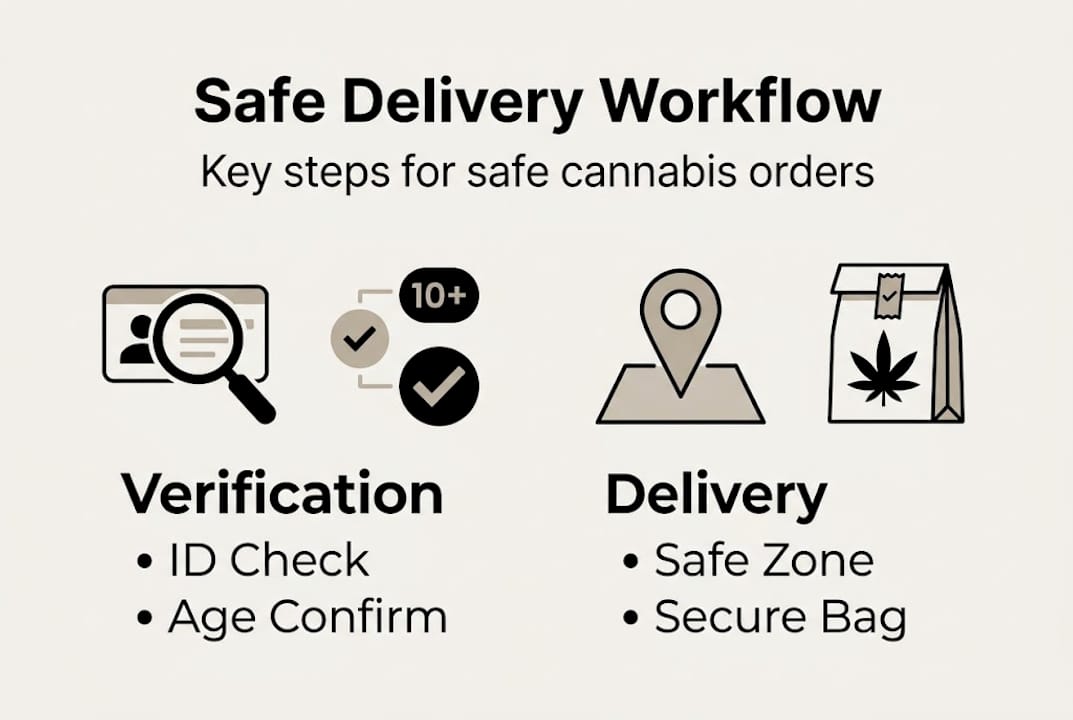
Packaging is another non-negotiable. Products must arrive in child-resistant, tamper-evident containers. In many regions, odour-proof materials are also required. This protects both the product and the people handling it along the way.
Delivery zones are tightly regulated too. Drivers cannot drop off orders near schools, parks designated for minors, or federal properties. These no-go zones are built into routing software so there’s no room for human error.
Here’s a quick overview of what a compliant delivery operation looks like:
| Safety element | Requirement |
|---|---|
| Age verification | At order placement and at the door |
| Vehicle equipment | GPS, lockbox, commercial insurance |
| Driver status | Employee, not contractor |
| Packaging | Child-resistant, tamper-evident, odour-proof |
| Restricted zones | Schools, federal property, parks for minors |
| Payment | Cash or approved digital methods |
The business case for getting this right is strong. Delivery boosts same-day sales by 50% for 55% of urban dispensaries. That kind of growth only holds if customers trust the process.
For buyers, reviewing cannabis delivery safety tips before placing your first order gives you a solid baseline. Understanding what legal cannabis delivery in Canada actually requires also helps you spot platforms that cut corners.
Now that you know what to look for, here’s the exact process trusted dispensaries follow. Each step has a clear purpose and a safety checkpoint built in.
Place your order. You visit a licensed platform, select your products, and confirm your age through the platform’s verification system. Payment options are presented upfront. Cash is common, but some platforms now offer contactless or digital options.
Dispensary prepares your order. Staff verify the order details, prepare a delivery manifest (a legal document listing every product), and package everything securely. Nothing leaves the facility without that manifest.
Driver checks out the vehicle. Before hitting the road, the licensed driver confirms the vehicle’s GPS is active, the lockbox is secure, and the route is loaded. Drivers follow direct routes with no unnecessary stops, which reduces exposure and keeps delivery times predictable.
Delivery and ID verification. At your door, the driver verifies your ID and confirms your age again before handing anything over. Adult signature is required. No product is ever left unattended on a doorstep.
Failed delivery protocol. If you’re not home or can’t provide valid ID, the product goes back to the dispensary. It’s logged and held until a new delivery can be arranged.
Pro Tip: Read the platform’s cannabis delivery explained guide before ordering so you know exactly what ID to have ready and what payment to prepare.
Here’s how the Canadian and US models compare on a few key points:
| Delivery element | Canada | United States |
|---|---|---|
| Regulatory body | Provincial authorities | State-by-state licensing |
| Age at door | 19+ (most provinces) | 21+ |
| Payment norms | Cash or e-transfer | Cash-heavy, limited digital |
| Driver classification | Employee | Employee (varies by state) |
Understanding the cannabis shipping process in Canada is especially useful if you’re ordering across provincial lines or from a new platform. Following compliance best practices protects both you and the service.
While the workflow is straightforward, technology and staff training make all the difference in outcome. A well-trained driver using smart routing software is far less likely to make a mistake than someone winging it with a paper map.

GPS tracking is standard in compliant operations. Dispatchers can monitor every vehicle in real time, which means faster response if something goes wrong. Route optimisation software reduces delivery windows and keeps drivers away from known problem areas.
Driver training programmes cover more than just navigation. Reputable services require training in:
One important structural choice that separates professional operations from risky ones is the hub-and-spoke model. The ‘pizza delivery’ model where drivers return to a hub between runs is far safer and more compliant than a roving truck approach. It keeps inventory controlled, reduces driver exposure, and makes auditing much easier.
“Avoid cash transactions when possible to reduce robbery risk.” This is a real operational concern, and the best platforms are actively building out digital payment options to address it.
Pro Tip: When choosing a platform, look for real-time order tracking. It gives you a live delivery window and confirms the driver is on a direct route. Platforms offering this feature take discreet cannabis delivery seriously.
For safe delivery practices that go beyond the basics, look for services that publish their driver training standards. Transparency here is a good signal. You can also review delivery business training requirements to understand what professional operations are expected to meet.
No system is perfect, so it pays to know what can go wrong and how to keep your order safe. Most delivery hiccups are preventable with a bit of preparation on your end.
The most common issue is a failed delivery due to an incorrect address or an absent recipient. In both cases, the product is never left behind. Wrong address or no recipient means the product is returned to the store, logged, and held. You’ll need to reschedule. It’s inconvenient, but it’s the law.
Here are the edge cases worth knowing:
“Driver safety protocols require direct routing, no unnecessary stops, and immediate return of undeliverable product.” Knowing this helps you plan your availability around the delivery window.
Pro Tip: Before your delivery arrives, confirm your address is correct in your account, have your ID ready, and know your payment amount. Reviewing common delivery mistakes takes two minutes and prevents most problems. The safe delivery guide covers the full list of what to prepare. For a deeper look at how driver safety protocols work, the operational standards are worth a read.
Stepping back from the technical details, here’s what matters most in the real world. Most conversations about cannabis delivery safety focus on regulations, GPS systems, and packaging standards. Those things matter. But they’re not what actually determines whether a buyer has a good experience.
The real differentiator is human follow-through. A driver who greets you professionally, hands over your order cleanly, and gives you a moment to confirm everything is right is doing more for safety than any piece of software. Compliance creates the floor. Behaviour determines the ceiling.
Buyers also overlook their own role. Being home on time, having your ID ready, and knowing your payment amount are small things that keep the workflow running smoothly. Feedback matters too. If something feels off, saying so helps platforms improve.
Legal cannabis delivery is ultimately about building trust through repeatable excellence. It’s not a one-time checklist. The role of cannabis delivery in Canada is growing fast, and the platforms that will lead are the ones treating every handoff as a relationship, not a transaction.
Now that you know what makes a delivery workflow safe, here’s where to go for more guidance, tips, and product recommendations. Green Society brings together curated educational content and a trusted product catalogue so you can shop with confidence.

Whether you’re checking the cannabis flower checklist before your first order or browsing the cannabis accessories guide to round out your setup, you’ll find practical, honest information at every step. Green Society is built for buyers who want quality, transparency, and delivery they can count on. Explore the full range of products and resources today.
Always confirm the platform is licensed and age-verified before placing your order, and check that packaging is described as secure and discreet.
The product is never left at your door. By law, undelivered items must be returned to the store and logged until a new delivery time is arranged.
Yes. Driver training covers defensive driving, conflict resolution, and emergency protocols to keep every order secure from dispatch to handoff.
Yes. Legal deliveries use child-resistant, tamper-evident packaging that is often odour-proof, protecting both your privacy and the product’s integrity.
Not always. Many services accept cash, but some now offer digital or contactless options. Payment norms vary by service, so confirm before your order is dispatched.