Free Shipping
on orders over $150.00
$0.00
$150.00
Add $150.00 more for free shipping!

TL;DR:
- The traditional sativa and indica labels describe plant appearance, not effects. Effects depend mainly on cannabinoid and terpene profiles, especially the entourage effect.
The distinction between sativa and indica cannabis strains originates from plant appearance and geography, not from their effects on the body or mind. Botanists first used these terms to describe two different plant shapes, not two different highs. Yet the sativa vs indica differences remain the most common framework consumers use when choosing cannabis. The problem is that science has largely moved past these labels. Cannabinoid and terpene profiles are far better predictors of what you will actually feel. This article explains what the labels mean, where they fall short, and how to use chemistry instead of folklore to pick the right strain.
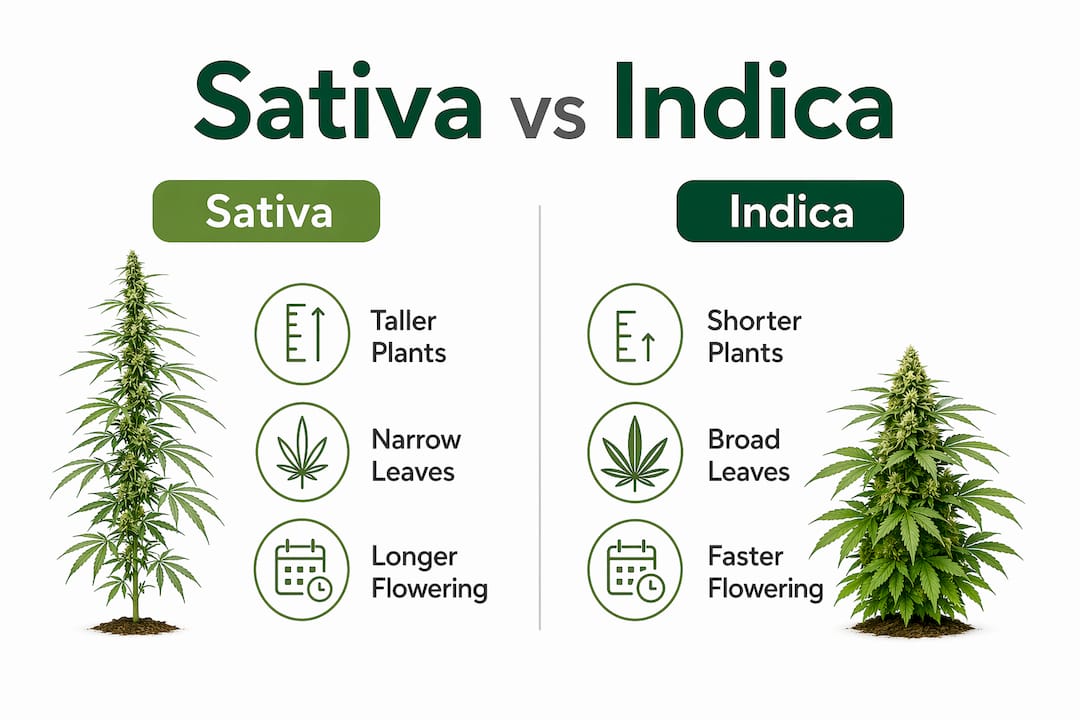
Sativa and indica are botanical classifications, not effect categories. Sativa plants grow tall, sometimes exceeding two metres, with narrow, finger-like leaves and longer flowering cycles. They originated in equatorial climates like Colombia, Thailand, and Mexico, where long growing seasons favoured height and light-seeking growth. Indica plants are shorter and bushier, with broad, dark-green leaves and faster flowering times. They adapted to harsher, high-altitude climates in regions like Afghanistan and the Hindu Kush.

These physical traits matter enormously to cultivators planning grow space and harvest timelines. For consumers, they tell you almost nothing useful. The morphology describes how the plant looks, not how it makes you feel.
The bigger issue is genetic mixing. 85.7% of commercial strains are hybrids, with pure indica and sativa accounting for less than 14% combined. That means the vast majority of what you buy at any dispensary carries mixed genetics from decades of crossbreeding. Calling a strain “sativa” or “indica” at that point is more marketing shorthand than botanical fact.
| Trait | Sativa | Indica |
|---|---|---|
| Plant height | Tall (1.5–3 metres) | Short to medium (0.6–1.5 metres) |
| Leaf shape | Narrow, elongated | Broad, wide |
| Flowering time | Longer (10–16 weeks) | Shorter (6–9 weeks) |
| Origin | Equatorial climates | High-altitude, harsher climates |
| Effect prediction | Unreliable | Unreliable |
The physical differences are real. The effect predictions attached to them are not.
The traditional story goes like this: sativa energises, indica relaxes. Sativa is for daytime creativity, indica is for couch-lock nights. This framework is intuitive, which is exactly why it persists. It is not, however, accurate.
Dr. Ethan Russo, one of the most respected researchers in cannabis pharmacology, calls the indica/sativa distinction “total nonsense” for predicting effects. He argues that morphology describes appearance only and has no reliable connection to biochemical or subjective outcomes. The science backs him up. An analysis of nearly 90,000 cannabis samples found that indica and sativa labels do not reliably predict terpene profiles or effects. Terpene profiles overlap widely regardless of how a strain is labelled.
Potency data tells the same story. THC averages 19–22% across indica, sativa, and hybrid strains, with no meaningful difference between categories. The label on the jar does not tell you how strong the experience will be.
What actually drives the difference between indica and sativa high experiences is the terpene profile. Terpenes are aromatic compounds that interact with cannabinoids to shape the effect, a process known as the entourage effect. Here is how the key terpenes break down:
| Terpene | Aroma | Associated effect |
|---|---|---|
| Myrcene | Earthy, musky | Relaxation, sedation |
| Limonene | Citrus | Mood lift, alertness |
| Pinene | Pine | Focus, mental clarity |
| Linalool | Floral, lavender | Calm, anxiety reduction |
| Caryophyllene | Spicy, peppery | Stress relief, anti-inflammatory |
A sativa-labelled strain with high myrcene content can induce sedation despite its typical energising associations. That single fact dismantles the entire sativa-equals-energy narrative. The terpene profile is what you need to read, not the category label.
Pro Tip: Ask your dispensary for the terpene breakdown on any strain you are considering. If a product only lists THC percentage and a sativa/indica label, you are missing the information that actually matters.
Chemovar is the term the scientific community uses to classify cannabis by chemical composition rather than plant shape. Modern cannabis labelling should focus on chemovar classification, which groups strains into three types based on cannabinoid ratios.
This framework is more useful than indica or sativa because it tells you what the plant actually contains. A Type II strain with linalool and caryophyllene will behave very differently from a Type I strain with limonene and pinene, even if both are labelled “hybrid.” Terpenes like myrcene, limonene, pinene, linalool, and caryophyllene are better predictors of relaxation, sedation, uplift, or alertness than any botanical label.
Reading a cannabis label with chemovars in mind takes practice. Here is what to look for:
Pro Tip: When browsing online, filter by dominant terpene rather than sativa or indica. A limonene-forward strain will likely feel more uplifting than a myrcene-forward one, regardless of its botanical category.
Greensociety’s flower selection guide walks through exactly how to read these labels when shopping online.
Almost all commercial cannabis is hybridised. Pure landrace strains are rare, and the indica-dominant, sativa-dominant, and balanced hybrid labels you see in dispensaries are rough guides at best. Here is a practical framework for making better choices.
Define your goal first. Are you looking to wind down after work, stay focused during a creative project, or manage physical discomfort? Your goal determines the terpene and cannabinoid profile you want, not the other way around.
Start with a Type II chemovar if you are new or sensitive. Balanced THC:CBD products and terpene profiles rich in linalool and beta-caryophyllene reduce anxiety risk better than relying on indica or sativa labels alone. CBD moderates the psychoactive intensity of THC in a measurable way.
Follow the “start low, go slow” rule. Experts recommend starting with 2.5mg THC combined with 5–10mg CBD and adjusting based on your individual reaction rather than the strain name. This applies to both new and returning consumers who are trying an unfamiliar product.
Track your reactions. Keep a simple note on your phone after each session. Record the strain name, dominant terpenes, THC/CBD percentages, dose, and how you felt. Patterns emerge quickly, and you will build a personal profile that no label system can replicate.
Ignore the myths. Sativa does not always energise. Indica does not always sedate. Personal biology and dose are the final arbiters of cannabis effects, overriding strain labels and genetics entirely. Two people consuming the same strain at the same dose can have meaningfully different experiences.
For consumers managing anxiety specifically, the evidence-based guidance on Greensociety covers which cannabinoid and terpene combinations carry the lowest risk of worsening symptoms.
The sativa vs indica framework describes plant morphology, not effects. Cannabinoid and terpene profiles are the only reliable guide to what a strain will actually do.
| Point | Details |
|---|---|
| Labels describe plants, not effects | Sativa and indica classify plant shape and origin, not the high you will experience. |
| Most strains are hybrids | 85.7% of commercial cannabis carries mixed genetics, making pure category labels largely meaningless. |
| Terpenes drive the experience | Myrcene, limonene, linalool, and caryophyllene shape effects more reliably than any botanical label. |
| Chemovars offer a better system | Type I, II, and III classifications group strains by cannabinoid ratio, giving you actionable purchasing information. |
| Start low, track your reactions | Begin with 2.5mg THC and note your response. Personal biology overrides every label on the market. |
I have watched the cannabis conversation in Canada evolve considerably since legalisation, and one pattern stands out. Consumers walk into a dispensary, ask for “a sativa for daytime” or “an indica for sleep,” and walk out with a product that may or may not deliver what they expected. When it does not work, they blame the strain. The real problem is the framework.
The indica/sativa split remains popular because it is intuitive shorthand, not because it reliably predicts effects. It gives people a vocabulary to use, which feels useful even when the underlying logic is shaky. I understand why it persists. But leaning on it exclusively means you are making purchasing decisions based on plant shape rather than chemistry.
What I have found actually works is treating cannabis selection like you would treat any other health-adjacent purchase. Read the label carefully. Look for the terpene breakdown. Understand whether you are buying a Type I, II, or III product. And accept that your first few sessions with any new strain are data collection, not guaranteed outcomes. Cultivation environment, including soil, light, temperature, and humidity, significantly influences chemical composition and resulting effects, sometimes more than genetic lineage. Two batches of the same strain from different grows can behave differently. That variability is not a flaw in the system. It is just how cannabis works, and the sooner you build your own reference points, the better your choices will get.
The good news is that Canadian labelling is improving. More producers are including terpene data and COAs on packaging. Use that information. It is the most honest thing on the label.
— Juiced
Choosing cannabis by chemistry rather than category takes a bit of practice, but the right resources make it straightforward.

Greensociety has built a detailed cannabis flower buying workflow that walks you through selecting strains based on cannabinoid ratios, terpene profiles, and personal goals rather than outdated botanical labels. The guide covers how to read a COA, what to look for in a product description, and how to match chemical profiles to specific outcomes. Whether you are buying for the first time or refining a routine that is not quite working, the workflow gives you a structured, science-grounded approach to every purchase. Greensociety also offers dosage guidelines to help you calibrate your starting point safely.
Sativa and indica describe plant morphology, including height, leaf shape, and origin climate. They do not reliably predict the effects a consumer will experience, which depend on cannabinoid and terpene profiles instead.
No. This is the most common cannabis myth. A sativa-labelled strain high in myrcene can produce sedation, while an indica-labelled strain high in limonene may feel uplifting. Terpene content determines the effect, not the botanical category.
A chemovar classifies cannabis by its chemical composition: Type I (THC-dominant), Type II (balanced THC/CBD), and Type III (CBD-dominant). This system is more useful than indica/sativa labels because it tells you what the plant actually contains.
No. 85.7% of commercial strains are hybrids with mixed genetics. Pure landrace indica and sativa strains together account for less than 14% of the market.
Define your goal, look for the terpene breakdown and cannabinoid ratio on the label, and start with a low dose of 2.5mg THC. Track your reactions across a few sessions to build a personal reference point that no category label can provide.