Free Shipping
on orders over $150.00
$0.00
$150.00
Add $150.00 more for free shipping!

TL;DR:
- Dose is the most critical factor in cannabis use, determining therapeutic, recreational, or adverse effects. Small changes in THC dose can shift effects from stress relief to anxiety, especially considering route and product composition. Following “start low, go slow” principles and monitoring personal responses enhances safety and efficacy.
Dosage is the single most important variable in cannabis use, determining whether you experience therapeutic relief, recreational enjoyment, or unwanted adverse effects. The role of dosage in cannabis use is not a minor detail. It is the difference between a 7.5 mg oral THC dose that reduces stress and a 12.5 mg dose that triggers anxiety, according to placebo-controlled research. Cannabis products today range from low-potency CBD tinctures to high-concentration extracts exceeding 80% THC, and that variability makes understanding dose more critical than ever. The Society of Cannabis Clinicians, the FDA’s dronabinol prescribing framework, and the National Institute on Drug Abuse all ground their guidance in one shared principle: dose governs outcome.
THC does not follow a simple “more is better” rule. Its dose-response is biphasic, meaning effects shift direction as dose increases rather than simply intensifying. A placebo-controlled study found that 7.5 mg oral THC reliably reduces stress, while just 12.5 mg of the same compound increases anxiety in the same subjects. That roughly 5 mg difference separating calm from distress is one of the most striking findings in cannabis pharmacology. It means the margin between a pleasant experience and an uncomfortable one is genuinely narrow.
The implications extend beyond mood. At higher doses, THC produces dose-dependent psychiatric effects including paranoia, cognitive impairment, and elevated heart rate. High-potency cannabis above 15 to 20% THC increases cannabis use disorder risk in a dose-dependent manner, meaning the relationship between potency and harm is not theoretical. It is measurable and consistent across studies.
“THC dose-response is not linear; small dose changes can shift effects drastically, highlighting the need for measured dosing.” — Therapeutically motivated cannabis use for anxiety
Anxiety, stress relief, and mood changes are all dose-sensitive outcomes. Cannabis containing CBD is associated with more consistent anxiety reduction over time compared to THC-dominant products, which means cannabinoid composition is inseparable from dosage when predicting effects. You cannot evaluate a dose without knowing what is in it.
Pro Tip: If you notice your heart rate rising, feel suddenly anxious, or lose track of your thoughts after consuming cannabis, these are reliable signals that your dose exceeded your personal threshold. Stop, sit down, drink water, and do not take more.

The answer is yes, and the mechanism matters. Two products with identical THC milligrams can produce very different effects depending on potency concentration, cannabinoid composition, and how you consume them. Understanding these factors is what separates informed dosing from guesswork.
THC and CBD act on the endocannabinoid system through different pathways. THC produces psychoactive effects and carries dose-dependent psychiatric risk. CBD is non-intoxicating and modulates THC’s effects, often reducing anxiety at combined doses. The difference between THC and CBD is not just chemical. It directly changes how much of a product you need and what you should expect. A CBD-dominant product at 20 mg carries a fundamentally different risk profile than a THC-dominant product at the same milligram count.
| Route | Onset time | Duration | Key dosing consideration |
|---|---|---|---|
| Inhalation (flower, vape) | 2 to 10 minutes | 1 to 3 hours | Effects arrive quickly, making real-time adjustment easier |
| Oral (edibles, capsules) | 30 to 120 minutes | 4 to 8 hours | Delayed onset creates high risk of stacking doses too soon |
| Sublingual (tinctures) | 15 to 45 minutes | 2 to 4 hours | Faster than edibles, more predictable than inhalation |
| Topical | Minimal systemic effect | Localised | Not relevant for psychoactive dosing |
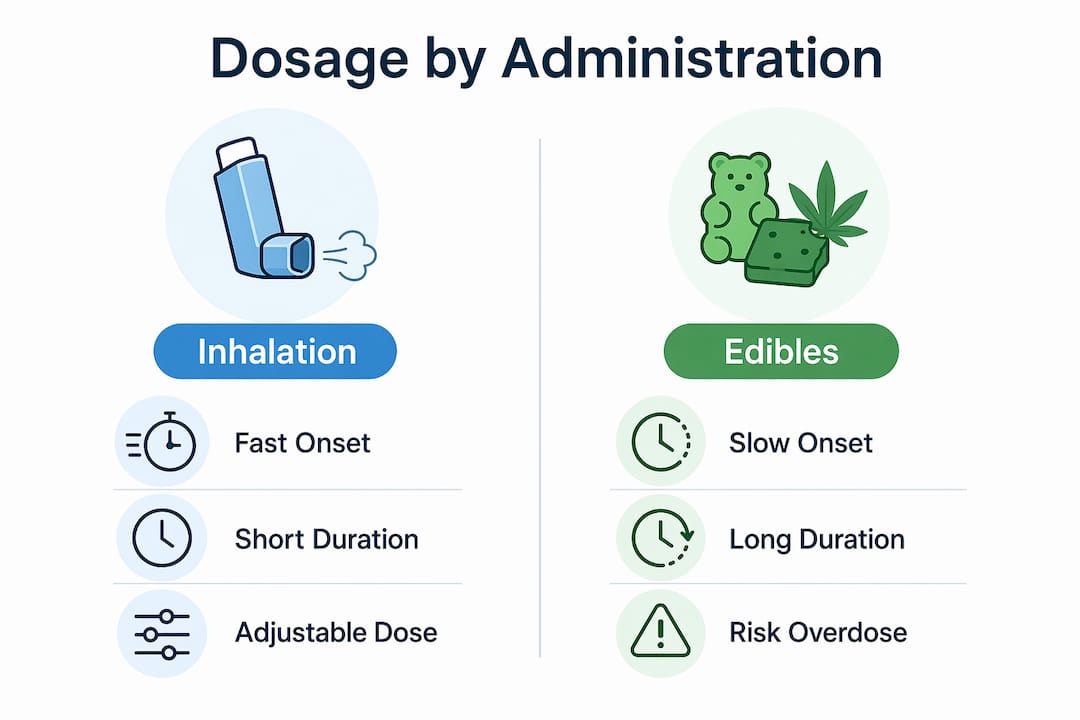
Edibles have a delayed onset and prolonged duration that significantly increases the risk of overconsumption. The most common edibles mistake is consuming a second dose before the first has taken effect, which leads to an overshoot that can last hours. Pharmacokinetics dictate that you must wait the full onset window before concluding a dose was insufficient.
Potency labels show THC concentration as a percentage, but effective dose depends on product form and route. Misjudging this relationship leads to tolerance misinterpretation and unintended dose escalation. A 25% THC flower and a 25 mg THC edible are not equivalent experiences, even though the numbers look similar.
Pro Tip: With edibles, always wait at least 90 minutes before considering a second dose. The common edibles mistakes that send people to urgent care almost always involve impatience with onset time.
The most clinically validated approach to cannabis dosing is “start low, go slow.” This is not a casual suggestion. It is the framework used by the Society of Cannabis Clinicians, the FDA’s dronabinol prescribing protocol, and medical cannabis programmes across Canada.
Here is a practical step-by-step framework for approaching cannabis dosage safely:
The Greensociety cannabis dosage step-by-step guide expands on each of these steps with product-specific examples. For a condensed reference, the dosage checklist covers the seven most critical safety steps in a single page.
The goals are different, and that changes everything about how dosage should be approached.
Medical cannabis users prioritise symptom relief with minimal psychoactivity. A patient managing chronic pain or anxiety is typically seeking a consistent, repeatable effect at the lowest effective dose. Medical frameworks, including the Society of Cannabis Clinicians’ guidelines, emphasise CBD-rich formulations, cautious THC titration, and clear documentation of outcomes. The medical cannabis dosing approach treats dosage as a clinical variable to be optimised, not a preference to be indulged.
Recreational users face a different risk profile. Tolerance varies widely, social settings can encourage faster consumption, and high-potency products are often selected for intensity rather than precision. The data on this distinction is clear.
| User type | Primary dosing goal | Key risk factor | Recommended approach |
|---|---|---|---|
| Medical | Symptom relief, low intoxication | Tolerance build-up, adverse psychiatric effects | Slow titration, CBD pairing, clinical oversight |
| Recreational | Desired psychoactive effect | Overconsumption, high-potency products | Low starting dose, route awareness, session limits |
| Multimodal (both) | Variable | Highest cannabis use disorder risk | Strict dose tracking, route consolidation |
Multimodal cannabis users have over fourfold higher odds of cannabis use disorder compared to oral or mucosal-only users. This finding reframes the dosage conversation entirely. It is not just about milligrams. It is about how many routes you use, how frequently, and whether you are tracking cumulative exposure across a session or a day.
Recreational users who adopt medical-style titration principles, starting low, waiting for full onset, and avoiding dose stacking, consistently report better experiences and fewer adverse events. The discipline of medical dosing is not exclusive to patients.
Dosage in cannabis use is the primary determinant of whether effects are therapeutic or harmful, making measured, informed consumption the foundation of any safe cannabis experience.
| Point | Details |
|---|---|
| Biphasic THC response | A 5 mg difference in oral THC dose can shift effects from stress relief to anxiety. |
| Route changes the dose | Edibles require 90 to 120 minutes before redosing; inhalation allows faster real-time adjustment. |
| Start low, go slow | Clinical frameworks recommend beginning at 2.5 to 5 mg THC and titrating over days, not hours. |
| Daily THC limit matters | Keeping total daily THC at or below 30 mg reduces the risk of adverse psychiatric effects. |
| Multimodal use multiplies risk | Using multiple consumption routes significantly increases cannabis use disorder risk beyond milligrams alone. |
Most dosing mistakes are not about ignorance. They are about impatience. People read that a product is “low potency” and assume that means they can take more of it. They eat an edible, feel nothing after 45 minutes, and take a second. They switch from flower to concentrates without adjusting their expectations. Every one of these mistakes is predictable, and every one of them is avoidable.
The insight that changed how I think about this topic is that potency percentage and effective dose are not the same thing. A 30% THC concentrate consumed through a dab rig delivers a fundamentally different exposure than a 30% THC flower smoked in a joint. The route, the combustion efficiency, and the speed of consumption all change what your body actually receives. Treating the label as the whole story is where people consistently go wrong.
For medical users, I cannot stress enough the value of working with a healthcare provider who understands cannabis pharmacology. The titration process is genuinely slow by design. Two weeks of gradual adjustment feels tedious when you are managing pain or anxiety, but it is the only way to find your actual therapeutic window without overshooting it. Patience in titration is not passive. It is the most active thing you can do to protect your outcome.
The broader point is this: cannabis is not uniquely dangerous, but it is uniquely variable. Respecting that variability, through dose awareness, route selection, and honest self-monitoring, is what separates a positive experience from a regrettable one. Informed consumption is not a restriction. It is what makes the experience worth having.
— Juiced
Greensociety brings together product selection and practical education in one place, so you can make confident dosing decisions before you buy.
Whether you are selecting cannabis flower online based on THC and CBD profiles, or exploring edibles and their benefits for controlled, longer-lasting effects, Greensociety’s product pages include potency information and usage guidance to support your choices. The blog covers everything from strain selection to edible recipes and dosing tips for home preparation. If you are new to cannabis or adjusting your approach, the cannabis dosing guide is the clearest starting point on the site.
The safest starting dose for THC is 2.5 to 5 mg orally, or one to two inhalations from a low-potency product. Clinical frameworks including dronabinol prescribing protocols begin at 2.1 mg twice daily and titrate upward only as needed.
Edibles are metabolised through the liver, converting THC into a more potent compound with a longer duration. Their delayed onset of 30 to 120 minutes also leads users to redose too soon, resulting in a combined effect that far exceeds the intended dose.
CBD modulates THC’s psychoactive effects and is associated with more consistent anxiety reduction over time compared to THC-dominant products. Pairing CBD with THC can allow lower effective THC doses while maintaining therapeutic benefit.
The Society of Cannabis Clinicians recommends keeping total daily THC dose-equivalent at or below 30 mg per day. Exceeding this threshold increases the risk of adverse psychiatric effects and tolerance development.
Multimodal cannabis users have over fourfold higher odds of cannabis use disorder compared to those who use only oral or mucosal routes. Combining inhalation with edibles or other routes significantly increases cumulative THC exposure and disorder risk.