Free Shipping
on orders over $150.00
$40.00
$150.00
Add $110.00 more for free shipping!
-
×
 Green Society Herb Grinder
$40.00
Green Society Herb Grinder
$40.00


TL;DR:
- Legal cannabis legalization reduces opioid overdoses, violence, and arrests, but long-term reforms are necessary for justice.
- The benefits take years to materialize, requiring policies like expungement, equitable licensing, and enforcement accountability to address systemic disparities.
Cannabis legalization is the process of regulating cannabis use, sale, and possession under a formal legal framework, and it fundamentally reshapes public health outcomes, criminal justice systems, and economic structures. Why cannabis legalization matters is no longer a philosophical debate. Research from institutions including Johns Hopkins University and publications like JAMA Network Open now provides hard data on opioid overdose reductions, arrest rate changes, and market displacement effects. The evidence points in one direction: thoughtful legalisation delivers measurable benefits across multiple domains, though it also surfaces challenges that require ongoing policy attention.
Cannabis legalisation produces some of its most compelling results in public health, particularly in reducing opioid-related harm. Medical legalisation is linked to a 15.47% decrease in non-fatal opioid overdoses, while recreational legalisation correlates with an 11.92% reduction. That gap matters: it suggests medical frameworks, which connect patients directly to healthcare providers, may be more effective at substituting opioids with cannabis for pain management.

Fatal overdose data reinforces the case. Recreational legalisation is associated with approximately 3.5 fewer opioid deaths per 100,000 people annually. Across a province or state with millions of residents, that figure represents thousands of lives over a decade. Cannabis serves as a versatile alternative for chronic pain management, reducing the need for opioid prescriptions that carry a far higher overdose risk.
The therapeutic applications extend beyond pain. Cannabis is widely used to manage chemotherapy-induced nausea, appetite loss in HIV/AIDS patients, and certain forms of treatment-resistant epilepsy. These are not fringe applications. They are documented clinical uses that legalisation makes accessible to patients who previously had no safe, legal option.
One concern that often surfaces in public debate is youth cannabis use. The data here is reassuring. National youth cannabis prevalence has remained stable or declined following legalisation in most jurisdictions. Legalisation does not appear to increase teen uptake, likely because regulated markets include age verification requirements that illicit dealers do not enforce.
Pro Tip: If you are evaluating cannabis as an alternative to opioid pain management, consult a physician familiar with cannabis therapeutics. Dosing and delivery method matter significantly for both safety and effectiveness.
The criminal justice impact of legalisation is substantial and well-documented. Post-legalisation arrest data shows possession arrests fell by 62% for white individuals and 51% for Black individuals. Sales-related arrests dropped by 44% and 49% respectively. These are not marginal shifts. They represent tens of thousands of people each year who are no longer entering the criminal justice system over cannabis.
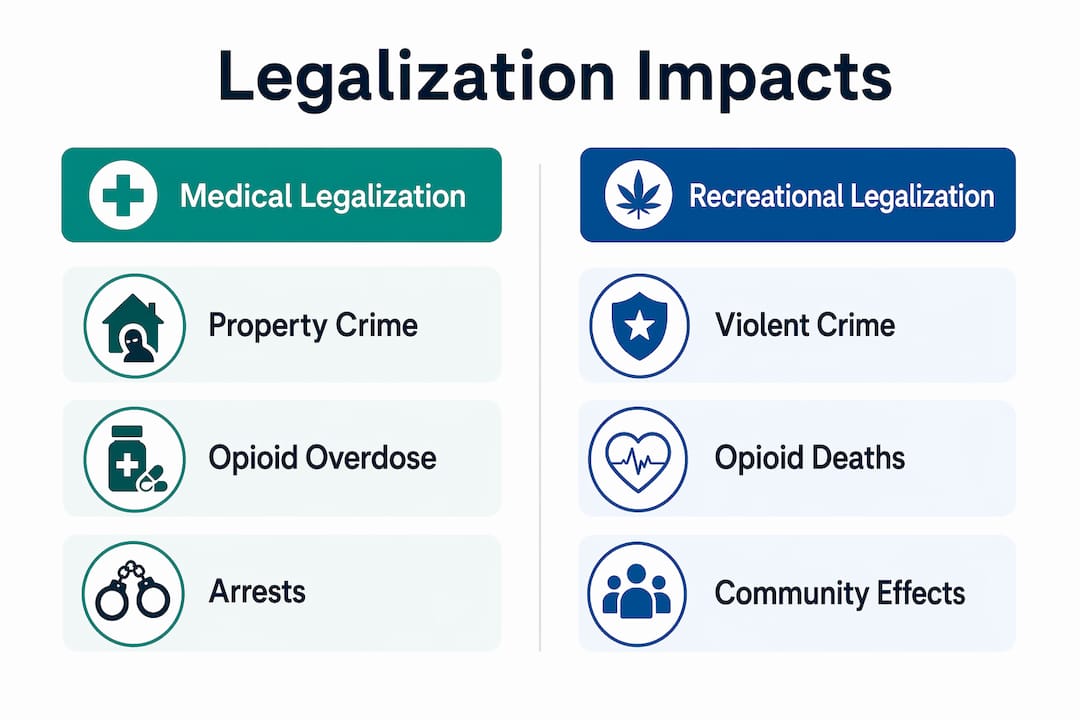
The crime reduction effects extend beyond cannabis-specific arrests. Research on Atlanta’s decriminalisation policy found a 20% reduction in violent crime following the policy change. That figure reflects a broader dynamic: when police resources are no longer consumed by low-level cannabis enforcement, they can be redirected toward more serious offences.
The type of legalisation also determines which crimes decrease. Studies show medical legalisation reduces property crime, while recreational legalisation is linked to reductions in violent crime. The mechanism differs: medical frameworks reduce desperation-driven theft by providing affordable access to cannabis for patients, while recreational legalisation undercuts the illicit market that generates gang-related violence.
| Crime Category | Medical Legalisation Effect | Recreational Legalisation Effect |
|---|---|---|
| Property crime | Significant reduction | Moderate reduction |
| Violent crime | Moderate reduction | Significant reduction |
| Cannabis possession arrests | 51–62% reduction | 51–62% reduction |
| Cannabis sales arrests | 44–49% reduction | 44–49% reduction |
The racial equity picture is more complicated. While arrest volumes dropped for all groups, relative racial disparities in arrest rates remain largely unchanged. Black Canadians and Americans are still arrested at disproportionately higher rates than white individuals for equivalent cannabis activity. Legalisation reduces the total harm, but it does not eliminate systemic bias in enforcement. Record expungement programmes and community reinvestment policies are necessary complements to legalisation if social justice goals are to be fully realised.
Pro Tip: Advocates pushing for cannabis legalisation should pair their efforts with campaigns for automatic record expungement. Legalisation without expungement leaves thousands of people with criminal records for conduct that is now legal.
Legal cannabis markets do not immediately displace illegal ones. Market maturity is the critical variable. In early-stage legal markets, high taxes, limited retail access, and regulatory compliance costs keep legal prices above illicit prices. Over time, that dynamic reverses.
In mature markets like Colorado and California, legal cannabis prices are significantly lower than illicit prices, giving consumers a strong financial incentive to buy legally. This price advantage is the primary mechanism through which legal markets crowd out illegal sellers. When legal cannabis is cheaper, safer, and more convenient, the illicit market loses its customer base.
Regulatory flexibility accelerates this process. Jurisdictions that allow a wide range of licence types, including micro-cultivators, craft producers, and delivery services, tend to develop more competitive pricing faster. Rigid licensing structures that favour large producers slow the price decline and inadvertently protect illicit operators.
The health argument for legal markets is equally strong:
The cannabis legalization 2025 overview from Greensociety details how Canadian regulatory frameworks have evolved to address these pricing and access challenges specifically.
Legalisation is not a complete solution. Several challenges have emerged or persisted in jurisdictions that have moved to legal frameworks, and honest advocates need to understand them.
Hospitalisations related to cannabis use disorder and poisoning have increased in some populations following legalisation. Greater legal access appears to increase consumption among some adults, and a subset of those users develop problematic use patterns. This does not negate the benefits of legalisation, but it does argue for robust public health education alongside regulatory frameworks.
The benefits of legalisation also take time to materialise. Crime reductions and health improvements emerge over years, not months. Policymakers and advocates who expect immediate results will be disappointed. The lag effect is real, and it requires patience and sustained commitment to evaluation.
Long-term health research remains incomplete. Studies on chronic cannabis use, cognitive effects in adults, and respiratory impacts from smoking are still developing. JAMA Network Open and similar peer-reviewed outlets continue to call for longitudinal studies to clarify these questions. Current evidence supports legalisation, but it does not mean all health questions are settled.
Systemic inequities in enforcement persist even after legalisation. Broader reforms are required:
Pro Tip: When evaluating a jurisdiction’s legalisation policy, look beyond the legalisation itself. Ask whether the framework includes expungement, equity licensing, and community reinvestment. These elements determine whether legalisation delivers on its social justice promises.
Cannabis legalisation delivers measurable reductions in opioid overdoses, violent crime, and cannabis arrests, but its full benefits require time, complementary reforms, and sustained policy commitment to emerge.
| Point | Details |
|---|---|
| Opioid overdose reduction | Medical legalisation cuts non-fatal opioid overdoses by 15.47%; recreational by 11.92%. |
| Crime decreases by type | Medical legalisation reduces property crime; recreational legalisation reduces violent crime. |
| Arrest reductions with caveats | Cannabis arrests fell sharply, but racial disparities in arrest rates remain unchanged. |
| Market displacement takes time | Legal markets only undercut illicit prices once they reach maturity through licensing flexibility. |
| Complementary reforms are required | Expungement, equity licensing, and community reinvestment are necessary for full social justice outcomes. |
I have spent years reading the research on cannabis policy, and the honest conclusion is this: the evidence for legalisation is compelling, but the policy conversation often stops too early. Advocates celebrate the vote, the legislation passes, and everyone moves on. The harder work of designing equitable licensing, funding expungement programmes, and monitoring enforcement disparities rarely gets the same attention.
What strikes me most in the 2026 data is the persistence of racial arrest disparities. Legalisation cut the total number of arrests dramatically, which is genuinely significant. But the ratio between Black and white arrest rates barely moved. That tells you legalisation alone does not fix enforcement culture. It requires explicit accountability measures built into the regulatory framework from the start.
The opioid data is where I find the strongest argument for why legal cannabis is important. A 15.47% reduction in non-fatal overdoses from medical legalisation alone represents an enormous public health gain. Given that opioid overdoses remain one of the leading causes of preventable death in Canada and the United States, any intervention that produces that magnitude of reduction deserves serious policy support.
My advice to advocates is to lead with the health and crime data. Those numbers are hard to dismiss. Then push for the equity provisions that make legalisation meaningful beyond the headline. Legalisation without expungement is an incomplete reform. The goal is not just a legal market. The goal is a just one.
— Juiced
Understanding why cannabis legalization matters is the first step. Choosing the right products once you have legal access is the next one.

Greensociety is a trusted Canadian online cannabis platform with a full catalogue of flowers, edibles, concentrates, vapes, and CBD products. Whether you are new to legal cannabis or refining your preferences, the Greensociety blog offers practical guidance to help you shop with confidence. Start with the cannabis flower selection guide to understand how to evaluate quality, potency, and strain characteristics before you buy. You can also explore recreational cannabis facts for 2025 to stay current on what legal access actually means for Canadian consumers.
Medical cannabis legalisation is linked to a 15.47% reduction in non-fatal opioid overdoses, and recreational legalisation is associated with approximately 3.5 fewer fatal opioid deaths per 100,000 people annually.
National youth cannabis prevalence has remained stable or declined following legalisation in most jurisdictions. Regulated retail markets with age verification appear to limit youth access more effectively than illicit markets do.
Recreational legalisation is linked to reductions in violent crime, with Atlanta’s decriminalisation policy producing a 20% drop in violent crime. Medical legalisation is more strongly associated with reductions in property crime.
Legalisation significantly reduces total arrest volumes, but relative racial disparities in cannabis arrest rates remain largely unchanged. Broader reforms including expungement and enforcement accountability are required to address systemic inequity.
Crime reductions and health improvements from legalisation typically emerge over several years, not immediately. Legal market price advantages over illicit sellers also develop gradually as markets mature and licensing frameworks become more flexible.