



Marijuana
Why Use CBD Products for Relief and Wellness

Jan
Finding the right Canadian CBD product can feel complicated, especially with so many myths and mixed messages in the wellness world. More than 40 percent of Canadians aged 25 to 45 report using CBD to help manage stress and pain. Understanding what CBD really is—along with the facts about safety, legality, and product options—empowers you to choose reliable solutions tailored to your needs. This guide breaks down research-backed CBD properties and sheds light on common misconceptions so you can navigate the market confidently.
Table of Contents
- Defining CBD: Properties And Common Myths
- Varieties Of CBD Products And Their Differences
- How CBD Works In Your Body
- Legal And Safety Considerations In Canada
- CBD For Stress, Pain, And Wellness
- Potential Risks And Common Misconceptions
Key Takeaways
| Point | Details |
|---|---|
| Understanding CBD | CBD is a non-intoxicating compound that potentially offers therapeutic benefits without the psychoactive effects associated with THC. |
| Product Varieties | CBD products come in various formats, including oral, topical, and inhalable, each with unique absorption characteristics and benefits. |
| Legal Considerations | The legal landscape for CBD in Canada is complex, requiring consumers to purchase from licensed sources and adhere to provincial regulations. |
| Potential Risks | CBD can lead to side effects and drug interactions; consumers should consult healthcare professionals and verify product quality through third-party testing. |
Defining CBD: Properties and Common Myths
Cannabidiol (CBD) represents a fascinating natural compound derived from cannabis plants that has garnered significant attention in wellness circles. Unlike its psychoactive cousin THC, CBD does not produce intoxicating effects, making it an increasingly popular option for those seeking potential therapeutic benefits. Scientific research on CBD continues to explore its complex interactions with the human body’s endocannabinoid system.
At its core, CBD is a non-impairing cannabinoid extracted from hemp and cannabis plants. The compound interacts with receptors throughout the body’s nervous system, potentially influencing processes like pain perception, mood regulation, and inflammation response. Contrary to widespread misconceptions, CBD will not cause users to experience a “high” sensation typically associated with cannabis consumption. Researchers are actively investigating its potential applications across various health and wellness domains, including managing anxiety, supporting sleep quality, and potentially alleviating chronic pain.
Despite growing popularity, CBD remains a somewhat misunderstood compound. Many consumers mistakenly believe all cannabis derivatives produce psychoactive effects or that CBD is universally safe without potential side effects. Medical studies highlight potential risks including possible liver damage, drug interactions, drowsiness, and gastrointestinal issues. The current regulatory landscape remains complex, with limited FDA approval for specific medical conditions like rare seizure disorders.
Pro tip: Always consult healthcare professionals and purchase CBD products from reputable sources that provide third-party lab testing to ensure quality and safety.
Varieties of CBD Products and Their Differences
CBD products come in a diverse range of formats, each designed to meet different wellness needs and personal preferences. Cannabis product variations span multiple delivery methods, including oral, topical, and inhalable options that offer unique absorption characteristics and potential benefits. Understanding these varieties helps consumers make informed choices about which format might best suit their individual health goals.
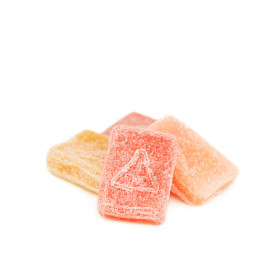
Oral CBD products represent one of the most popular categories, encompassing tinctures, capsules, edibles, and softgel supplements. Tinctures allow precise dosage control by using dropper administration under the tongue, enabling rapid absorption into the bloodstream. Capsules and edibles provide a more convenient, pre-measured approach, though they typically have slower absorption rates due to digestive processing. Topical CBD products like creams, balms, and lotions target localised areas, potentially offering relief for muscle soreness, joint discomfort, and skin conditions by interacting directly with cannabinoid receptors in the skin.
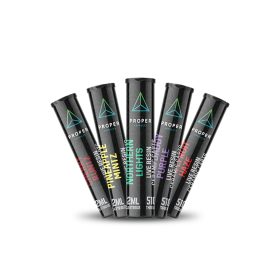
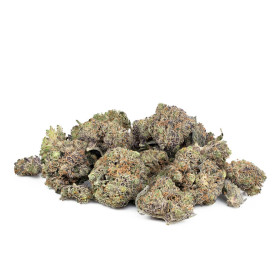
Inhalable CBD options, including vaporizers and hemp flower products, offer the fastest absorption method by delivering compounds directly into the lungs. These formats appeal to users seeking immediate effects, though they may present different regulatory considerations compared to other consumption methods. The legal landscape for CBD products remains complex, with distinctions between hemp-derived CBD (containing less than 0.3% THC) and other cannabis derivatives significantly impacting product availability and compliance.

Pro tip: Always verify the THC content and source of CBD products, and start with lower dosages while monitoring your body’s response to determine the most suitable format for your wellness needs.
Here is a comparison of popular CBD product formats and their key characteristics:
| Format Type | Onset Time | Application Example | Typical Use Case |
|---|---|---|---|
| Oral (Tincture) | 15-45 minutes | Under tongue drops | Precise daily dosing |
| Edible (Capsules) | 45-90 minutes | Softgels, gummies | Discreet supplementation |
| Topical (Cream) | Varies, local effect | Direct skin application | Targeted joint or skin relief |
| Inhalable (Vape) | 2-10 minutes | Vapour inhalation | Rapid stress or pain relief |
How CBD Works in Your Body
Understanding how CBD interacts with the human body requires exploring the complex endocannabinoid system, a sophisticated network of neurotransmitters and receptors responsible for maintaining physiological balance. Cannabinoid interaction mechanisms reveal that CBD does not directly bind strongly to primary cannabinoid receptors like THC, but instead modulates various receptor systems and molecular pathways to produce its therapeutic effects.
The endocannabinoid system plays a crucial role in regulating numerous bodily functions, including mood, sleep, pain perception, and immune response. CBD primarily influences this system by interacting with multiple receptor types, particularly serotonin receptors and TRPV1 receptors involved in pain and inflammation management. By affecting neurotransmitter signaling and reducing inflammatory responses, CBD can potentially help manage conditions like anxiety, chronic pain, and sleep disorders without producing the intoxicating effects associated with THC.
Researchers continue to investigate the nuanced ways CBD impacts human physiology. Its ability to interact with ion channels and influence neurotransmitter reuptake suggests potential benefits for neurological and mental health. The compound appears to work by creating a balancing effect within the body’s systems, potentially helping to reduce inflammation, calm neural activity, and support overall cellular health. Unlike traditional pharmaceuticals, CBD offers a more holistic approach to wellness by supporting the body’s natural regulatory mechanisms.
Pro tip: Consult with healthcare professionals to understand how CBD might interact with your specific health conditions and any existing medications.
Legal and Safety Considerations in Canada
Navigating the legal landscape of CBD in Canada requires a comprehensive understanding of the complex regulatory framework. Cannabis regulatory requirements are stringent, with the Cannabis Act providing comprehensive guidelines for CBD production, distribution, and consumption. Only licensed entities are permitted to grow, produce, and sell CBD products, ensuring strict quality control and consumer safety across the country.
The legal status of CBD varies depending on its source and THC content. Hemp-derived CBD containing less than 0.3% THC is federally legal, but provincial regulations can introduce additional restrictions. Each province and territory maintains distinct rules regarding retail distribution, possession limits, and personal consumption. Consumers must be at least 18 or 19 years old (depending on the province) to legally purchase CBD products, and must only acquire them from licensed retailers or authorised online platforms.
Safety considerations extend beyond legal compliance. Potential users should be aware of possible side effects, including interactions with existing medications, potential liver impacts, and individual variability in metabolic responses. Quality and purity are paramount, with reputable sources providing third-party lab testing results and clear cannabinoid content labelling. Consumers are advised to start with low doses, monitor their body’s response, and consult healthcare professionals, particularly if managing pre-existing health conditions or taking other medications.
Pro tip: Always verify the licensing and certification of CBD suppliers, and keep documentation of product origins and laboratory test results for your personal records.
CBD for Stress, Pain, and Wellness
Cannabidiol has emerged as a promising natural compound for addressing multiple wellness challenges, particularly stress, chronic pain, and mental health management. Research on CBD usage indicates growing interest among individuals seeking alternative approaches to managing psychological and physical discomfort. Users consistently report seeking relief from anxiety, sleep disruptions, and inflammatory conditions through carefully selected CBD products.
For stress management, CBD demonstrates potential in modulating the body’s neurochemical responses. By interacting with serotonin receptors, the compound may help reduce anxiety symptoms and promote a sense of calm without the intoxicating effects associated with THC. Chronic pain sufferers have also found potential benefits, with CBD potentially reducing inflammation and altering pain perception through complex neurological pathways. These therapeutic applications span conditions ranging from mild daily tension to more complex chronic pain syndromes.
The wellness potential of CBD extends beyond immediate symptom management. Emerging scientific evidence suggests broader impacts on overall health, including potential improvements in sleep quality, mood regulation, and immune system function. However, individual responses vary significantly, and users are advised to approach CBD as a complementary wellness strategy rather than a universal cure-all. Consultation with healthcare professionals remains crucial for understanding individual suitability and optimal dosage.
Pro tip: Start with low CBD dosages and gradually adjust, keeping a detailed journal to track your body’s specific responses and potential benefits.
Potential Risks and Common Misconceptions
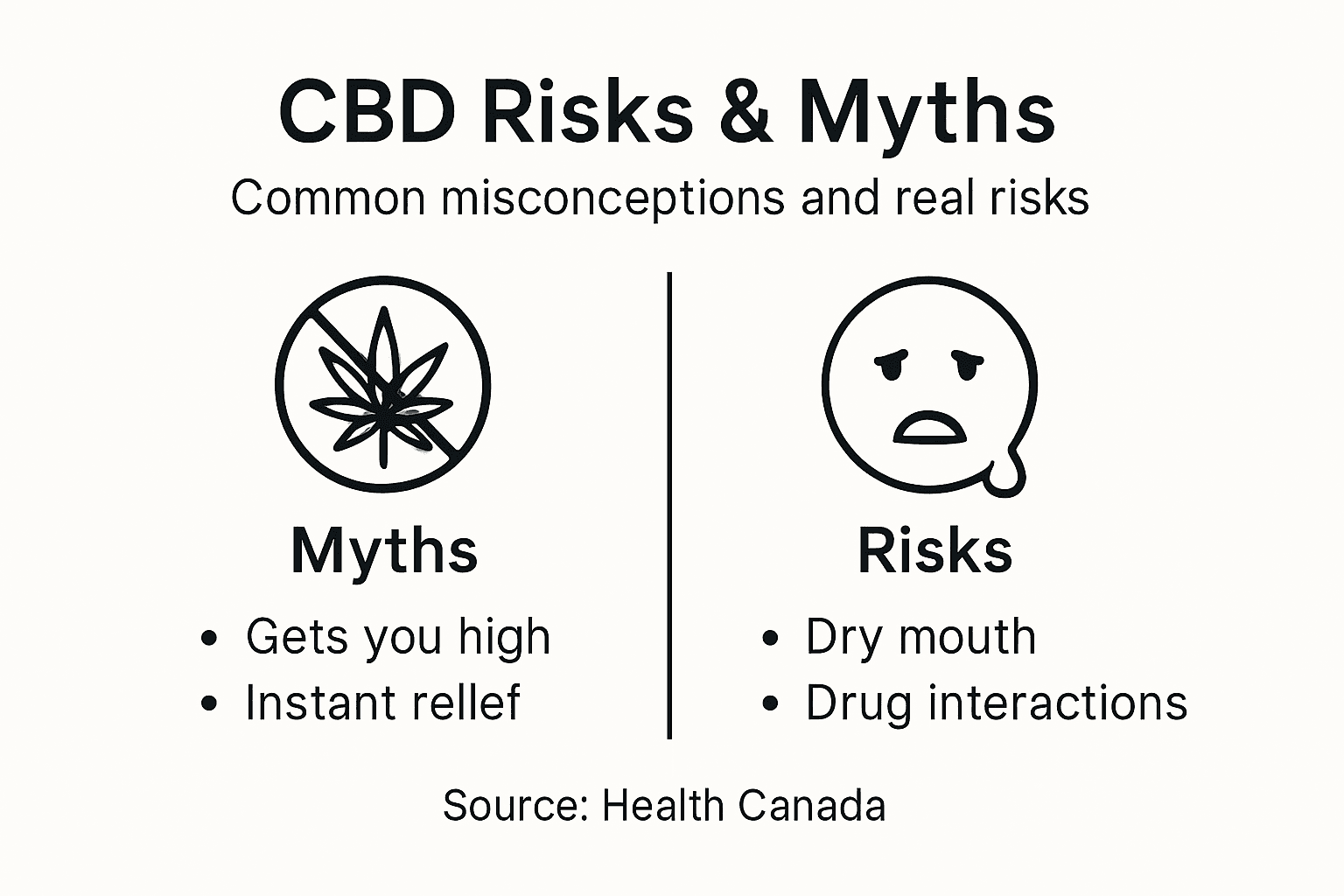
The rapidly growing CBD market has generated numerous misconceptions about its safety, efficacy, and potential impacts. CBD product safety considerations reveal critical nuances that consumers must understand before incorporating these products into their wellness routines. Many individuals incorrectly assume CBD is entirely risk-free and universally applicable across all health conditions.
Common side effects can include dry mouth, drowsiness, reduced appetite, and potential interactions with existing medications. Particularly significant are interactions with blood thinners and other pharmaceuticals, which can lead to unexpected health complications. CBD is not a universal remedy, and its therapeutic potential varies dramatically between individuals. Some users mistakenly believe CBD produces intoxicating effects similar to THC, while others assume it can cure multiple health conditions without scientific substantiation.
Product quality remains a significant concern in the CBD marketplace. Inconsistent regulation means many products feature mislabeled concentrations, potential contaminants, or unreliable CBD content. Pregnant and breastfeeding individuals should avoid CBD entirely, and those with pre-existing health conditions must consult healthcare professionals before beginning any CBD regimen. The current scientific landscape suggests promising potential for specific conditions like epilepsy, but many health claims require substantially more rigorous research to validate.
Below is a summary of common misconceptions versus factual realities about CBD:
| Myth or Misconception | Reality | Key Consideration |
|---|---|---|
| CBD produces intoxication | Non-intoxicating compound | Does not cause a cannabis “high” |
| All CBD is equally safe | May cause side effects | Review risks for health status |
| CBD cures all health issues | Limited evidence for most uses | Consult current medical research |
| Label accuracy guaranteed | Common mislabelling problems | Demand third-party lab proof |
Pro tip: Always request and review third-party laboratory testing results for CBD products, and maintain open communication with healthcare providers about your CBD usage.
Discover Effective CBD Solutions for Your Wellness Journey
If you are seeking natural relief from stress, chronic pain, or sleep challenges CBD products can offer you a gentle but powerful option. The article highlights key concerns such as precise dosing, product quality, and understanding how CBD interacts with your body to support wellness without intoxication. At GreenSociety.cc we understand these needs and provide a curated selection of high-quality CBD products that are third-party tested to ensure safety and potency with transparent lab results.
Explore our extensive range of CBD tinctures, edibles, topicals, and vapes designed to help you find the format that suits your unique needs. Don’t let misconceptions or uncertainty hold you back — our user-friendly platform offers detailed product information and fast discreet shipping across Canada. Take control of your wellness today by visiting Green Society and discover CBD options tailored to bring relief and balance. Start your journey now at https://greensociety.cc and experience trusted CBD products delivered to your door.
Frequently Asked Questions
What are the potential benefits of using CBD products for wellness?
CBD is known for its potential therapeutic benefits, including managing stress and anxiety, aiding sleep quality, and reducing chronic pain through its interaction with the body’s endocannabinoid system.
How do different CBD product formats affect absorption and effects?
Oral products like tinctures and edibles have varying onset times, with tinctures generally acting faster than edibles due to direct absorption into the bloodstream. Topicals provide localized benefits while inhalable forms, such as vapes, offer the quickest relief.
Are there any side effects associated with using CBD products?
Yes, potential side effects may include dry mouth, drowsiness, reduced appetite, and interactions with medications. It’s essential to consult with a healthcare professional before starting CBD, especially for those with pre-existing conditions.
How should I determine the right dosage of CBD for my needs?
Starting with a low dose and gradually increasing while monitoring your body’s response is recommended. It’s also beneficial to consult healthcare professionals to tailor the dosage to your specific health and wellness goals.
Recommended
- The Benefits of CBD for Chronic Pain ~ Green Society Blog
- 7 Essential Benefits of CBD for Wellness and Relief ~ Green Society Blog
- Why Cannabis for Chronic Pain: Complete Guide ~ Green Society Blog
- Complete Guide to Using Cannabis for Anxiety ~ Green Society Blog