Free Shipping
on orders over $150.00
$0.00
$150.00
Add $150.00 more for free shipping!


TL;DR:
- Cannabis education is vital because the current evidence base is limited and consumption methods significantly affect risks. Understanding dosage, method-specific onset times, and vulnerable group considerations enables safer use and informed decision-making. Public health benefits include reduced stigma, better clinical conversations, and improved safety through accurate knowledge dissemination.
Cannabis is legal in Canada, yet most adults are operating on a mix of outdated stigma, online hype, and word-of-mouth advice. That gap is exactly why cannabis education matters more now than at any point in the country’s history. Whether you are exploring cannabis for the first time or have been using it for years, understanding health effects, consumption methods, dosing principles, and real risks changes how you make decisions. This article breaks through the noise with evidence-based clarity so you can use cannabis confidently and safely.
| Point | Details |
|---|---|
| Evidence base is limited | Many medical cannabis claims lack large-scale clinical trial support, making educated caution critical. |
| Consumption method shapes risk | Onset time and duration vary sharply by method; edibles carry the highest risk of unintentional overconsumption. |
| Dose stacking is a real danger | Edibles’ delayed onset leads many users to redose too soon, causing unexpectedly intense effects. |
| Vulnerable groups need tailored guidance | Adolescents, pregnant women, and young children face disproportionate harm from cannabis exposure. |
| Education reduces stigma and improves care | Informed consumers make better product choices and have more productive conversations with healthcare providers. |
Most Canadians assume that because cannabis is legal and widely available, its safety profile is well established. It is not. The evidence base for medical cannabis is “thin” across many commonly promoted conditions because large-scale, gold-standard clinical trials simply do not yet exist at scale. That does not mean cannabis has no legitimate uses. It means consumers and clinicians are often working with incomplete information, which makes self-education a practical necessity rather than an optional extra.
There are FDA-approved cannabinoid medicines, such as Epidiolex for specific seizure disorders, that come with precise weight-based clinical dosing and strict medical oversight. These are not comparable to the broad array of unregulated cannabis oils and edibles sold for generalised wellness. Treating them as equivalent creates false confidence and genuine safety risk.
“Clinicians are often caught between patient demand for cannabis therapies and a scientific literature that hasn’t yet caught up. Education on both sides of that relationship is the missing piece.” This framing, drawn from ongoing medical commentary, captures exactly why the importance of cannabis education extends into the clinic, not just the dispensary.
The confusion is compounded by clinical education gaps among healthcare providers themselves. Many physicians received little to no formal training in cannabis pharmacology. When your doctor is not sure what to tell you, your own knowledge becomes your best protection.
Here is a grounded summary of the current state of cannabis research:
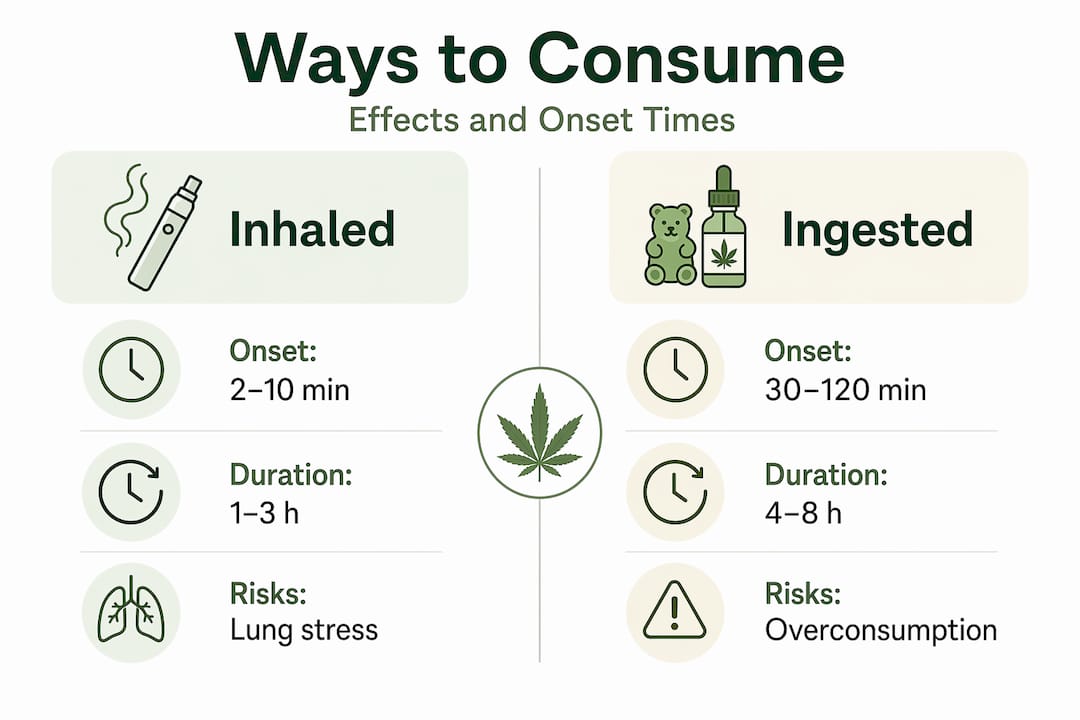
How you consume cannabis shapes virtually everything about the experience: how quickly effects arrive, how long they last, and where the risk concentrates. This is one area where cannabis knowledge benefits people most directly.
| Method | Onset time | Duration | Key risk |
|---|---|---|---|
| Smoking | 2 to 10 minutes | 1 to 3 hours | Respiratory irritation, fast and easy to overconsume |
| Vaping | 2 to 10 minutes | 1 to 3 hours | Lung irritation, variable potency across devices |
| Edibles | 30 to 120 minutes | 4 to 8 hours | Dose stacking due to delayed onset |
| Tinctures | 15 to 45 minutes | 2 to 4 hours | Sublingual vs. swallowed absorption differs widely |
| Concentrates | 2 to 5 minutes | 2 to 4 hours | Very high potency, not suitable for new users |
As the onset differences between inhalation and edibles illustrate, smoked cannabis affects you within minutes while edibles can take up to two hours. That gap is where most bad experiences happen. A user feels nothing after 45 minutes, takes a second dose, and then both doses hit simultaneously. The result is an hours-long experience far more intense than intended. Understanding the potential side effects of edibles before you consume them is not overly cautious. It is just smart.
Tinctures deserve more attention than they typically receive. Taken sublingually, meaning held under the tongue rather than swallowed, they absorb faster and more predictably than edibles. For anyone wanting a middle ground between smoking and the long unpredictable arc of an edible, tinctures are worth understanding. Concentrates, on the other hand, are best approached after you have a solid baseline of experience with other methods.
Pro Tip: When trying edibles for the first time, choose a product clearly labelled with THC per serving, start with 2.5 to 5 mg, and wait a full two hours before considering another dose. Keep a brief log of dose, time, and effects so you have reliable personal data for next time.
The cannabis wellness conversation often skips past risk in favour of benefits. That selective framing is exactly why the impact of cannabis education on public health is so significant. A 2025 review published in PubMed frames clinical cannabis counselling around weighing harms alongside benefits, and consumers deserve the same honest approach.
Key risks that every cannabis user should understand include:
The “start low and go slow” principle is not just advice for new users. It applies every time you try a new product, a new consumption method, or return after a break. Tolerance changes, product potency varies, and what worked six months ago may not be the right dose today.
Pro Tip: Never compare your dose directly to a friend’s. Body weight, metabolism, prior cannabis exposure, and the specific product all affect your response. Your dose is personal.

Adolescents and children deserve a specific mention here. Stronger and inconsistently regulated cannabis products pose particular risks to developing brains, and cannabis-infused edibles that look identical to regular candy or baked goods create genuine accidental ingestion risks for children. Education here is a form of harm prevention that goes beyond the individual user.
Understanding why learn about cannabis shifts when you see it through a public health lens rather than a purely personal one. The harm-reduction, person-centred approach consistently outperforms abstinence-only messaging when it comes to supporting informed, safer decisions. People will use cannabis regardless of what public health messaging says. The question is whether they will do so with accurate information.
Here is how cannabis awareness education creates tangible community-level benefits:
How cannabis education helps at a systemic level comes down to informed choice. When adults understand what they are consuming and why, the entire ecosystem, from dispensaries to healthcare providers, becomes more accountable.
Good intentions are not a substitute for reliable information. Here is how to move from curiosity to genuine understanding:
I have watched the cannabis conversation in Canada swing from “this plant will solve everything” to “it is dangerous and you should abstain,” and neither extreme serves anyone well.
In my experience, the people who have the worst outcomes with cannabis are not reckless. They are simply under-informed. They did not know edibles take two hours to kick in. They did not know their antidepressant could interact with THC. They did not know that high-potency concentrates are categorically different from the flower their parents’ generation used. These are not failures of character. They are failures of education.
What I find genuinely encouraging is the shift toward harm-reduction frameworks. When you treat cannabis education for patients and adults as a matter of informed consent rather than moral instruction, the entire conversation changes. People ask better questions. They make better choices. They are honest with their doctors.
The uncomfortable truth is that abstinence-only messaging has never worked for alcohol, tobacco, or cannabis. What does work is honest, specific, evidence-based guidance that respects the intelligence of the person receiving it. That is what good cannabis education looks like, and it is what more Canadians deserve access to.
— Juiced
Greensociety is built for adults who want more than a shopping cart. The platform combines a wide product selection with genuinely useful educational resources designed to help you make informed, confident choices every time. Whether you are figuring out which flower suits your needs or ready to try edibles with a clearer sense of what to expect, the content and products are there to support you.
If edibles are on your radar, the cannabis kitchen guide walks through recipes and safe-use tips that make the experience both enjoyable and predictable. And if you are starting with flower, the flower quality checklist gives you a practical, six-step framework for buying with confidence. Knowledge and quality product belong together. Greensociety puts both in one place.
Cannabis education reduces the risk of accidental overconsumption, helps users understand onset times and potency, and supports better conversations with healthcare providers about interactions and dosing.
Without proper knowledge, users often redose too early due to edibles’ delayed onset of 30 to 120 minutes, resulting in unexpectedly intense effects that can last four to eight hours.
No. Cannabis use during pregnancy is associated with fetal growth restriction, preterm birth, and impaired brain development. No amount has been proven safe.
Use sources with clear citations and editorial standards such as Health Canada, peer-reviewed journals, and public health agencies. Be cautious of promotional content that lacks supporting evidence.
Many physicians are becoming more knowledgeable, though clinical education gaps remain. Disclosing your cannabis use to your healthcare provider is still critical for avoiding drug interactions and receiving relevant guidance.