Free Shipping
on orders over $150.00
$0.00
$150.00
Add $150.00 more for free shipping!


TL;DR:
- Cannabis legality varies by region across possession, retail sales, and home cultivation, and rules differ significantly.
- Understanding these distinctions and current laws helps consumers avoid legal risks when purchasing or traveling with cannabis.
Cannabis legality by region is defined by three distinct legal variables: possession limits, retail sales authorisation, and home cultivation rights. These three variables operate independently, and a region can permit one while prohibiting the others. Canada, the United States, Uruguay, Germany, and the Netherlands each illustrate a different point on the spectrum. Adults 19+ who want to purchase legally and stay compliant need to understand all three layers, not just whether cannabis is “legal” in a given place.
The gap between countries is wider than most people expect. Canada legalised recreational cannabis in october 2018, making it one of only two countries in the world to do so at the federal level. Provinces set their own minimum purchase age: 19 in most provinces, 18 in Alberta, and 21 in Quebec. Possession limits and retail models also vary by province, ranging from government-run stores to private dispensaries.

The United States presents a far more fragmented picture. Recreational cannabis is legal in 24 states, Washington D.C., and three territories, while medical cannabis is permitted in 42 states. Despite that, cannabis remains a Schedule I controlled substance under federal law. That federal status creates real contradictions for consumers who live in legal states but cross state lines or use federal services.
Internationally, Uruguay was the first country to legalise cannabis nationally, though sales are restricted to registered residents through pharmacies and social clubs. The Netherlands has operated under a regulated tolerance policy since 1976, permitting cannabis sales in licensed coffee shops while technically keeping cultivation and wholesale illegal. Germany’s Cannabisgesetz (CanG), which came into force april 1, 2024, now allows home cultivation and non-profit cannabis clubs, marking the most significant shift in European cannabis policy in decades.
| Region | Recreational legal | Medical legal | Home cultivation | Retail sales |
|---|---|---|---|---|
| Canada | Yes (federal) | Yes | Yes (up to 4 plants) | Yes (varies by province) |
| USA (legal states) | Yes (state level) | Yes (42 states) | Varies by state | Yes (licensed dispensaries) |
| Uruguay | Yes | Yes | Yes (registered residents) | Pharmacies and clubs only |
| Germany | Yes (CanG 2024) | Yes | Yes (limited) | Non-profit clubs only |
| Netherlands | Tolerance policy | Yes | No | Licensed coffee shops |
Possession, retail sales, and home cultivation are legally distinct categories, and conflating them is the most common mistake consumers make. A region can legalise possession while keeping retail sales illegal, or permit retail while banning home growing entirely.
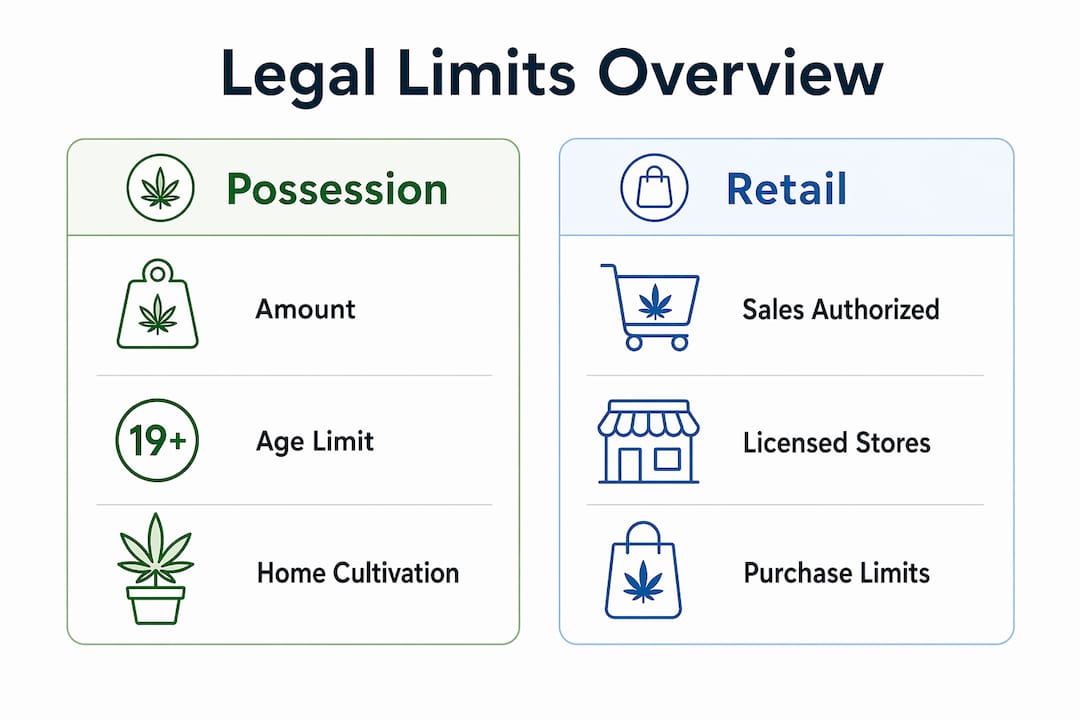
In Canada, adults can possess up to 30 grams of dried cannabis in public. Home cultivation is permitted federally at up to four plants per household, though Quebec and Manitoba have banned home growing at the provincial level. Retail models differ sharply: Ontario operates a private dispensary model, while provinces like Prince Edward Island use government-run stores. Greensociety provides a detailed breakdown of provincial cannabis laws for readers who want province-specific details.
In U.S. legal states, possession limits typically range from one ounce to two ounces for recreational consumers. Home cultivation rules vary widely: California allows six plants per adult, while some legal states prohibit home growing altogether. Medical consumers in most states face different, often more generous, limits on both possession and cultivation. The key point is that a medical card does not override federal law, and federal scheduling reforms in april 2026 only moved FDA-approved and state-licensed medical products to Schedule III. Recreational cannabis remains Schedule I federally.
Pro Tip: Always check both the provincial or state law and the local municipal rules. Some cities in legal jurisdictions have passed their own restrictions on dispensary locations or public consumption.
Federal law overrides local law in most countries, and cannabis consumers often underestimate that risk. In the United States, the U.S. Department of Justice’s april 2026 order placed FDA-approved marijuana products and qualifying state-licensed medical cannabis into Schedule III. That is a meaningful shift for medical patients. Recreational cannabis, however, remains Schedule I, meaning federal prosecution remains a legal possibility regardless of state law.
Air travel is where the federal-versus-regional conflict becomes most immediate. The Transportation Security Administration (TSA) operates under federal authority. TSA officers do not actively search for cannabis, but they are required to report any discovery to law enforcement. That law enforcement response is governed by federal law, not state law. Carrying cannabis on a domestic flight between two legal states still carries federal legal risk.
International treaties add another layer. The 1961 UN Single Convention on Narcotic Drugs and its successors obligate signatory countries to control cannabis. Countries like Canada and Uruguay have technically stepped outside full treaty compliance by legalising recreational use nationally. That tension shapes how other countries approach reform, since treaty obligations give governments a legal reason to move slowly.
Pro Tip: If you hold a medical cannabis card, carry your physician’s recommendation letter alongside it. Some TSA checkpoints and law enforcement officers treat documented medical use differently, even if it does not guarantee legal protection.
Compliance starts before the purchase, not after. Verify the minimum legal age in your specific province, state, or country. In Canada, that means knowing your province’s rule, since the age differs between Alberta (18) and Quebec (21). In the U.S., all legal states set the recreational age at 21, but medical programmes may have lower thresholds with parental consent.
Buy exclusively from licensed retailers. In Canada, that means provincially authorised stores or regulated online platforms. In U.S. legal states, that means state-licensed dispensaries. Unlicensed sellers operate outside the legal framework, which exposes buyers to product quality risks and potential criminal liability. Greensociety’s guide to safe cannabis purchasing covers what to look for in a licensed Canadian retailer.
The marijuana legalization map shifts regularly. Germany’s CanG came into force in 2024. The U.S. rescheduling order arrived in april 2026. Thailand, which briefly liberalised cannabis laws, reversed course. Checking a current, authoritative source before purchasing in any new jurisdiction is not optional. It is the baseline for legal compliance.
Cannabis legality by region requires understanding possession, retail sales, and home cultivation as three separate legal categories, since each can be regulated differently within the same jurisdiction.
| Point | Details |
|---|---|
| Three distinct legal variables | Possession, retail sales, and home cultivation are each regulated separately in every jurisdiction. |
| Canada leads federally | Canada legalised recreational cannabis nationally in 2018, with provincial age and retail variations. |
| U.S. federal risk remains | Recreational cannabis stays Schedule I federally despite legalisation in 24 states. |
| Air travel carries federal risk | TSA operates under federal law; cannabis discovered during screening must be reported regardless of state law. |
| Laws change frequently | Germany’s CanG (2024) and the U.S. rescheduling order (2026) show how quickly the global picture shifts. |
I’ve spoken with enough people who’ve run into legal trouble to know that the single biggest mistake is treating cannabis legality as a yes-or-no question. Someone hears that cannabis is legal in their state or province, buys a product from a licensed shop, and then carries it on a plane or drives across a state line without a second thought. That’s where the system catches people out.
The more useful question is: “What exactly is legal, for whom, in what quantity, and in what location?” Canada’s federal legalisation is genuinely broad, but Quebec’s home cultivation ban and Alberta’s lower purchase age show that even within a single country, the details matter. Germany’s CanG is a landmark law, but non-profit club membership is not the same as walking into a dispensary. Uruguay’s national legalisation is real, but tourists cannot legally buy there at all.
What I find most telling about the current global picture is that the countries with the clearest frameworks, Canada and Uruguay, built them around specific, enforceable rules rather than vague tolerance. The Netherlands has operated on tolerance for nearly 50 years, and the legal ambiguity has never fully resolved. Clarity in the law produces clarity for the consumer. Until more countries follow that model, the burden falls on individual consumers to read the fine print before they purchase or travel.
— Juiced
Understanding where cannabis is legal is the first step. Knowing which products are right for you within that legal framework is the second.
Greensociety has put together a detailed guide to cannabis product categories covering flowers, edibles, concentrates, vapes, CBD products, and accessories available to Canadian adults. Each category comes with quality indicators and practical guidance so you can match the right product to your needs and stay within what your province permits. If you want to go deeper on what makes a quality product worth buying, the cannabis product quality indicators guide breaks down exactly what to look for before you add anything to your cart.
Canada legalised recreational cannabis federally in october 2018, but provinces set their own rules on minimum age, possession limits, and retail models. Quebec and Manitoba also prohibit home cultivation, which is otherwise permitted federally.
Recreational cannabis is legal in 24 states, Washington D.C., and three U.S. territories, while 42 states permit medical use. Cannabis remains a Schedule I substance under federal law for recreational purposes.
TSA screening operates under federal authority, so cannabis discovered during screening must be reported to law enforcement regardless of state law. Flying with cannabis carries federal legal risk even on domestic routes between two legal jurisdictions.
Germany’s Cannabisgesetz (CanG) came into force april 1, 2024, legalising home cultivation and non-profit cannabis social clubs for adults. It is the most significant cannabis legalisation in European history.
A medical card does not override U.S. federal law. The april 2026 DOJ rescheduling order moved FDA-approved and state-licensed medical products to Schedule III, but recreational cannabis and non-approved products remain Schedule I federally.