Free Shipping
on orders over $150.00
$0.00
$150.00
Add $150.00 more for free shipping!


TL;DR:
- COAs provide an objective, batch-specific analysis of cannabis safety and potency.
- Verify COA details match your product’s packaging and testing date before trusting results.
- Examining safety panels and actual cannabinoid levels helps consumers make safer, informed choices.
That number printed on your cannabis package — the big, bold THC percentage — feels authoritative. It looks official. But research shows that observed THC potency is often significantly lower than what’s labelled, particularly for flower. The actual document that tells the truth about what’s in your product is called a Certificate of Analysis, or COA. Most consumers never look at one. This article will change that, walking you through exactly what COAs reveal, how to verify them, and how to use them to make safer, more confident cannabis purchases.
| Point | Details |
|---|---|
| Trust lab reports, not just labels | COAs give the actual cannabinoid content and contaminants, not just what’s claimed on the packaging. |
| Verify batch and product details | Always match the COA’s batch number, product ID, and date to your product to ensure the results apply. |
| Review safety and potency panels | Look for pass/fail contaminant results and THC/CBD numbers to make safe and predictable choices. |
| Know lab methods influence results | Testing methods can change how THC and other cannabinoids are reported, so read COA details carefully. |
With so much riding on the product label, it’s essential to dig deeper and understand what a COA actually tells you.
A COA is an official document issued by a licensed, independent laboratory after testing a specific batch of cannabis. It is not a marketing tool. It is not created by the producer. It is the closest thing the cannabis market has to an objective truth about what’s inside a product. COAs provide information on safety, quality, and potency, and in regulated markets, products must be tested by licensed third-party labs before they can be sold.
Here’s what a complete COA typically covers:
“A label tells you what a producer wants you to know. A COA tells you what a lab actually found.”
The habit of reading cannabis lab results before purchasing is the single most effective way to move from guessing to knowing. Most reputable online dispensaries and licensed retailers make COAs available on request or directly on their product pages. If you can’t find one, that absence is itself useful information.
| COA section | What it tells you |
|---|---|
| Cannabinoid panel | Actual THC, CBD, and minor cannabinoid percentages |
| Pesticide panel | Whether harmful agricultural chemicals are present |
| Heavy metals panel | Levels of toxic metals absorbed from soil or equipment |
| Microbial panel | Presence of harmful bacteria, mould, or yeast |
| Residual solvents | Leftover extraction chemicals in concentrates |
| Moisture / water activity | Risk of mould growth in flower |
Understanding cannabis lab testing regulations helps you appreciate why this document exists and what standards labs must meet to produce reliable results.
Now that you know what a COA generally covers, let’s see why verifying that the results apply to your exact product batch is crucial.
Here’s a scenario that happens more often than most consumers realise: a dispensary posts a COA on their website, but it was created for a different batch than the one currently on shelves. The products look identical. The packaging is the same. But the lab results are from a completely different run of flower, grown under different conditions, possibly months earlier. You have no way of knowing unless you check the identifying details.
Consumer-facing COA reading guides are clear that verifying batch and lot identifiers against the product in hand is a fundamental consumer check. Here’s how to do it step by step:
| Field | Where to find it | What to check |
|---|---|---|
| Product name | Top of COA and packaging | Exact match, including strain |
| Batch / lot number | COA header and product label | Identical alphanumeric code |
| Sampling date | COA header | Must predate the report date |
| Report date | COA header | Should be recent, not years old |
| Testing lab name | COA footer or header | Independent, licensed facility |
Pro Tip: If a COA is more than 12 months old, treat it with scepticism. Cannabis products can degrade, and testing conditions from a year ago may not reflect the current product’s safety or potency profile.
The value of lab testing and trust comes down to this: a COA is only as reliable as its traceability. One mismatched field should prompt you to ask questions before purchasing.
Verifying the right batch is only half the story — understanding safety results is where you protect your health.

The safety section of a COA is arguably more important than the potency numbers for most consumers. A product could have exactly the THC percentage you want, but if it fails a pesticide screen, consuming it poses a genuine health risk. Contaminant testing ensures products are free from harmful substances, covering microbial threats, heavy metals, pesticides, and moisture content.
Here’s what each safety category means in practical terms:
“A ‘pass’ stamp on every safety category is the minimum standard for a product worth consuming.”
Pro Tip: Don’t just scan for an overall “pass.” Look at each individual category. Some COAs display a summary pass/fail, but individual panel results can reveal borderline numbers worth noting, even when technically passing.
Understanding why cannabis safety checks matter goes beyond regulatory compliance. It’s about knowing that the product you’re consuming has been independently verified as safe, not just marketed as premium.
Between confirming safety and matching the right product, understanding what the potency data actually means can change how you shop and consume.
The potency panel is what most consumers look at first. It’s also the section most likely to mislead you if you rely on the package label rather than the COA. Research published in Nature Scientific Reports found that labelling accuracy for THC varied significantly by product type: 96.0% of concentrate products were within ±15% of their labelled THC, while only 56.7% of flower products met that same standard.
That means nearly half of all flower products tested had THC levels that deviated by more than 15% from what was printed on the label. For a product labelled at 25% THC, that could mean actual content anywhere from roughly 21% to 29%, or potentially further outside that range.
| Product type | Within ±15% of labelled THC |
|---|---|
| Concentrates | 96.0% |
| Flower | 56.7% |
This variability matters for several practical reasons:
The COA potency panel shows the actual measured percentages for each cannabinoid, typically including THC, THCA (the acidic precursor), CBD, CBDA, CBG, CBN, and sometimes others. Decoding cannabis potency from a COA gives you the real numbers, not the marketing version. Understanding why potency matters helps you align your product choice with your actual goals, whether that’s mild relaxation or stronger therapeutic effects.
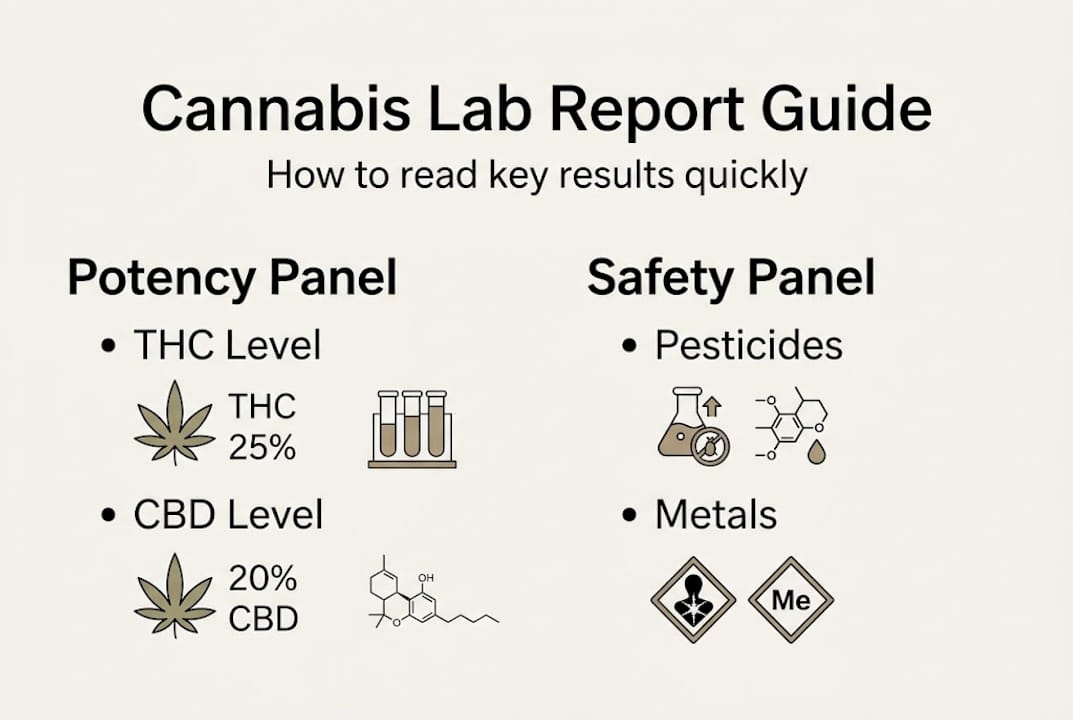
For anyone still learning to interpret these figures, a guide to understanding THC percentages can translate raw COA numbers into practical consumption guidance.
Once you understand what the report says, a closer look at how those results are produced helps ensure your trust is well-placed.
Not all COAs are created equal, and the same product tested by two different labs can produce slightly different numbers. This isn’t necessarily fraud — it reflects genuine differences in testing methodology, equipment calibration, and reporting conventions.
One of the most important nuances involves how cannabinoids are reported. Cannabis contains cannabinoids in both acidic and neutral forms. THCA is the acidic precursor to THC; it converts to THC through heat (a process called decarboxylation). Some labs report only the neutral form (THC). Others report the acidic form (THCA). Many report a “Total THC” figure that combines both using a conversion formula. NIST analytical methods for cannabinoids highlight exactly these issues with multiple cannabinoids, isomers, and the reporting of Total THC.
Here’s what to watch for when reading the methodology section of a COA:
Understanding the difference between THC vs CBD reporting is also relevant here, since some COAs bundle or separate these figures in ways that can be confusing without context.
Pro Tip: When comparing products from different producers, try to find COAs from labs that use the same reporting conventions. Comparing a “Total THC” figure from one lab to a “THC only” figure from another is like comparing apples to oranges.
Most people who glance at a COA are looking for one of two things: the THC percentage or a “pass” stamp. They find what they’re looking for, feel reassured, and move on. That’s understandable. But it means they’re leaving most of the value of the document on the table.
The real power of a COA is in the details that most consumers overlook. A mismatched batch number. A sampling date from eighteen months ago. A pesticide panel that passes overall but shows borderline numbers in two categories. A residual solvent result that’s technically within limits but higher than other products you’ve seen. None of these are obvious at a glance, but all of them are meaningful.
Experienced cannabis consumers treat COAs the way a careful shopper treats a nutrition label — not as a formality, but as a genuine tool for decision-making. They compare COAs across products. They notice when a producer consistently shows comprehensive testing versus minimal panels. They recognise that a full COA guide is worth bookmarking and returning to as they build their knowledge.
The uncomfortable truth is that the cannabis market, even in regulated regions, still has variability in testing standards and reporting transparency. Some producers invest heavily in thorough, frequent testing. Others do the minimum required. A COA is the fastest way to tell the difference. Consumers who learn to interrogate these documents don’t just make safer choices — they make more repeatable ones. They find products that consistently deliver what they promise and build a shortlist of producers they trust based on evidence, not packaging design.
Ready to use this knowledge in practice? Green Society offers even more tools to help you shop wisely.
At Green Society, we believe informed consumers make better choices — and we’ve built our platform to support exactly that. Whether you’re exploring products for the first time or refining a well-established routine, our educational resources help you go beyond the label.
Start with our detailed guide to cannabis flower grading, which pairs perfectly with COA knowledge to help you evaluate quality from multiple angles. If you’re curious about concentrates, our cannabis concentrates guide explains what to look for in terms of both product type and lab results. Our product listings are backed by quality standards, and our team is committed to making sure you have the information you need before you buy. Shop with confidence, knowing you have the tools to read the evidence for yourself.
A COA is a lab-issued document listing test results for cannabinoids, contaminants, and other quality markers for a specific cannabis batch. COAs provide information on safety, quality, and potency, and must be produced by licensed third-party labs in regulated markets.
Check that the product name, batch or lot number, sampling date, and testing lab on the COA match your product’s packaging exactly. Consumer-facing COA guides emphasise verifying these identifiers as the most important consumer check.
Look for results covering pesticides, heavy metals, and microbial contaminants, and confirm each category is marked as passing. Contaminant testing ensures products are free from harmful substances across all major safety categories.
Label THC can differ because actual batch content varies by product type and growing conditions. Research shows labelling accuracy for THC is far lower for flower than for concentrates, making COA data the most reliable guide.
Do not rely on that COA as evidence of your product’s safety or quality. COA reading guides recommend contacting the seller directly or choosing a different product with a complete, verifiable report.