Free Shipping
on orders over $150.00
$40.00
$150.00
Add $110.00 more for free shipping!
-
×
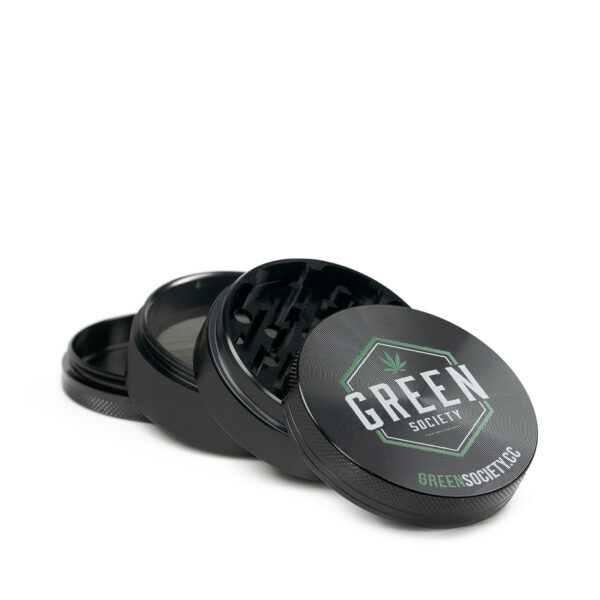 Green Society Herb Grinder
$40.00
Green Society Herb Grinder
$40.00


TL;DR:
- Full-spectrum cannabis extract retains all cannabinoids, terpenes, and flavonoids from the plant. It offers potential benefits through the entourage effect but carries a risk of THC buildup that can affect drug tests. Consumers should verify products with third-party lab reports and choose formats based on their desired onset and duration.
Full-spectrum cannabis extract is defined as a product that retains all naturally occurring cannabinoids, terpenes, and flavonoids from the cannabis plant in their original proportions. This includes primary compounds like THC and CBD alongside minor cannabinoids such as CBG, CBC, and CBN. Hemp-derived full-spectrum products sold in Canada and the United States must contain THC at or below 0.3% by dry weight to meet federal compliance standards. Understanding what full-spectrum means helps you choose the right product for your needs and avoid being misled by vague label claims.
Full-spectrum extract preserves the complete chemical profile of the cannabis plant, including every cannabinoid, terpene, and flavonoid present in the original plant material. This is what separates it from the two other major extract categories: broad-spectrum and isolate.
The differences between these three types are meaningful, not just marketing language.
| Extract type | THC present | Cannabinoids retained | Terpenes retained |
|---|---|---|---|
| Full-spectrum | Yes (≤0.3% hemp) | All, including minor cannabinoids | Yes |
| Broad-spectrum | No | Most, minus THC | Partially |
| Isolate | No | Single cannabinoid only (99%+ purity) | No |
Here is what each category means in practice:
The key distinction is complexity. Full-spectrum products carry the widest range of plant compounds. Broad-spectrum sits in the middle. Isolate is the simplest form. For a deeper comparison, Greensociety has a dedicated guide on full-spectrum vs isolate CBD worth reading before you buy.
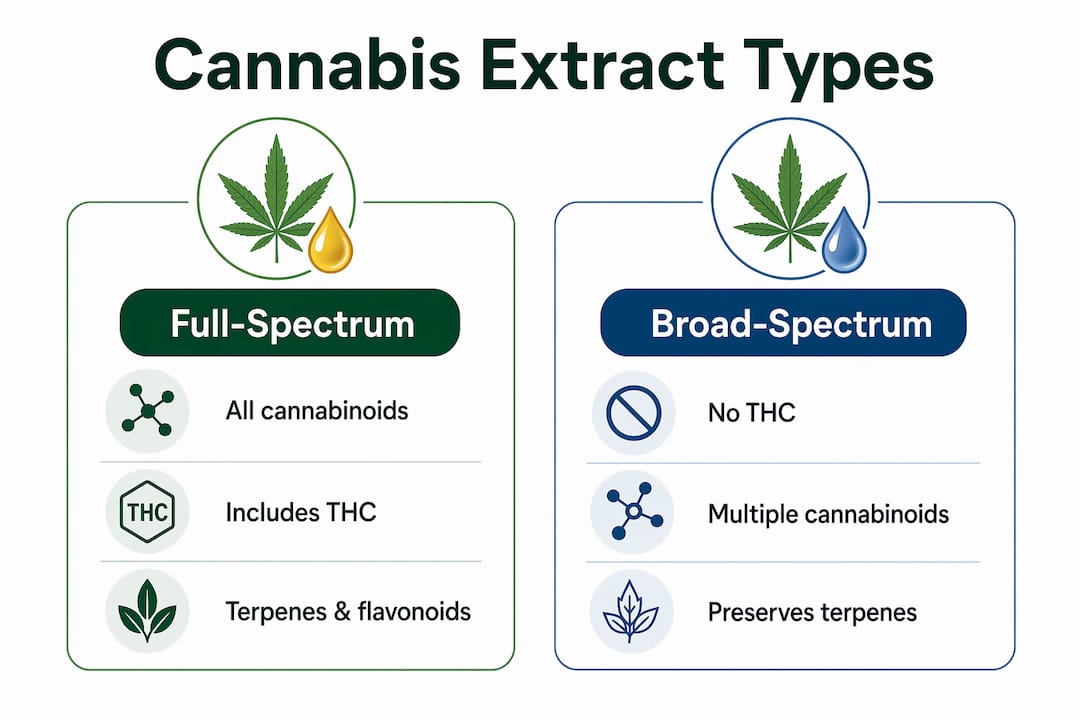
The primary argument for full-spectrum products centres on the entourage effect. This is the theory that cannabinoids and terpenes work together synergistically, producing effects greater than any single compound alone. You can read more about how this works in Greensociety’s breakdown of the entourage effect explained.
Therapeutic areas where full-spectrum products are most commonly used include:
That said, expert consensus advises separating marketing claims about “whole-plant” benefits from the still-limited clinical evidence. Large-scale human trials confirming that full-spectrum products consistently outperform isolates are not yet available. The entourage effect is a well-supported hypothesis, not a proven clinical outcome.
The THC content in full-spectrum products, even at legal trace levels, carries real risks for some users. High-dose or repeated use of full-spectrum hemp products can cause THC metabolites to accumulate in the body at levels sufficient to trigger a positive drug test. This is not a theoretical concern. If you are subject to workplace drug testing, full-spectrum products carry a genuine risk that broad-spectrum or isolate products do not.
Full-spectrum products with up to 0.3% THC are generally insufficient to cause intoxication at normal doses, but large amounts consumed regularly can produce mild psychoactive effects in sensitive individuals.
Pro Tip: If you are subject to drug testing at work, choose a broad-spectrum or isolate product instead of full-spectrum. The THC levels are legal, but metabolite build-up is real and can cost you a test.
Quality full-spectrum extraction starts with the source plant and the method used to pull compounds out of it. Two methods dominate the industry.
Supercritical CO2 extraction uses pressurised carbon dioxide to act as a solvent. It is precise, leaves no residual solvent in the final product, and preserves delicate terpene profiles better than most alternatives. This makes it the preferred method for producers prioritising entourage effect claims.
Ethanol extraction uses food-grade alcohol to strip cannabinoids and terpenes from plant material. It is faster and more scalable than CO2, though it requires careful post-processing to remove the solvent and unwanted plant compounds like chlorophyll.
After extraction, two processing steps are critical for product quality.
Winterisation chills the raw extract to remove fats, waxes, and lipids that would otherwise cloud the oil and affect its texture and stability. Skipping this step leaves a product that is less refined and harder to dose accurately.
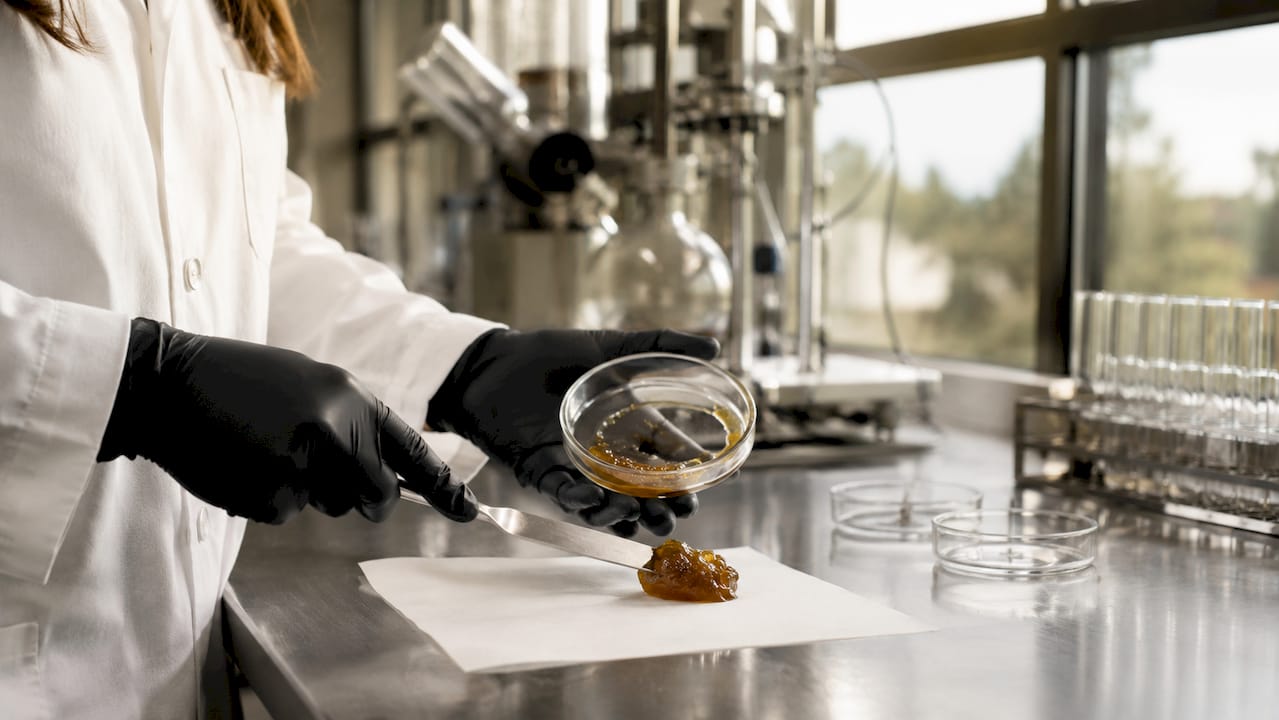
Decarboxylation applies controlled heat to convert raw acidic cannabinoids, such as CBDA and THCA, into their active bioavailable forms, CBD and THC. Without decarboxylation, the cannabinoids in an extract remain largely inactive.
No universally enforced regulatory definition for “full-spectrum” exists. Any producer can use the term on a label without meeting a specific standard. This means third-party certificates of analysis (COAs) are the only reliable way to verify that a product actually contains a representative range of cannabinoids and terpenes rather than reconstituted isolates blended together.
When reviewing a COA, check for:
Pro Tip: Always request or look up the COA before purchasing any full-spectrum product. If a brand does not publish COAs, treat the “full-spectrum” label as unverified.
Full-spectrum products are available in several delivery formats, and the format you choose affects how quickly you feel effects, how long they last, and how easy it is to control your dose.
Each format suits different lifestyles and goals. If you want long-lasting effects and do not mind a delayed onset, edibles work well. If you need fast relief and precise control, tinctures or vapes are better suited. Start with the lowest effective dose regardless of format, and increase gradually based on your response.
Full-spectrum cannabis extract delivers the broadest range of plant compounds available in any extract type, making it the most complex and potentially the most therapeutically rich option, but also the one requiring the most consumer diligence.
| Point | Details |
|---|---|
| Full-spectrum definition | Retains all cannabinoids, terpenes, and flavonoids from the cannabis plant, including THC at ≤0.3% for hemp products. |
| Entourage effect | Cannabinoids and terpenes may work synergistically, though large-scale clinical proof of superiority over isolates is still limited. |
| Drug testing risk | Repeated high-dose use can accumulate THC metabolites sufficient to trigger a positive drug test, even with legal THC levels. |
| Verify with COAs | No regulatory standard for “full-spectrum” exists; third-party certificates of analysis are the only reliable product verification. |
| Format affects experience | Tinctures, edibles, topicals, and vapes each offer different onset times, durations, and dosing precision. |
Most consumers buy full-spectrum products because they have heard it is the “strongest” or “most natural” option. That framing is not wrong, but it misses the point. Full-spectrum is not about potency. It is about complexity. A well-made full-spectrum tincture with 25mg of CBD per serving is not stronger than a 25mg isolate product in any simple sense. What it offers is a broader chemical conversation happening in your body at the same time.
Where I think the real value lies is in terpene diversity. Most people focus on cannabinoid content and ignore the terpene panel entirely. Terpenes like linalool, myrcene, and limonene contribute meaningfully to how a product feels, not just what it does. Two full-spectrum products with identical cannabinoid profiles can feel noticeably different because their terpene compositions differ. That is the part of the full-spectrum story that does not get enough attention.
My honest concern is the COA gap. Too many consumers buy full-spectrum products based on the label alone. The term has no legal definition in most markets, which means a producer can blend CBD isolate with a terpene mixture, call it full-spectrum, and not be technically lying. The only protection you have is the COA. Read it. If a brand does not publish one, move on.
The entourage effect is real as a concept, but the clinical evidence is still catching up to the marketing. Buy full-spectrum because you want the full plant profile and you have verified it with a lab report. Not because a label told you it was better.
— Juiced
Greensociety carries a wide selection of full-spectrum cannabis products, from tinctures and edibles to topicals and vape cartridges, all sourced from producers who provide third-party lab testing. Whether you are new to cannabis extracts or looking to refine your routine, the Greensociety catalogue makes it straightforward to find products that match your goals and dosing preferences.
If you are curious about edibles made with full-spectrum extracts, Greensociety’s guide on cannabis edible recipes is a practical starting point. For those selecting flower to understand what goes into a quality extract, the cannabis flower selection guide covers what to look for before you buy. Browse the full product range at Greensociety and shop with confidence knowing every product listing includes lab verification details.
Full-spectrum means the product contains the complete range of cannabinoids, terpenes, and flavonoids from the cannabis plant, including THC at or below 0.3% for hemp-derived products. Because no universal regulatory definition exists, always verify the claim with a third-party COA.
At legal hemp levels of 0.3% THC, full-spectrum CBD products are generally not intoxicating at normal doses. However, large or repeated doses can cause mild psychoactive effects in sensitive individuals and may cause THC metabolite accumulation.
Full-spectrum retains THC alongside all other cannabinoids and terpenes, while broad-spectrum removes THC through chromatography or distillation. Broad-spectrum sometimes loses minor cannabinoids and terpenes in that process, making it slightly less complex.
Yes. Even at legal THC concentrations, high-dose or frequent use of full-spectrum hemp products can build up enough THC metabolites in the body to exceed drug test detection thresholds. People subject to workplace testing should use broad-spectrum or isolate products instead.
Supercritical CO2 extraction is widely regarded as the best method for preserving terpene profiles and producing clean full-spectrum oil without residual solvents. Ethanol extraction is also effective when followed by proper winterisation and decarboxylation.