Free Shipping
on orders over $150.00
$0.00
$150.00
Add $150.00 more for free shipping!


TL;DR:
- Cannabis tolerance involves decreased receptor sensitivity and number due to repeated use.
- Tolerance reduces effects, leading to higher doses but also decreasing side effects over time.
- Strategic breaks and mindful consumption can reverse tolerance and maintain effectiveness.
The more you use cannabis, the less it seems to do. Sound familiar? This frustrating pattern catches many recreational and medical users off guard, leading to bigger doses, higher spending, and a growing sense that their favourite products just aren’t working anymore. But tolerance isn’t a sign that cannabis has stopped being effective. It’s a predictable, well-documented physiological response that you can actually work with rather than fight against. Understanding the science behind cannabis tolerance, how it shapes your day-to-day experience, and what you can do to manage it puts you back in control of your consumption.
| Point | Details |
|---|---|
| Tolerance is natural | Your body adapts to regular cannabis use, requiring adjustment over time. |
| Reduction is possible | Taking breaks and managing dose can reset or lower your tolerance quickly. |
| Tolerance has benefits | It can reduce side effects and improve symptom control, especially for medical users. |
| Smart dosing matters | Restart doses at much lower levels after breaks to prevent over-intoxication. |
| Optimisation is key | A strategic approach boosts effectiveness, enjoyment, and value from your cannabis use. |
Cannabis tolerance is your body’s way of adapting to a repeated chemical signal. When you consume cannabis regularly, your brain starts to compensate for the ongoing presence of THC by making its cannabinoid receptors less responsive. The result is a reduced effect from the same dose that once felt noticeable. This isn’t your imagination. It’s a measurable, biological process.
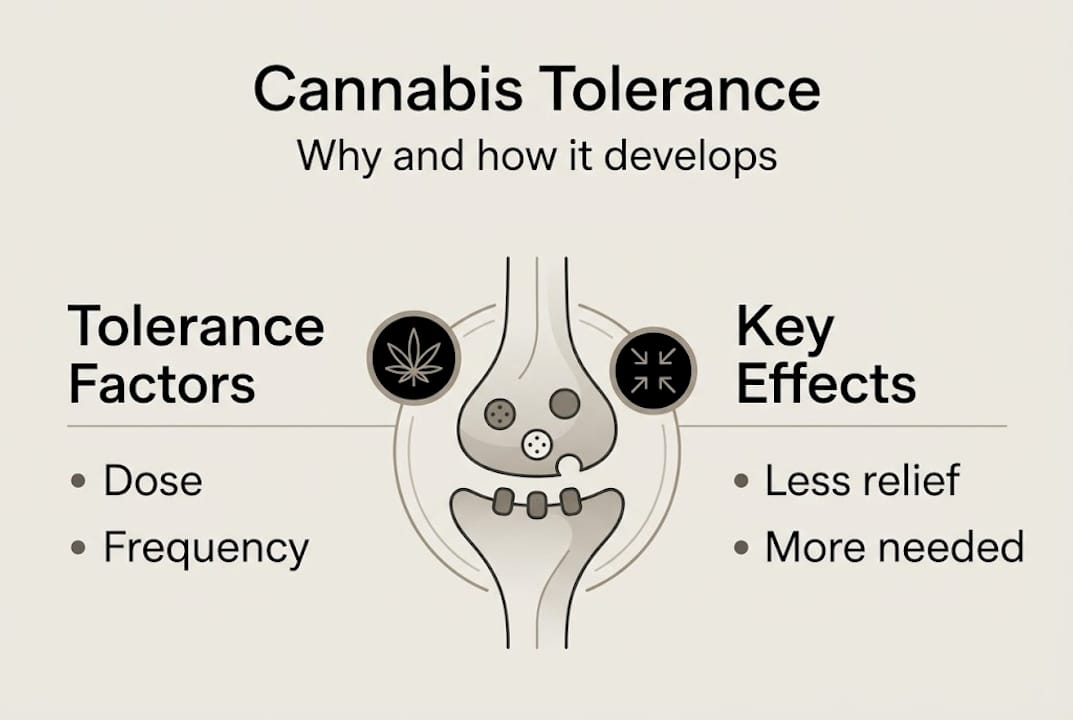
The science centres on a specific receptor type called CB1 (cannabinoid receptor type 1). These receptors are spread throughout your brain and nervous system, and they’re the primary target of THC. With repeated cannabis use, the brain reduces both the number of available CB1 receptors and their sensitivity through a process called receptor downregulation. Studies on CB1 receptor availability show that chronic users can have approximately 20% lower CB1 receptor availability compared to non-users, particularly in cortical regions like the prefrontal cortex and temporal cortex. This reduction correlates directly with how long and how frequently someone has been using cannabis.
Here’s what this means in practical terms:
“Tolerance is the body’s attempt to maintain equilibrium. It’s a sign that your endocannabinoid system is actively responding to your consumption habits, not that cannabis has permanently lost its effect.”
For medical cannabis users, tolerance can become a clinical issue when relief from symptoms like pain, anxiety, or nausea diminishes over time. For recreational users, tolerance means the enjoyable effects begin to dull. In both cases, understanding why this happens is the first step toward managing it intelligently.
One useful distinction worth knowing: tolerance to THC is much more pronounced than tolerance to CBD. If you’re curious about how these two compounds work differently in your body, our THC vs CBD guide breaks it down clearly. CBD interacts with the endocannabinoid system through different mechanisms and does not produce the same receptor downregulation that THC does.
The important takeaway is that tolerance is a normal, reversible phenomenon. It doesn’t mean you’ve damaged your receptors permanently. It simply means your current approach may need some adjustment.
With the basics in mind, let’s see how tolerance shapes your real-world experience.
The most immediate effect of rising tolerance is reduced potency perception. A strain or product that once delivered noticeable relaxation, pain relief, or euphoria starts to feel underwhelming. Many users respond by increasing their dose, switching to higher-THC products, or consuming more frequently. This can create a cycle of escalation that affects both your budget and your overall well-being.
| Experience level | Typical effect of same dose | Side effects | Symptom relief |
|---|---|---|---|
| New or infrequent user | Strong, noticeable high | More likely (anxiety, dizziness) | High initial impact |
| Moderate regular user | Moderate effects | Reduced over time | Moderate and consistent |
| Experienced heavy user | Minimal noticeable effect | Much lower | Diminished per session |
Data from a large-scale analysis of over 120,000 sessions reveals a clear trend: there is approximately a 0.5% decrease in symptom relief per subsequent cannabis session, and experienced users demonstrate significantly stronger tolerance profiles. The same data confirms that while higher THC doses can partially compensate for this reduced relief, they also increase the likelihood of unwanted side effects, including anxiety, cognitive fog, and rapid heart rate.
This creates a real tension. You use more to get the same effect, but using more also raises the risk of experiencing side effects you may have originally avoided. It’s worth pausing and assessing your consumption patterns before automatically reaching for a stronger product or a larger dose.
Statistic to know: A review of cannabis session data shows experienced users require measurably higher doses to achieve comparable symptom relief, while simultaneously being less likely to experience the side effects that new users often encounter.

Pro Tip: Before increasing your dose, try switching your timing instead. Consuming cannabis at a different time of day, particularly in the evening if you’ve been a daytime user, can temporarily restore some sensitivity without requiring a full tolerance break.
For practical guidance on keeping your dose appropriate to your experience level, cannabis dosage guidelines offer a structured framework. And if you want a more hands-on approach to calibrating your dose over time, the step-by-step dosing guide walks you through a systematic process.
One genuinely underappreciated aspect of tolerance is that it doesn’t affect all effects equally. Pain relief may diminish faster than sleep support in some users. Euphoric effects may fade before appetite stimulation does. This means that tolerance is not a uniform blanket over your entire experience. It’s worth tracking which specific effects are fading and which remain, so you can make informed decisions rather than assuming everything has stopped working at once.
If your tolerance is rising, what can you do about it? Let’s review proven strategies.
The good news is that tolerance is entirely reversible. Your CB1 receptors don’t disappear permanently. They recover. PET imaging studies show a clear timeline for this recovery: receptor upregulation begins within 48 hours of stopping cannabis use, significant recovery (approximately 80% of baseline receptor availability) is achieved within one to two weeks of abstinence, and a full reset to levels comparable to non-users occurs after 28 days of continuous abstinence.
Here’s a simple overview of the recovery timeline:
| Time since last use | Recovery status | What you’ll likely notice |
|---|---|---|
| 48 hours | Initial upregulation begins | Subtle sensitivity returning |
| 1 week | Moderate recovery (~50%) | Noticeably stronger effects at same dose |
| 2 weeks | Significant recovery (~80%) | Near-normal sensitivity |
| 4 weeks (28 days) | Full reset | Back to baseline receptor availability |
For many people, a full 28-day abstinence period isn’t realistic or necessary. Strategic short breaks are often more practical and surprisingly effective for maintenance:
Pro Tip: If you use cannabis medicinally and a full break isn’t feasible, consider alternating between methods of consumption. Medicinal cannabis consumption methods vary in bioavailability, meaning switching from, say, inhalation to edibles or vice versa can temporarily shift how your body processes cannabinoids and partially offset tolerance.
You don’t need to see a tolerance break as a punishment. Think of it as a recalibration. A short pause protects both your sensitivity to cannabis and your spending. For broader context on keeping your habits safe and sustainable, safe cannabis use tips provide practical, evidence-informed guidance.
Resetting tolerance is not always the answer. It’s important to understand the advantages tolerance sometimes brings.
Most conversations about cannabis tolerance frame it entirely as a negative. But tolerance is not purely a problem. For many users, particularly those consuming cannabis for medical purposes, tolerance can actually be a functional benefit worth preserving under the right conditions.
Consider these scenarios where tolerance works in your favour:
As research from large-session analyses confirms, while therapeutic relief does decrease with tolerance over many sessions, side effects decrease in parallel. This means an experienced medical user is often trading peak relief for consistent, manageable relief with far fewer uncomfortable side effects. For some users, that’s an entirely acceptable trade-off.
“The goal isn’t always to maximise your high. Sometimes the goal is steady, reliable symptom control with minimal disruption to your daily life. Tolerance can help achieve that.”
A balanced approach recognises that optimal cannabis use isn’t about chasing the most intense effect. It’s about matching your consumption to your actual goals. If you’re using cannabis for sleep, you need a different tolerance profile than someone managing daytime pain. Choosing strains for pain relief that align with your specific symptoms and tolerance level is a far more nuanced strategy than simply switching to higher THC products when relief diminishes.
Customising your cannabis practice around your own tolerance level, rather than defaulting to escalation or unnecessary breaks, is where genuine long-term satisfaction lives.
Here’s what most cannabis guides get wrong: they treat tolerance as a binary issue. Either you break it completely through extended abstinence or you just accept diminishing returns. Neither extreme is particularly helpful for the majority of users.
After understanding the science and the nuance, it becomes clear that strategic tolerance management is a far more sophisticated and effective approach. The evidence shows that tolerance is reversible and not pathological, meaning there’s no need for alarm and certainly no need for dramatic, unsustainable behaviour changes.
What we believe in, based on the research and real user experience, is the concept of purposeful consumption. This means knowing why you’re using cannabis, tracking how your body responds over time, and proactively adjusting your approach before escalation becomes necessary. It means viewing a two-day break not as deprivation but as a tool that keeps your consumption efficient and cost-effective.
We think the broader cannabis community benefits when users shift away from the idea that more is better. Higher doses, stronger products, and back-to-back sessions aren’t signs of savvy consumption. They’re often signs that tolerance has taken the wheel. Our dosing for optimal results resource reflects this philosophy directly.
Strategic tolerance management protects your wallet, preserves product effectiveness, and keeps your cannabis experience genuinely enjoyable or genuinely therapeutic for years rather than months.
Ready to put your knowledge into action? Here’s how you can improve your cannabis experience today.
Understanding tolerance is just the beginning. Applying that understanding through smart product choices, mindful dosing, and the right accessories makes the real difference.
At Green Society, we carry a curated selection of cannabis products across all categories, from flowers and concentrates to edibles and vapes, so you can match your product choice to your tolerance level and consumption goals. Before you change what you consume, it helps to revisit how you consume it. Our cannabis accessories guide covers the tools that support precise, consistent consumption. And if you’re recalibrating after a tolerance break, revisiting dosage guidelines ensures you restart safely and effectively.
Most CB1 receptors recover significantly within one to two weeks of abstinence, with a full reset achieved after 28 days of continuous non-use.
Tolerance is not harmful and reversible, and it can actually reduce unwanted side effects like anxiety or dizziness that some users experience at higher doses.
Yes. Using higher THC doses consistently accelerates the development of tolerance and increases the likelihood of side effects over time.
Frequent short breaks, even 48 hours per week, are highly effective for managing tolerance and keeping your cannabis effects consistent without requiring prolonged abstinence.
Medical users benefit from active tolerance management because it can preserve symptom control, reduce side effects, and prevent the escalating dose cycle that increases cost and risk over time.