Free Shipping
on orders over $150.00
$40.00
$150.00
Add $110.00 more for free shipping!
-
×
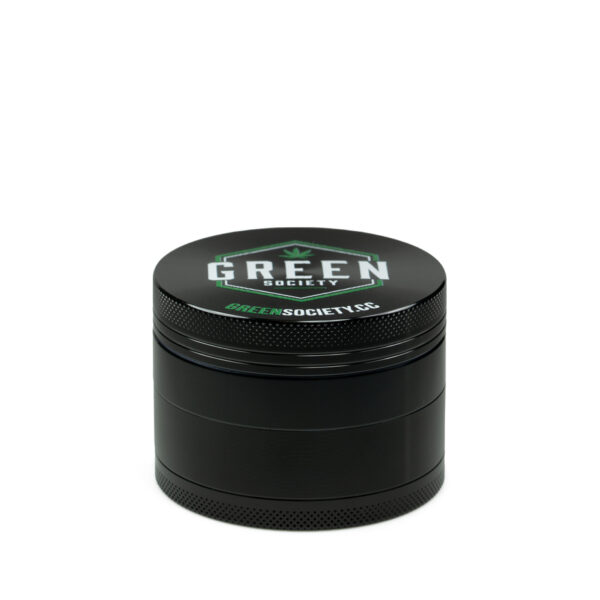
 Green Society Herb Grinder
$40.00
Green Society Herb Grinder
$40.00


TL;DR:
- A cannabis connoisseur evaluates cannabis through structured sensory assessment rather than usage or brand recognition.
- The Ganjier Systematic Assessment Protocol standardizes evaluation across appearance, aroma, flavor, and effects using measurable criteria.
A cannabis connoisseur is defined as someone who deliberately evaluates and appreciates cannabis through sensory experience and informed judgement, not through frequency of use or brand recognition alone. The term “cannabis appreciation expert” is gaining traction in professional circles, but the formal industry term is connoisseur, a word borrowed directly from wine and food culture to describe a person with trained, intentional taste. Defining cannabis connoisseur accurately means separating it from casual heavy use. A connoisseur focuses on aroma, flavour, smoke or vapour smoothness, and the arc of effects over time. Frameworks like the Ganjier Systematic Assessment Protocol (SAP) now formalise this evaluation, giving the practice a shared language and measurable standards.
Cannabis connoisseurship emphasises sensory evaluation across four core dimensions: aroma, flavour, smoke feel, and timed effects. Each dimension tells you something different about quality, and missing any one of them leaves your assessment incomplete.
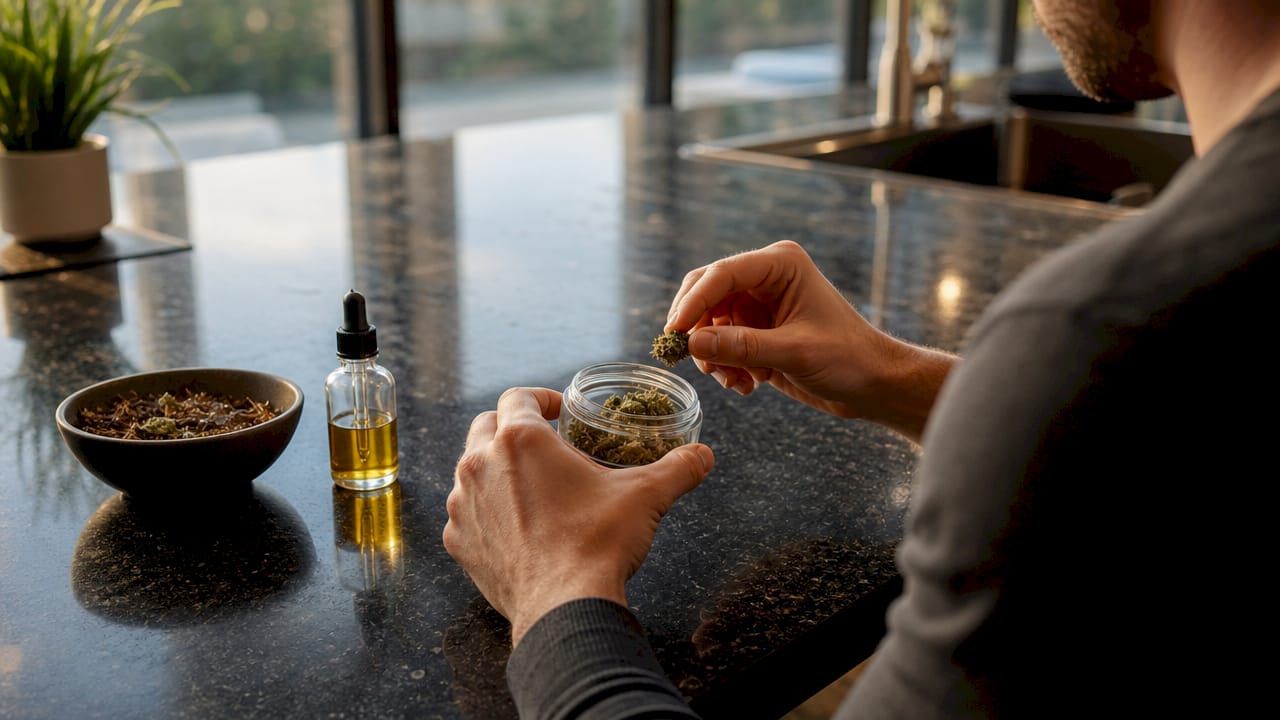
Aroma is the first and most telling indicator. Experienced connoisseurs treat the initial smell as a rich information source, evaluating it both before and after grinding. A complex, layered scent profile signals healthy terpene content. A flat or chemical smell signals degradation, poor curing, or contamination. Connoisseurs also verify that the flavour they taste matches the aroma they detected. A mismatch between smell and taste is a red flag for product degradation.
Flavour is evaluated as a progression, not a single note. The first inhale, the mid-palate, and the finish can all differ. A high-quality sample delivers a flavour arc that mirrors its aroma. A low-quality sample often tastes harsh, flat, or chemically off, regardless of its THC percentage.
Smoke or vapour feel directly affects how clearly you can assess flavour. Irritation, harshness, or excessive coughing masks the subtler notes in a sample. Smoothness is not just a comfort preference. It is a quality signal.
Effects are tracked over time, not just at the peak. A connoisseur notes onset speed, character (physical vs. mental), duration, and the quality of the comedown. This temporal tracking separates intentional evaluation from casual consumption.
Pro Tip: Smell the sample twice: once from the sealed container and once immediately after grinding. The difference between those two moments tells you a great deal about terpene preservation and curing quality.
The Ganjier Council is the leading professional body standardising cannabis quality evaluation. Its Systematic Assessment Protocol gives connoisseurs a structured, repeatable method for scoring cannabis, modelled closely on the wine sommelier tradition.
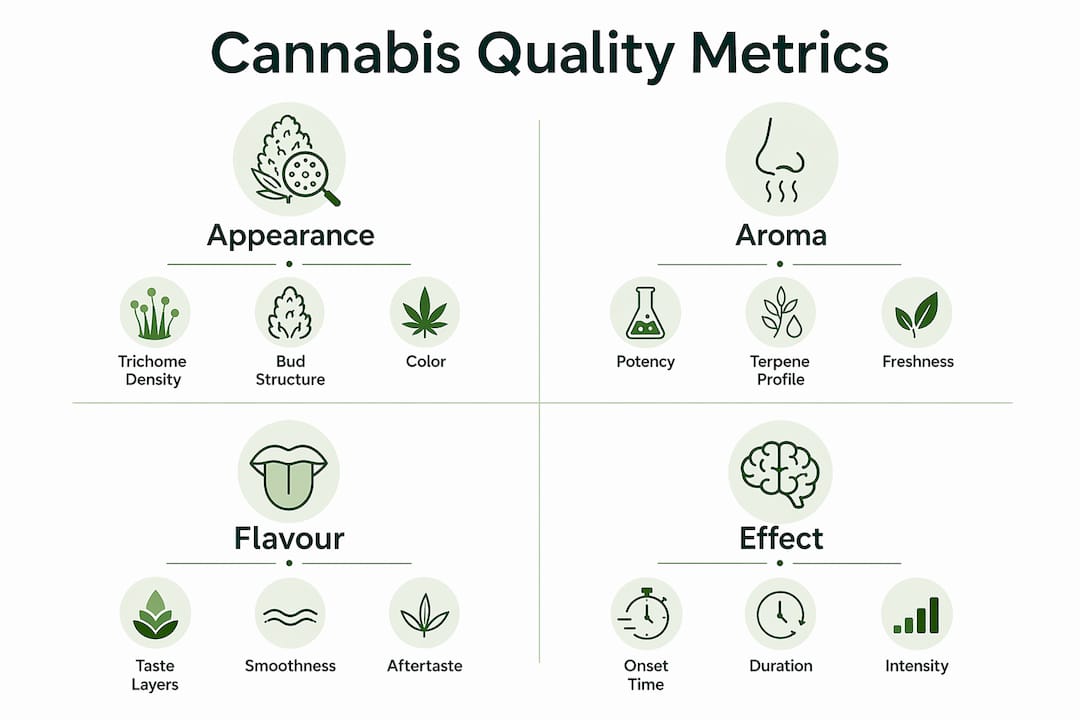
The SAP evaluates cannabis across four categories:
Candidates pursuing Ganjier certification train hands-on and pass a three-part exam. Samples are scored on a 100-point scale, directly analogous to wine industry scoring systems. This structure removes the subjectivity that plagues informal cannabis conversations and replaces it with consistent, communicable quality descriptors.
| SAP category | What it measures | Why it matters |
|---|---|---|
| Appearance | Visual quality and trichome coverage | Indicates cultivation and curing standards |
| Aroma | Scent complexity and intensity | Reflects terpene richness and freshness |
| Flavour | Taste evolution and aroma match | Confirms product integrity and quality |
| Experience | Effects onset, character, and duration | Measures the full consumption outcome |
Professional connoisseurship is fundamentally about creating a shared language. The Ganjier Council describes connoisseurs as translators who clarify quality descriptors so that expectations carry consistently across different markets and consumers. That function is what separates a trained evaluator from someone who simply has strong personal preferences.
The SAP also separates objective traits from subjective preference. This prevents a common evaluation error: letting personal liking skew quality scoring. A connoisseur can score a sample highly on objective criteria even if its flavour profile is not personally preferred.
Pro Tip: When practising SAP-style evaluation at home, score each category separately before forming an overall impression. Combining them too early lets one strong trait, like an exceptional aroma, inflate your score for a weaker flavour.
Strain names are inconsistent marketing labels, not reliable quality indicators. The same name, such as “Blue Dream” or “OG Kush,” can describe plants with significantly different genetics, cannabinoid ratios, and terpene profiles depending on the grower, region, and batch. Strain names are less reliable than verified chemical profiles for predicting the actual experience a product will deliver.
The more reliable approach is reading lab reports directly. THC percentage, CBD percentage, and terpene profiles give you a factual basis for comparison. Terpenes like myrcene, limonene, and caryophyllene each correlate with distinct sensory and effect characteristics. A lab-verified terpene profile gives you far more predictive power than a strain name ever will.
That said, chemistry alone does not tell the full story. GC-MS terpene analysis reveals that terpene profiles alone do not reliably predict perceived aroma. Complex terpene interactions produce aromas that differ from what individual compound measurements would suggest. This is why sensory evaluation remains essential even when you have access to detailed lab data.
| Evaluation method | Strengths | Limitations |
|---|---|---|
| Strain name | Easy to remember and share | Genetically inconsistent across sources |
| THC/CBD percentage | Objective potency indicator | Does not predict flavour or effect character |
| Terpene lab profile | Predicts likely sensory and effect traits | Multi-compound interactions affect actual aroma |
| Sensory evaluation | Captures real experience directly | Requires training and consistent conditions |
Terpene chemistry measured by headspace solid-phase microextraction paired with GC-MS is the preferred analytical method for cannabis terpene quantification. Understanding this technique is not required for everyday evaluation. Knowing that the method exists and that its results have limits is enough to keep your assessments grounded.
Connoisseurship is distinct from casual heavy use. It centres on care for quality, intentional evaluation, and informed choice, not consumption frequency. That means anyone can begin developing these skills regardless of how long they have been consuming cannabis.
The most effective starting point is intentional consumption at lower doses. High doses reduce your ability to distinguish subtle sensory details. A smaller, consistent dose in a calm environment gives your senses the clarity they need to actually evaluate what you are experiencing.
Keeping a journal and using consistent sensory evaluation methods build connoisseurship by revealing personal preferences and reliable quality indicators over time. The journal does not need to be elaborate. A simple record of aroma, flavour, smoothness, and effects for each session is enough to start identifying patterns.
Consistent environments and methods reduce confounding factors in cannabis evaluation. Using the same consumption device, the same dose size, and the same setting each time you evaluate a new sample means the only variable is the product itself. This is the same logic professional tasters use in wine, coffee, and spirits.
Pro Tip: Before your first evaluation session, cleanse your palate with still water and avoid strong foods or coffee for at least an hour. Your aroma and flavour perception is far more accurate on a neutral palate.
A cannabis connoisseur is defined by intentional sensory evaluation, structured assessment methods, and chemistry-informed choices, not by consumption volume or strain name familiarity.
| Point | Details |
|---|---|
| Sensory evaluation is the foundation | Assess aroma, flavour, smoothness, and timed effects to form a complete quality picture. |
| Ganjier SAP provides a professional standard | The 100-point protocol scores Appearance, Aroma, Flavour, and Experience for consistent evaluation. |
| Strain names are unreliable | Lab-verified terpene and cannabinoid profiles predict experience far more accurately than strain labels. |
| Chemistry and sensory data work together | Terpene lab results guide expectations, but sensory evaluation is still required to confirm actual quality. |
| Journaling builds skill over time | Recording consistent observations after each session reveals personal preferences and quality patterns. |
I have spent enough time around cannabis culture to notice a persistent gap between people who know a lot about cannabis and people who actually know how to evaluate it. Those are not the same thing. Rattling off strain names or THC percentages is not connoisseurship. It is trivia. Real connoisseurship is slower, quieter, and more personal than the culture often makes it look.
The shift that matters most is moving from “what is the strongest option” to “what is the most interesting option.” Potency is easy to measure. Complexity is not. A sample with a rich, layered terpene profile and a moderate THC level will almost always deliver a more memorable experience than a high-THC product with nothing else going on. The Ganjier movement is right to push for a shared evaluative language. Without it, quality conversations in cannabis stay stuck at the level of marketing copy.
My honest advice for anyone starting out: resist the urge to rush. Connoisseurship is not a destination you reach after trying enough products. It is a practice you build by slowing down, paying attention, and writing things down. The journal is not optional. It is where your actual preferences live, separate from what the industry tells you to want.
— Juiced
Greensociety carries a curated selection of cannabis flower with lab-tested terpene and cannabinoid information, giving you the data you need to evaluate products before they arrive at your door.

The Greensociety blog covers the practical side of connoisseurship in depth. You can learn how to select cannabis flower online with confidence, work through the cannabis strain selection workflow for 2026, or check the cannabis flower checklist before your next purchase. Whether you are building your first evaluation journal or refining a method you have used for years, Greensociety gives you the products and the knowledge to make every session count.
A cannabis connoisseur is a person who evaluates cannabis deliberately through sensory assessment of aroma, flavour, smoothness, and effects, prioritising quality and informed choice over consumption frequency.
Connoisseurship centres on intentional evaluation and quality-focused selection, not how often or how much someone consumes. A connoisseur rejects the cheapest or strongest option in favour of the most interesting and well-crafted one.
The Ganjier Systematic Assessment Protocol is a professional cannabis evaluation framework that scores samples across Appearance, Aroma, Flavour, and Experience on a 100-point scale, modelled on wine sommelier standards.
Strain names are inconsistent marketing labels and are not reliable predictors of experience. Lab-verified terpene profiles and cannabinoid percentages provide a far more accurate basis for selection.
Begin with consistent, moderate doses in a calm setting, keep a simple journal recording aroma, flavour, smoothness, and effects, and learn to read lab reports focusing on terpene profiles alongside THC and CBD percentages.