Free Shipping
on orders over $150.00
$0.00
$150.00
Add $150.00 more for free shipping!


TL;DR:
- Buying cannabis online in 2026 involves complex legal considerations, including regional, product, and regulatory differences. Federal, provincial, and state laws vary, making it essential to verify licences, product classification, age restrictions, and shipping rules before purchase. Staying informed about evolving regulations is crucial to ensure compliance and responsible purchasing.
Buying cannabis online sounds straightforward in 2026, but the legal reality is far messier than a simple “yes, it’s legal here” can capture. The laws governing online cannabis purchases shift depending on whether you’re buying for medical or adult-use purposes, which platform you use, and whether federal and provincial or state rules align. Recent major changes in the United States and Germany have reshuffled what was already a complicated picture. This article cuts through the confusion so you can make informed, compliant purchases wherever you are.
| Point | Details |
|---|---|
| Legality is layered | Laws for buying cannabis online depend on both federal and local rules, and can differ even within a country. |
| Medical vs adult-use | Online sale legality often splits between medical and recreational products, each with their own requirements. |
| Laws change fast | Policy shifts may quickly affect whether online cannabis sales or deliveries are legal in your area. |
| Verify before buying | Always confirm both seller authorisation and your own eligibility to avoid breaking laws or risking scams. |
When most people learn that cannabis has been legalised in their region, they assume that ordering it online is also fair game. That assumption causes real legal problems. Legalisation and the right to purchase online are two separate questions, and conflating them can leave you in a genuinely vulnerable position.
The first layer of complexity is the divide between federal and provincial or state authority. In Canada, for instance, the federal Cannabis Act legalised cannabis nationally, but each province controls how it is sold, including whether licensed online retailers can operate. In the United States, federal law still heavily restricts cannabis, while individual states have created their own frameworks. Neither country is a single, unified market for online cannabis.
The second layer involves the type of purchase. Legal cannabis online means something different depending on whether you are purchasing an FDA-approved medical product, a state-licensed medical product, or an adult-use recreational product. Each category can attract a different set of rules, different age verification requirements, and different shipping restrictions.
As legal analysis makes clear, online cannabis legality is not only about whether a region has legalised cannabis — it also depends on whether the specific transaction fits the legal category, such as adult-use versus medical, and whether the product falls under the relevant federal or state classification rules.
The key criteria that determine whether an online cannabis purchase is legal include:
Understanding these criteria is the foundation for every purchasing decision you make. Miss one, and what feels like a legal purchase may not be.
With the basics defined, it helps to see how different major jurisdictions tackle online cannabis legality — especially when those rules conflict or rapidly change.
The United States operates under a genuinely fragmented system. At the federal level, the Controlled Substances Act has long classified cannabis as a Schedule I substance. In April 2026, the Department of Justice issued an order that rescheduled FDA-approved and state-licensed medical marijuana to Schedule III — a significant shift for patients accessing medical cannabis. However, adult-use cannabis was explicitly described as unaffected by this order. That means recreational online purchases in the U.S. remain governed entirely by state law, without any new federal cover.
Each U.S. state decides independently whether online purchases are permitted, which product categories qualify, and how deliveries must be handled. California allows some licensed delivery services. Other states prohibit online ordering entirely and require in-store visits. If you live near a state border, the rules can change completely within a few kilometres.
Germany offers an equally instructive contrast. Germany legalised limited adult-use cannabis possession in 2024 and had established telemedicine pathways that allowed patients to receive medical cannabis prescriptions and deliveries through online systems. That convenience has been targeted for removal. Germany’s government moved to restrict online and mail-order purchasing for medical cannabis, citing concerns about prescription oversight and misuse of telemedicine loopholes.
| Feature | United States (medical) | United States (adult-use) | Germany (medical) |
|---|---|---|---|
| Federal framework | Schedule III (from April 2026) | Schedule I (unchanged) | EU regulations apply |
| Online ordering permitted | Varies by state | Varies by state | Being restricted |
| Telemedicine prescribing | Some states allow | Not applicable | Being removed |
| Mail-order delivery | Very limited | Generally not permitted | Being banned |
| Age verification required | Yes (21+ in most states) | Yes (21+ in most states) | Yes (18+) |
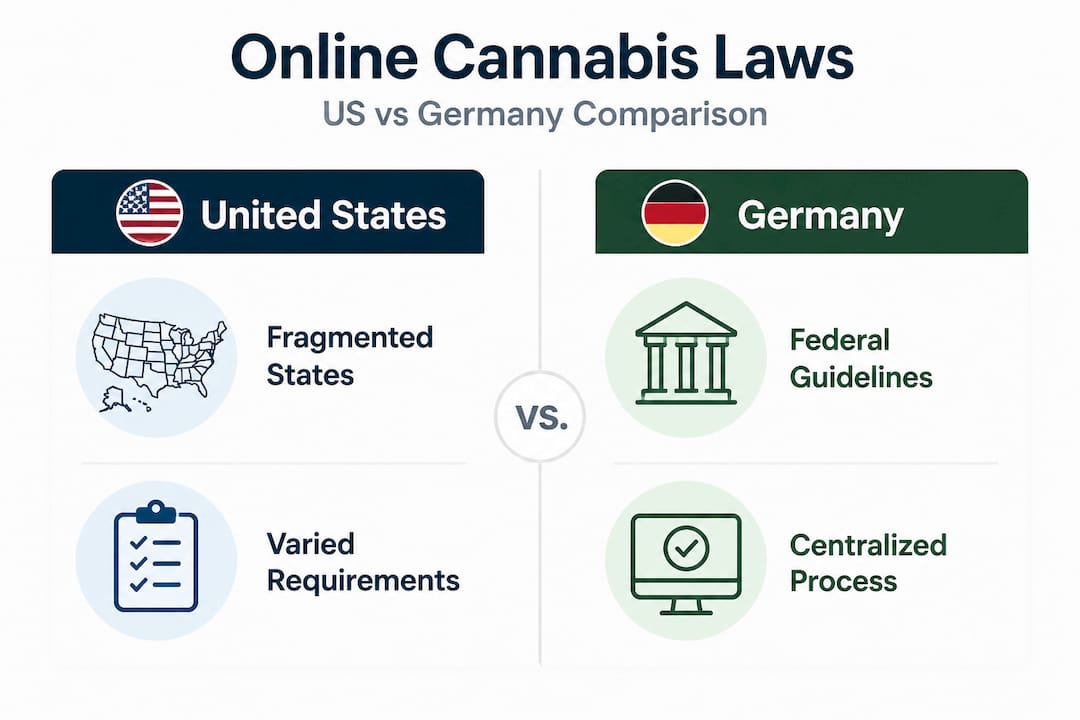
This table makes it clear that even within a single country, the rules for medical and adult-use cannabis online purchases are starkly different — and those rules can tighten without much public notice.
Pro Tip: Before you place an online cannabis order, confirm not just that cannabis is legal in your region, but that your specific retailer, product category, and delivery method are all covered under current regional rules. Check the retailer’s licence status directly with your provincial or state regulator.
For Canadians looking to understand how their specific rules apply, reviewing Canadian cannabis laws is a strong starting point, as the provincial regulatory differences are significant and frequently updated.
Seeing the global scope, let’s bring it back to current events so you understand how each new law or ruling directly influences your choices online.
The April 2026 DOJ order in the United States was a landmark moment. It rescheduled certain medical cannabis products, potentially reducing some federal penalties for qualifying operators. But adult-use cannabis remains Schedule I federally, and a separate DEA hearing is still pending to determine whether adult-use products might eventually follow. Until that hearing concludes, any online purchase of recreational cannabis in the U.S. exists in a legal zone shaped entirely by state law. As legal experts note, online ordering legality in the U.S. is best understood as state-authorised transactions layered on top of an evolving but still restrictive federal framework.

Here is a summary of key developments affecting online buyers in 2026:
| Date | Jurisdiction | Change | Impact on online buyers |
|---|---|---|---|
| April 2026 | United States (federal) | Medical cannabis rescheduled to Schedule III | Reduced federal risk for medical operators; adult-use unchanged |
| 2025 (enacted) | Germany | Online/mail-order medical cannabis targeted for ban | Patients lose telemedicine delivery access |
| Ongoing | Various U.S. states | State-by-state regulatory updates | Buyers must check individual state rules constantly |
| 2024 onwards | Canada | Provincial licence renewals and platform compliance updates | Some online retailers face new audit requirements |
For anyone navigating cannabis shipping laws as a buyer, these changes have immediate practical consequences. A retailer that was fully compliant in 2024 may now need updated licences or may face new restrictions on which products it can ship and where.
Here is a step-by-step process for verifying whether your online cannabis order is legal:
Understanding the risk of online cannabis purchases at this level of detail is not paranoia. It is simply how responsible adult consumers protect themselves in a landscape that shifts frequently and without much public warning.
With legal changes constantly in flux, it is vital to stay aware of the pitfalls that can trip up even experienced online cannabis shoppers.
The most dangerous assumption you can make is that what was legal six months ago is still legal today. Germany’s shift on online medical cannabis sales is a perfect illustration. Legal online ordering can change rapidly due to regulatory amendments — patients who relied on telemedicine and mail-order services built their routines around a system that is being dismantled. That same kind of disruption can happen in any jurisdiction.
Common mistakes online cannabis buyers make include:
Pro Tip: Bookmark your provincial or state cannabis regulator’s website and check it before placing any new order, particularly if you have not purchased online in the past few months. Regulations update more frequently than most consumers realise, and the regulator’s site is always more current than any third-party summary.
For those looking for Canadian insights on legal purchasing, the Canadian framework offers more stability than the U.S. system, but provincial differences still require attention. And understanding why legal online buying is safer goes beyond avoiding fines: it also means access to quality-tested products, transparent ingredient information, and reliable shipping.
After reviewing the biggest pitfalls, it is worth taking a step back and recognising the broader reality behind the supposed simplicity of “legal online cannabis.”
Here is what does not get said often enough: legal frameworks for cannabis online purchasing are not just complex — they are actively unstable. Most people approach online cannabis the way they approach buying a book or a piece of clothing. They find a website, add to cart, and pay. The assumption is that if the website exists and appears professional, someone has already sorted out whether the sale is lawful.
That assumption is borrowed from regulated industries that have had decades to mature. Cannabis has not had that time. And the risks of online legality are not theoretical. Germany’s patients built real habits around legal telemedicine cannabis access and are now watching that access be legislated away. U.S. consumers in adult-use states are purchasing products that remain federally classified as Schedule I substances, with only state law standing between them and federal exposure.
The grey zones are not always obvious either. Products that cross the medical and adult-use boundary — high-CBD formulations, for instance, or products with specific therapeutic dosages — can fall into ambiguous regulatory categories that neither the medical framework nor the adult-use framework cleanly covers. When regulators update their rules, those products are often the first to be pulled from legal online channels.
Our strong belief, built from watching this landscape evolve, is that responsible purchasing requires ongoing engagement. Past experience with a platform or product does not guarantee future legal safety. The consumer who feels most confident because they have “been doing this for years” is often the one most surprised when rules change. Staying current is not optional — it is the core competency of being a legal, informed cannabis buyer in 2026.
Staying compliant means not just reading about the law, but choosing safe, vetted sellers and resources for your cannabis journey.
At Green Society, we are committed to being a transparent, reliable platform for Canadians purchasing cannabis online. Whether you are exploring edible recipes and tips to make the most of your purchase, working through a cannabis flower checklist to find the right strain, or looking for guidance on tools through our cannabis accessories guide, we have resources to support every step of your experience. Our product listings are sourced from vetted vendors, and our platform operates within Canadian legal requirements. Browse with confidence, knowing that compliance and quality are built into everything we offer.
Yes, medical and adult-use cannabis often follow separate legal pathways and rules — even within the same country or province. Adult-use cannabis is unaffected by the DOJ’s April 2026 federal rescheduling order, while qualifying medical marijuana may fall under the new Schedule III framework.
Usually not. Online sales must follow your local laws, and international shipping of cannabis is typically prohibited regardless of the seller’s legal status. Online ordering legality is governed by your jurisdiction, not the seller’s.
Not always. Local and provincial authorities may set their own rules on top of federal law, and local compliance remains required. The April 2026 federal order created a framework for state-licensed medical operators while leaving adult-use and state-specific rules untouched.
Most regions require proof of a current medical prescription or licence, and some mandate an in-person consultation before online ordering is permitted. Germany’s proposed changes specifically require an in-person doctor visit before a prescription can be issued.
Monitor your provincial or state cannabis regulator’s website regularly and follow trusted industry publications for updates. Legal rules can change with little public notice, so building a habit of checking official sources before purchasing is the most reliable protection.