Free Shipping
on orders over $150.00
$0.00
$150.00
Add $150.00 more for free shipping!


TL;DR:
- Cannabis legalization removes criminal prohibition and establishes regulatory controls, which vary by jurisdiction.
- Understanding local laws, especially age limits, possession caps, and licensing requirements, is essential for lawful use and purchase.
Most people assume cannabis legalization simply means it’s legal to use. That assumption gets a lot of people into trouble. What is cannabis legalization, really? It’s a layered legal framework that removes criminal prohibition while introducing specific regulatory controls: age limits, possession caps, licensing requirements, and rules that vary dramatically depending on where you live. Understanding those layers isn’t just useful for curious readers. It’s necessary for anyone who wants to consume, purchase, or simply stay on the right side of the law.
| Point | Details |
|---|---|
| Legalization is not just decriminalisation | Legalisation adds regulatory controls like age limits and licensing, making it fundamentally different from simply removing criminal penalties. |
| Laws differ by jurisdiction | Cannabis laws vary widely between countries, provinces, and states, so knowing your local rules matters more than knowing the general concept. |
| Federal and provincial law can conflict | In countries like the U.S., federal prohibition and state-level legalisation create complex compliance situations for users and businesses alike. |
| Public health research is mixed | Studies show increased use after legalisation but inconclusive results on traffic safety and brain development, which shapes ongoing policy debates. |
| Practical compliance starts locally | Always verify your province or state’s specific rules on possession, purchasing locations, and age before buying or consuming cannabis. |
At its most basic, cannabis legalisation means laws that remove criminal prohibition and replace them with regulatory oversight. That second part is what most people miss. Legalisation doesn’t mean anything goes. It means the government steps in to control who can sell cannabis, who can buy it, how much they can possess, and under what conditions.
This distinguishes legalisation from two other legal categories people often confuse it with. Decriminalisation removes or reduces criminal penalties for possession but doesn’t create a legal market. You won’t be arrested, but there’s no licensed store, no age verification, and no quality control. Prohibition, the strictest approach, treats all cannabis activity as criminal regardless of quantity or purpose.
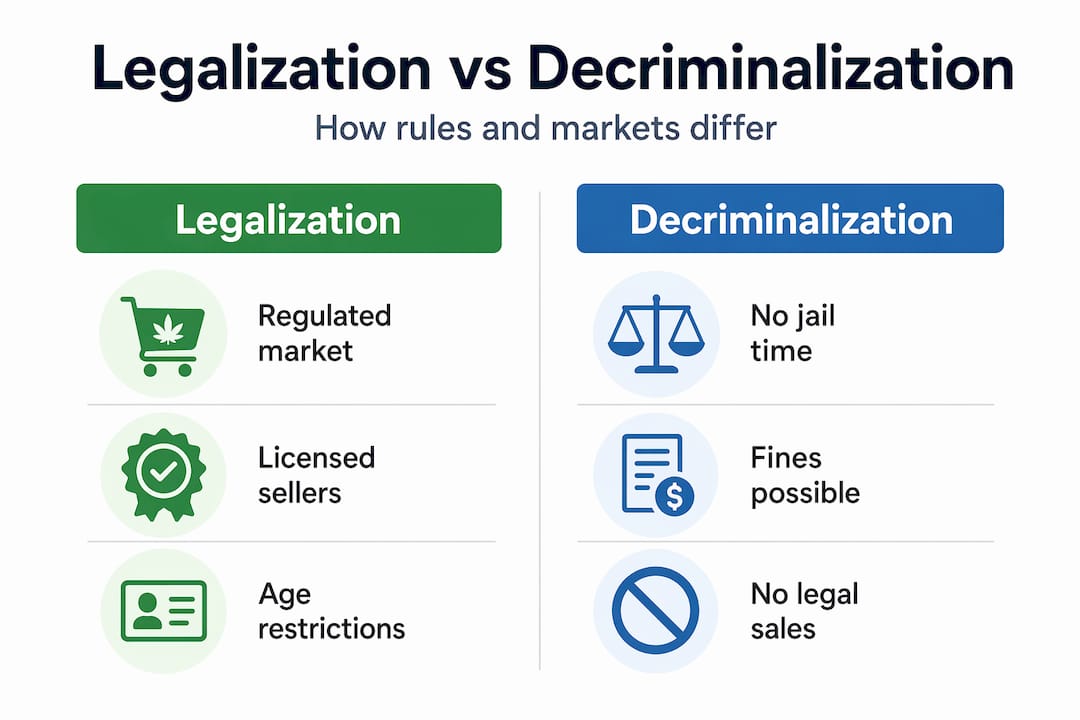
| Legal model | Criminal penalties | Licensed market | Age restrictions | Possession limits |
|---|---|---|---|---|
| Prohibition | Yes | No | No | None (all illegal) |
| Decriminalisation | Reduced or none | No | No | Varies |
| Legalisation | No (within limits) | Yes | Yes | Yes |
Canada provides the clearest example of full legalisation in action. The Cannabis Act (2018) created a federally regulated framework covering everything from cultivation licences to retail sales, with provinces setting their own rules on minimum age, retail models, and personal possession within federal limits. Understanding the 2025 legal status in Canada makes it obvious how much regulatory detail sits underneath what people casually call “legalisation.”
Pro Tip: If someone tells you cannabis is “basically legal” in their jurisdiction, always ask whether that means fully legalised with a licensed market or simply decriminalised. The difference affects where you can legally buy, what quality standards exist, and what your rights are if questioned by police.
Legalisation models differ significantly across jurisdictions, and the differences go far beyond a simple legal or illegal binary. The most important distinction is between medical and recreational legalisation.
Medical cannabis legalisation permits use only for qualifying health conditions, typically requiring a physician’s authorisation and registration with a government programme. Recreational legalisation extends access to any adult who meets the age requirement. Many jurisdictions have medical programmes but not recreational access, meaning the same plant is either legal medicine or a criminal substance depending entirely on why you’re using it.
Here’s a snapshot of how select jurisdictions approach legalisation:
| Jurisdiction | Recreational legal | Medical legal | Personal possession limit | Home cultivation |
|---|---|---|---|---|
| Canada (federal) | Yes (since 2018) | Yes | 30g in public | 4 plants per household |
| Colorado, U.S. | Yes | Yes | 28g | 6 plants per person |
| United Kingdom | No | Yes (limited) | N/A | No |
| Germany | Yes (partial, 2024) | Yes | 25g in public | 3 plants |
| Australia | Varies by state | Yes | Varies | Varies |
The United States presents the most complicated picture. As of 2025, 24 U.S. states have legalised recreational adult cannabis use despite cannabis remaining a Schedule I controlled substance under federal law. That gap creates real problems. Banks are often reluctant to work with cannabis businesses. Transporting cannabis across state lines, even between two states where it’s legal, remains a federal offence. For individuals, this means your legal rights can change the moment you cross a state border or enter federal property.
There’s also an international dimension that rarely gets discussed in casual conversations. The UN Single Convention on Narcotic Drugs (1961) technically restricts cannabis production and use to medical and scientific purposes. Countries pursuing recreational legalisation are technically operating in tension with this treaty, which is why international cannabis reform moves slowly and why some nations face diplomatic pressure when they attempt it.
Pro Tip: Check the province-specific cannabis laws for your region before assuming Canada-wide rules apply uniformly. Ontario, Alberta, and British Columbia each have different minimum ages, retail models, and rules around public consumption.
The key regulatory differences worth knowing across any jurisdiction include:
The effects of cannabis legalisation are more mixed than advocates and critics both tend to admit. Public health research shows increased consumption and healthcare utilisation following legalisation, but evidence on issues like traffic fatalities and long-term brain development remains inconclusive. That nuance matters because policy decisions in jurisdictions still debating legalisation often hinge on these contested data points.
“The evidence base for cannabis policy is growing but uneven. Increased use and changes in patterns of administration are documented, while long-term neurological and traffic safety effects require further research with more rigorous study designs.” — Cleveland Clinic Journal of Medicine, 2025
On the economic side, legalisation creates a taxable industry while simultaneously battling illicit markets. High tax rates and over-regulation can keep black market prices competitive, which is a persistent challenge in jurisdictions like California where the legal market has struggled to displace unlicensed operators. The economic impact on Canada’s cannabis industry illustrates both the revenue potential and the ongoing challenge of market consolidation.
In the U.S., cannabis businesses face a particularly brutal financial reality. Because cannabis remains Schedule I federally, Section 280E of the U.S. tax code denies standard business expense deductions to cannabis companies. A dispensary cannot deduct rent, salaries, or marketing costs the way any other retail business can, resulting in effective tax rates that can exceed 70% in some cases.

The social effects of legalisation also extend beyond economics. Advocates point to reduced criminal records for cannabis possession, which has disproportionately affected marginalised communities under prohibition. Critics raise concerns about increased youth access and social normalisation. Both are legitimate observations, and both are documented in multi-layered federal and state research examining the downstream effects of policy change.
Key effects observed after legalisation include:
Knowing the principles of legalisation matters less than knowing the specific rules where you live. Here’s what you need to check before purchasing or consuming cannabis legally.
Age and purchase location vary by jurisdiction. In Canada, you must be at least 19 in most provinces (18 in Alberta and Quebec). Purchases must be made from a licensed retailer, either in a physical store or through a provincially approved online channel. Buying from unlicensed sources remains illegal even where recreational cannabis is legal.
Possession limits apply both in public and at home. In Canada, adults can carry up to 30 grams in public. At home, the limit is effectively governed by what you’ve legally purchased. Exceeding public possession limits can still result in charges even under full legalisation.
Cross-border and shipping considerations are where many people make costly mistakes. Cannabis shipping laws in 2025 are clear: cannabis cannot be transported across international borders, and within Canada, shipping must comply with provincial regulations. Taking cannabis on international flights, even to another jurisdiction where it is legal, is illegal and enforced.
Medical vs. recreational access creates different legal protections in some regions. Medical patients may have higher possession limits, access to a wider product range, or tax exemptions that recreational users don’t have. If you use cannabis medically, registering with a licensed producer or your provincial health authority can provide both legal protection and cost savings.
Pro Tip: The 2025 Canadian cannabis law updates are the most reliable reference point for current rules on what you can buy, where, and how much. Legal landscapes shift regularly, so checking updated sources once or twice a year is wise.
Routes of administration have expanded significantly with legalisation. The diversification of cannabis products means edibles, vapes, topicals, and concentrates each carry distinct regulatory requirements and different onset times and effects. Understanding what you’re buying and how it affects you is part of responsible, legal use.
I’ve followed cannabis reform for years now, and the most common misunderstanding I see isn’t about the rules themselves. It’s about what legalisation actually changes. People assume legalisation means freedom from consequences. What it actually means is a shift in who controls the consequences and how.
In my experience, the readers who get into trouble aren’t the ones who don’t know cannabis is legal. They’re the ones who think “legal” means the same thing in every context. It doesn’t. A product that’s legal to buy in your province can still get you fired if your employer has a drug policy. It can still create complications if you’re travelling to a country with zero tolerance laws. And it absolutely still carries limits on where and how much.
What I think matters most is this: legalisation is a process, not an endpoint. The advocacy movements that shaped Canadian legalisation took decades to produce a framework that still gets revised and refined. The regulations you’re reading about today will look different in five years. Staying informed isn’t a one-time exercise.
The smartest approach I’ve seen is treating cannabis like any other regulated product: understand the rules, buy from licensed sources, and recognise that legality has context. The legal right to consume doesn’t override professional, safety, or international obligations.
— Juiced
Understanding the legal framework is the first step. Knowing how to make good choices within it is the next.
Greensociety is designed for exactly that moment, when you understand your rights and want to shop with confidence. Whether you’re curious about selecting cannabis flower online or exploring legal consumption methods like cannabis edible recipes, Greensociety’s blog and product guides offer clear, practical information tailored to Canadian consumers. You’ll find educational content on everything from CBD versus THC to understanding flower grades, all built to help you buy smarter and stay compliant. Greensociety keeps its resources updated as laws evolve, so you’re always working from current information.
Cannabis legalisation means a government removes criminal penalties for cannabis use and replaces them with a regulated system that includes age restrictions, licensed sellers, and possession limits. It is not the same as decriminalisation, which only reduces penalties without creating a legal market.
Yes. Canada has had federal recreational cannabis legalisation since 2018 under the Cannabis Act. Each province sets its own minimum age, retail model, and rules around public consumption, so the specifics vary depending on where you live.
No. Even if cannabis is legal where you live and where you’re going, transporting it across international borders is illegal under both Canadian law and international agreements. This applies to air travel as well, including within Canada to international destinations.
Medical cannabis users often have access to higher possession limits, a broader product range, and in some jurisdictions, tax exemptions that recreational users don’t receive. Registering with a licensed medical provider protects your legal standing and can reduce your costs.
Federal law still classifies cannabis as a Schedule I substance, meaning it is prohibited at the national level regardless of state laws. This creates conflicts including banking restrictions and tax disadvantages for cannabis businesses operating legally under state law.